Activity
Mon
Wed
Fri
Sun
Dec
Jan
Feb
Mar
Apr
May
Jun
Jul
Aug
Sep
Oct
What is this?
Less
More
Owned by Michael
An exclusive group collectively dedicated to physique enhancement through education, transparency, and a precision based framework.
41 contributions to Set The Standard
10d •
My client's Lp(a) dropped 85%
It's not often I come across a serum lab panel like the one below and see Lp(a) drop. 103.3 down to 15.1 nmol/L. An 85% drop. That's rare because Lp(a) typically doesn't budge. Changing up your diet won't do it. Exercise certainly won't do it, and statins aren't reducing it either. Historically, I've only consistently seen it drop with nandrolone, but in this case, no nandrolone was in place. And truth be told, it's really what prompted me to write this newsletter. Testosterone, methenolone enanthate (Primobolan) and drostanolone enanthate (Masteron) were included. The first time I came across a change like this, I was confused and thought it was a lab error. It wasn't. Naturally, my thought process went something like: "whoa, drugs are cool, I'm intrigued, now how does this work?" Before we get to how, here's a quick Lp(a) 101. A quick lesson on Lp(a) Lp(a) is an LDL particle with an extra protein attached, called apolipoprotein(a), or apo(a). (That's about as much science as we really need to know here.) It's largely genetically determined and an independent predictor of heart disease and calcific aortic stenosis. One large analysis estimated a single Lp(a) particle is about 6 times as harmful as a regular LDL particle. Your Lp(a) level is set mostly by one gene, LPA. Diet, training and statins don't meaningfully move it, so it's widely accepted you really only need to test it once. The risk cutoff is generally 50 mg/dL, or 125 nmol/L, depending on which unit your lab uses. A lean, fit 35-year-old with great LDL can still carry a high Lp(a) and have no idea- so this is your sign to check it if you haven't. That said, I’ve seen the same avatar who eats like a boring bodybuilder all year round, and still has a higher LDL-c, because Lp(a) is high. And don't confuse apo(a) with ApoA. ApoA (Apo capital A) lives on HDL, the "good cholesterol." Apo(a) (Apo little a) lives on Lp(a). It would be wonderful if the names weren't also confusing, but here we are, I don't make the rules.
2
0

14d •
The Standard EP 2
Spent some time reflecting on body dysmorphia, the coaching space, and some of the philosophies I have about coaching in this one. I hope you enjoy! Side note, I'm working on a visual aid to help with the lectures I'm building. I'm a visual learner, and I think illustrating that as I discuss different mechanisms might help them land.
2
0
Mar '24 •
Welcome to the log.
This is an ongoing log I will keep for my own progress and transparency. I'm leaving absolutely nothing out. Feel free to use this thread to ask specific questions related to the log itself or questions about what I'm doing. Please save any other non-log related questions for outside of this thread.
0 likes • Aug 22
8/22/26 224.1lbs In-laws came to stay with us last weekend so I couldn't check in as normal. Was a bit more relaxed on food but overall have kept things pretty well on track. I'm beginning to notice lines disappearing and I don't love it, but I'll accept it. It's always the low back and waist that'll accumulate fat first. I've been keeping up with my steps and cardio for the most part. Gym equipment should arrive within the next two weeks and I'll have my garage fully set up for that and I'm stoked to get it done! My last labs were taken at the end of June (I published a lab review here for you to see) and I'm going to have another draw here within a week or two. I also got an omega check for this one and I think it'll make for great informative material to share. Most of us take fish oil (I hope) and that serum test will give insight as to where my markers should be and if the fish oil I'm taking is truly helping me out- I'm sure it is. Leaving food the same as I am steadily increasing. This is also not accounting for some of the extras I've snuck in lately- so I'll have to be better about that and not let my tracking slip. I am pushing my gear up though! Will likely remain here for another 10ish weeks or so- we'll see once I get my labs back! - Training day: 250P 545C 70F ~3810kcal - Rest day: 250P 395C 70F ~ 3210kcal --------------------------------------------------------------------------------------------------------------------------------------------------- - Supplements AM: Nattokinase CoQ10 D3/K2 SEED probiotic Gorilla Mind Multi Gorilla Mind Smooth (focus, non-stim) Gorilla Mind Omegas Gorilla Mind Beef Liver Zinc picolinate - Pre workout: Gorilla Mind non-stim preworkout Gorilla Mind EAAs PM / Post-workout Gorilla Mind Calm - cortisol manager w/ phosphatidylserine (my fav supplement, ever) Gorilla Mind Creatine gummies - SO GOOD Glutatmine GI Integrity Magnesium Glycinate Melatonin 20mg - Peptides: Lantus: 15iu
0 likes • Sep 25
It's been hell of a month! Busy doesn't begin to describe it. The good news is that I'll be updating this with a YouTube link for a continuous vlog where you'll see training, rambling, educational material, and more. I'll add the link to this post. Some fun updates and some real ones: Admittedly, I've had some poor adherence to both food and even pinning. I pin daily, so my adherence can fall especially if I wait until the end of the day and occasionally, I'm too tired to even do it. I ran out of mast- and instead of continuing with it I figured I'd trial NPP. So, I've been on that for about ~3 weeks and I feel quite good. My garage gym contributed a lot to missing meals- I spent nearly a week getting it set up and then about ~5 days getting it all together. I'm a bit bummed looking at the weight in my last update and I'm really not much higher at all. Here's how I'm going to change that: Up until now, I've been holding myself accountable. It's been good, but it hasn't been great. This week is the Olympia and with that, a lot of pros are in town as you'd imagine. Over the last several years I've had the pleasure of getting to know John Jewett personally. I was his dedicated health coach while I was at Marek. We've had countless conversations about labs, other pro athlete protocols, and more. He's really been a sound resource for me and it's been awesome to chat back and forth with him. When I left Marek, I still kept that relationship alive and I've leaned on him several times for feedback. I'd always missed the chance to connect with him in person but this year I finally had a chance to meet him. I'd been thinking about asking him if he had an opening to take me on as a client and he graciously welcomed the idea. He even said it would be fun! So, all this to say, next week I'll connect with him and allow him to take over everything so I don't have to. I'm excited for it, but not just for me personally, for everyone I coach, too. I'll be back on this with more updates and working to bring more value to you all soon!
Aug 20 •
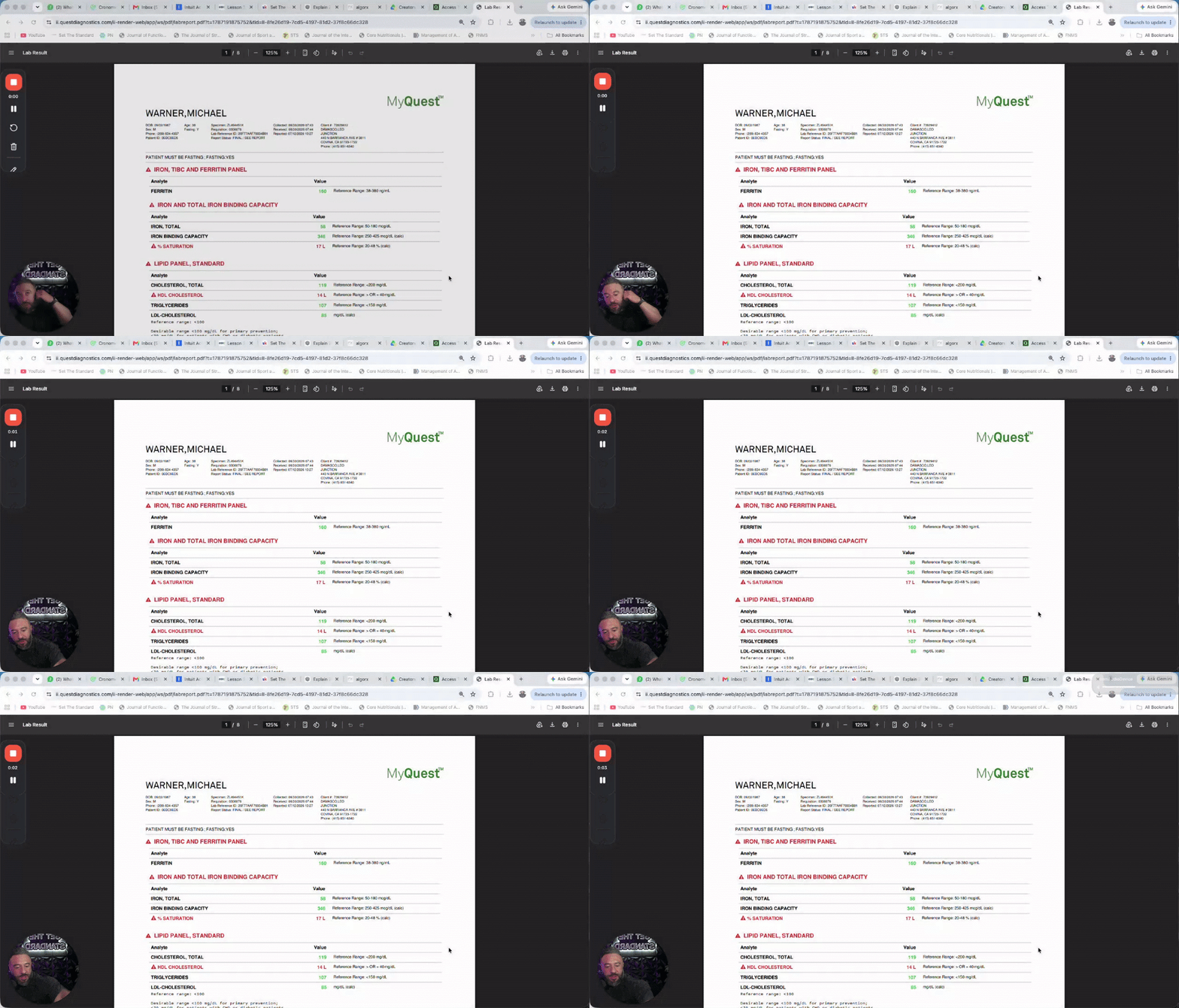
Reviewing my post-show labs
This is part 1 of my post-show labs taken back in June. I never recorded this previously but figured it would be useful to start doing here. I say it's part one because these labs weren't taken at peak doses during my post-show push. These were done post show just to see how things were looking and I was pretty happy with how they turned out. I'll be drawing my labs here again real soon and will compare them to these labs here. I'll do my best to walk you through what my thoughts are as I dive into these and help me ultimately decide what my next move is. Let me know if you like this and would enjoy seeing more! https://www.loom.com/share/3431c4d30e184ce998f78f3c27ae4c45
0
0
Aug 3 •
New books, the process of growth, and more
When was the last time you picked up a book and read it? I used to be an avid reader when I was younger (before college). Then my reading habits turned to textbooks out of necessity. This past week I decided enough time has passed since I've picked up a book I actually wanted to read, so I purchased two of them. I spend a lot of time reading on-screen material. From science articles to random posts online; emails, texts, AI generated prompts- you name it. The point is, there's something different about picking up a physical book and turning a page. It feels nostalgic, which is kind of sad to say really. I recently purchased a record player because I've always wanted one. I still have yet to buy an actual record, but I have it ready to go haha. Really what I'm after is something different than digital reads or what's accessible on my computer, phone, or tablet. I told my wife the other day a classic car would be awesome to drive. I can't remember the last time I pulled down on a shaft by the steering wheel to put a vehicle in drive, or crank the window manually. I love the convenience of what we have now but I still like the idea of classic things. Anyway, it feels good to drop everything and turn away from my screen, to physically turn a page in a book. Admittedly when I'm reading something on my computer screen I have about 3 dozen tabs open, pop-ups, texts, email alerts- so it can be tough to remain focused on one thing alone. I'm not sure if this is actual ADHD or if I'm not allowing myself the proper environment to focus. It's nice to watch my makeshift bookmark slowly make its way through the pages of my book. It's like watching my progress unfold haha. I bought "The Magic of Thinking Big" by David Schwartz and "How to Win Friends and Influence People" by Dale Carnegie. I started with The Magic of Thinking Big and so far, it's great. The power of belief and positive thinking can really change your life. Ironically, this was also illustrated in my previous post about LDN and the people in the case study who weren't even taking it, yet believed it had a positive effect, and reported positive outcomes.
5
0
1-10 of 41

@michael-warner-3056
Hey everyone! I'm Michael Warner; coach, educator, and lifelong student.
Active 7h ago
Joined Mar 10, 2024
Powered by