Activity
Mon
Wed
Fri
Sun
Aug
Sep
Oct
Nov
Dec
Jan
Feb
Mar
Apr
May
Jun
Jul
What is this?
Less
More
Memberships
AI Automation Agency Hub
328.4k members • Free
AI Sales Agency Launchpad
15.3k members • Free
10 contributions to AI Automation Agency Hub

May '25 •
🧠 One Month in AI — What I Wish I Knew When I Started
Today marks exactly one month since I started learning about AI automation. Looking back, I’m honestly shocked at how much I’ve learned in such a short time and how different I feel compared to when I first started. I’m not an expert, but I’ve gone through enough ups and downs to know there are things that would really help someone who just joined or is still finding their footing. So I made a short video sharing some of the most important lessons I’ve learned so far. If you're just getting into AI, I truly believe this will give you clarity, save you time, and help you avoid some early frustration. 🎥 Watch here: https://youtu.be/_Rht1JwZB6w⏱️ It’s 7 minutes of honest, straight-to-the-point advice based on my real experience. Thank you to everyone in this community who’s helped or inspired me so far. I’m grateful to be learning and building alongside you. Let’s keep growing together.

1 like • Jun '25
🔥🔥🔥🔥🔥🔥🔥
May '25 •
🚨 The Privacy Risks of Custom AI Startups: Are We Prepared? 🚨
Hey everyone, I've been diving deep into the privacy and cybersecurity risks surrounding the rapid rise of custom AI design and agent-builder startups, and it’s pretty eye-opening. As more of us build and deploy custom AI agents for small businesses, we might be exposing ourselves (and our clients) to some serious vulnerabilities. 🔍 Key Issues and Real-World Examples: 1. Data Breaches are Already Happening: In early 2025, OmniGPT got hacked, leaking 34 million lines of chatbot logs and 30,000 user emails/phone numbers. It turns out some of those logs contained API keys, credentials, and even billing info. Earlier, in 2023, OpenAI’s ChatGPT leaked users’ chat titles and partial credit card info due to a bug. 2. New Attack Methods (Prompt Injection): Attackers have found ways to trick AI agents into revealing confidential data or even running unauthorized code. Imagine your chatbot getting hijacked to spill customer info just by inputting a cleverly crafted prompt. 3. Compliance Challenges: Privacy laws like GDPR and CCPA do apply to AI agents handling personal data. OpenAI got slapped with a €15 million fine in 2024 for failing to protect user data adequately. HIPAA non-compliance is a big deal too. If a healthcare provider uses an AI chatbot to discuss patient data, that could be an immediate data breach. 4. Consumer Trust is on the Line: Over 73% of users worry about their data privacy when interacting with chatbots. If one of our AI solutions accidentally leaks client info, the fallout could be massive – not just legally but in terms of reputation. 💡 What Can We Do, according to AI lol... 1. Vet Your AI Vendors: Make sure the platform you’re using follows privacy best practices and complies with relevant regulations. 2. Minimize Data Input: Avoid putting in sensitive info like API keys or customer PII unless absolutely necessary. 3. Build Privacy into Your Solutions: Apply encryption, data minimization, and strict access control to reduce the risk of leaks. 4. Stay Informed: Privacy regulations are changing fast. Keeping up with the EU AI Act and FTC guidelines is crucial for staying compliant.
3
0


May '25 •
AI Automation Blueprint
I'm 16. But building a $100M AI company. Sounds crazy? Here's the blueprint -- the exact steps I'm taking to get there. Last month, I quit my sales job to go all in Only thing i have is a plan: • Learn how to build AI agents + automations • Create an irresistable offer for businesses • Build a system to get clients on autopilot • Document the entire journey on youtube In my latest video, I break down: 👇🏻 1. My full client acquisition strategy 2. My daily roadmap as a 16y/o founder 3. The mindset shift that helped me start 4. Why EdgeSocials isn't just a business, it's a movement
1 like • May '25
This is so amazing! I am about to take a very similar approach and start documenting the process of getting an AI Agency off the ground from scratch. Pretty much all of the current content around the subject is either highly specific building instructions or agency owners who already have success and are trying to teach others. I will document the daily trials and tribulations of learning, planning, and finally executing on selling AI solutions to small businesses!
May '25 •
Questions about Relevance Ai and Api Keys
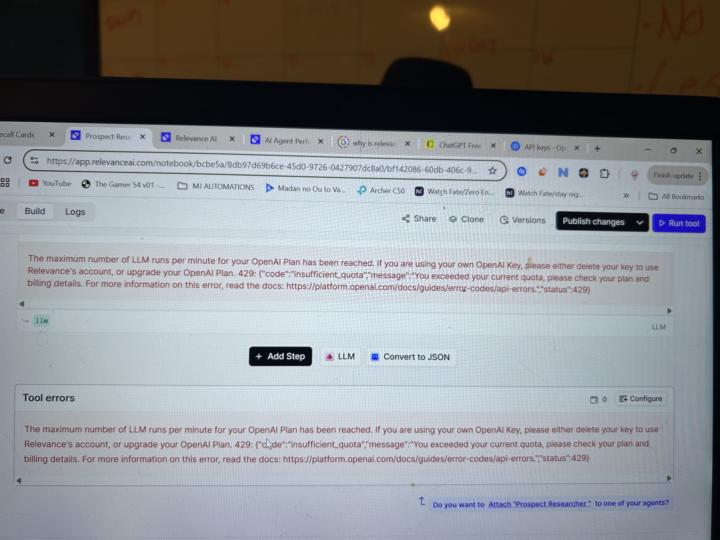
I’ve just tried building my first agent using Relevance AI. While the learning curve was steep at first, I can definitely see myself getting good at it soon. When following Liam’s Co-pilot agent build from the Ultimate Beginner’s Guide, I ran into a few issues—mainly realizing too late that having ChatGPT Plus doesn’t mean my OpenAI API key has access to GPT-4 or other higher-tier models. I ended up burning through most of my Relevance credits on tools that didn’t run properly. So my main question is: would it be smarter to upgrade my Relevance AI account for more credits, or my OpenAI plan for better model access? Any insight is appreciated.
1 like • May '25
Great question! Following for more! 🙋♂️
May '25 •
LLC address???
Hi everyone, I am going through the process of filing for my LLC down here in Texas, and of course it is requiring me to input an address for the business. I have bounced ideas off of my own chatbots and it seems that my only options are to either file with my private residence as the business address, or sign up for a "virtual address" which is just a nice fancy building downtown that receives and redistributes mail for 3rd party companies. I am nervous about undertaking additional monthly costs before I actually have a client, but juggling that with the implications of putting my personal residence address out into the public world. I am told that a PO Box would possibly give my company less credibility as well? Maybe I use my home address just to get the LLC filed, and after I have a couple clients, I can justify filing for a change of address using a nicer location offered at a virtual address service? Any ideas or personal experiences would be much appreciated!!
1
0
1-10 of 10

@michael-longoria-2556
💼 bAIt | AI-powered business growth & lead gen for pest control pros
🔗AutomateWithBait.com
Active 258d ago
Joined Feb 24, 2025
Austin Texas
Powered by