Activity
Mon
Wed
Fri
Sun
Aug
Sep
Oct
Nov
Dec
Jan
Feb
Mar
Apr
May
Jun
Jul
What is this?
Less
More
Memberships
AI Automation Society
424.6k members • Free
11 contributions to AI Automation Society

May 11 •
Heym just crossed 200 GitHub stars: self-hosted AI workflow automation with agents, RAG, MCP, and observability
We just crossed 200 GitHub stars for Heym. Thanks to everyone who checked it out, starred it, opened issues, shared feedback, or tried building workflows with it. Heym is a source-available, self-hosted AI workflow automation platform. It gives you a visual canvas for building production AI workflows with LLM nodes, Agent nodes, multi-agent orchestration, RAG pipelines, MCP client/server support, human-in-the-loop approvals, guardrails, execution history, LLM traces, evals, and reusable templates. The goal is simple: make AI automation inspectable and self-hostable, instead of spreading prompts, tools, vector search, approvals, and logs across a pile of scripts and SaaS dashboards. If you want to try one workflow first, this multi-agent template is a good starting point: https://heym.run/templates/research-writer-pipeline GitHub repo:https://github.com/heymrun/heym Would love feedback from people building agent workflows, self-hosted automation, or internal AI tools. Issues, stars, template ideas, and tough questions are all welcome.
4
0
May 5 •
built a workflow that auto-exports Nate Herk's YouTube videos to CSV using an open source AI agent tool
Hey everyone! Built a small workflow template that tracks Nate's YouTube channel automatically and exports everything to CSV. It uses Heym - a native AI-first workflow automation platform, open source, think n8n but built around LLM agents and skills from the ground up. The template does the following: 1. HTTP node fetches the public Atom/RSS feed from Nate's channel (no API key needed) 2. An Agent node runs a built-in Python skill that parses the raw XML and writes a clean CSV with title, video ID, URL, publish date, and channel title 3. The CSV gets saved to Heym Drive automatically with a download link The skill is the interesting part - it is a self-contained Python tool the agent calls directly. No manual parsing, no prompt engineering for XML. The agent just invokes the skill and returns the result. Swap the channel ID in the HTTP node to track any public YouTube channel. Template link: https://heym.run/templates/youtube-rss-csv-exporter Heym is open source and free to self-host. Happy to answer questions if anyone wants to try it out.
4
0
Apr 28 •
We built a self-hosted platform for production AI workflows — agents, retrieval, approval steps, and observability in one runtime
The gap we kept hitting: research-grade AI capabilities exist, but putting them into a reliable, inspectable, controllable production workflow requires gluing together too many tools. We built Heym to address this. It's a self-hosted, source-available AI workflow automation platform. Visual canvas for building multi-agent pipelines, built-in vector store management for retrieval-augmented workflows, human-in-the-loop review checkpoints, full LLM execution traces, and an MCP Server to expose any workflow as a callable tool for AI assistants. The execution engine builds a DAG from the workflow graph and runs independent nodes concurrently. Agent nodes have automatic context compression so long-running agents don't silently fail as context grows. Everything runs on your own infrastructure via Docker Compose. Source available :) https://github.com/heymrun/heym
2
0
Apr 28 •
We built an n8n alternative because AI workflows kept breaking our stack — open sourced it today
Hey everyone, For the past several months we've been building something that came out of a frustration most of you probably know well. We love n8n for what it does. But the moment a workflow needed real agent behavior, document retrieval, approval checkpoints, and full observability in the same place, we kept fighting the platform instead of building. It wasn't designed for that and it's not a criticism, just a different problem. So we built Heym. Self-hosted, source-available, visual canvas for AI-native workflows. Multi-agent orchestration, built-in knowledge retrieval, human review checkpoints, MCP support. Launched today on Product Hunt and the repo just went public. We're two engineers and genuinely curious: for those of you building real AI workflows with agents and orchestration, what's the part that breaks down most often in your current stack? github.com/heymrun/heym
0 likes • Apr 28
Also live on Product Hunt today if you want to support: producthunt.com/posts/heym
0 likes • Apr 28
@Tsvetomir Krumov Yeah, n8n was totally fine for basic trigger/action automation. The pain started mostly on the AI-agent side, especially when workflows needed more than “call an LLM and pass the text along.” The workflows that broke down for us were things like support triage with RAG, multi-step research agents, human approval steps, tool-calling loops, and debugging long-running executions. It was less “n8n cannot automate this” and more “we kept gluing together agent logic, retrieval, retries, approvals, and observability around it.” So for simple automations, I still think n8n is a solid tool. Heym is more focused on the cases where AI is the main execution model: agents, RAG, MCP tools, approvals, traces, and self-hosting in one runtime.
Dec '25 •
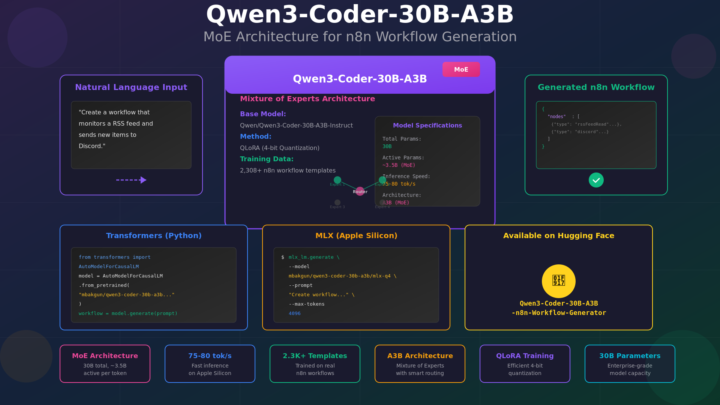
🚀 From Dense to MoE: Next-Gen n8n Workflow Generator
I'm excited to share our second-generation n8n workflow generator model! After releasing the Qwen2.5-Coder-14B model three days ago, we've taken a massive leap forward with the Qwen3-Coder-30B-A3B-n8n-Workflow-Generator - a Mixture of Experts (MoE) architecture that brings both superior quality and incredible speed. Blog: https://n8nbuilder.dev/blog/qwen3-coder-30b-a3b-n8n-workflow-generator-model 💡 What Makes This Special? • 30B total parameters with only ~3.5B active per token • MoE architecture for smarter expert routing • 75-80 tokens/second on Mac M4 (MLX Q4) • Complete workflows generated in ~15 seconds • Better quality than dense models, faster than you'd expect Why did we move from Dense (14B) to MoE (30B)? Simple - MoE uses specialized "expert" networks that only activate when needed. Think of it as having 30B parameters worth of knowledge, but only using 3.5B at a time. This means: ✅ 30B model quality ✅ 3.5B model speed ✅ Best of both worlds 🛠️ Technical Details: • Base: Qwen3-Coder-30B-A3B-Instruct • Fine-tuned with QLoRA on 2,308+ workflow templates • 8192 token context window • Available in Transformers, MLX Q4, and LoRA formats 📊 Performance on Mac M4 Pro (64GB): • Inference: 75-80 tok/s • Complex multi-node workflows • AI agent integrations • Structured data extraction • API workflow generation The model handles everything from simple RSS monitoring to complex AI agent workflows with multiple decision points. 💬 Available Now: • HuggingFace: https://huggingface.co/mbakgun/qwen3-coder-30b-a3b-n8n-workflow-generator Would love to hear what workflows you build with this! The jump from dense to MoE has been a game-changer for us.
0 likes • Dec '25
@Rafan Natasya thanks
1-10 of 11

@mehmet-akgun-8280
Senior Software Engineer | AI Agents
n8nbuilder.dev
Active 63d ago
Joined Oct 2, 2025
n8nbuilder.dev
Powered by