Activity
Mon
Wed
Fri
Sun
Aug
Sep
Oct
Nov
Dec
Jan
Feb
Mar
Apr
May
Jun
Jul
What is this?
Less
More
Memberships
AI Automation Society Plus
3.8k members • $99/month
AI Automation Society
422.1k members • Free
Synthesizer: Free Skool Growth
44.5k members • Free
6 contributions to AI Automation Society

1h •
The old automation vs AI automation
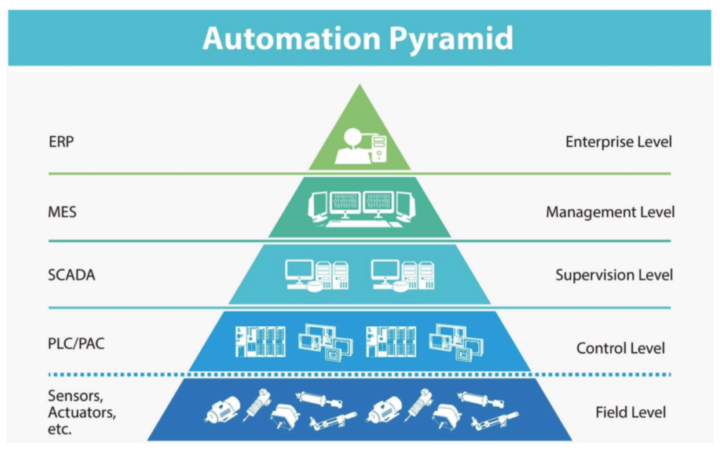
A few days ago, I read an article on automation from a hardware perspective and found it very interesting, as the hardware industry has already developed a roadmap for it. On the pyramid's first level, we have sensors and actuators; from an AI automation perspective, these are the connections to MCP servers, WebSocket or server action endpoints, and any other connections we create from the automation to the outer world. That is the eyes, ears, and hands of the system we create. On top of the eyes and hands, we have what is called the "control level"; this level is where the automation logic resides, meaning that at the control level we decide what we do with the data we collect and what actions we execute programmatically. The next level, the supervision level, serves as the interface between automation and humans, enabling process control and oversight. N8n covers this layer partially; it provides logs (a record of what is done, the actor, and when it was done) and real-time control that allows a human to stop the entire flow. But if a client's automations fail and nobody finds out until something breaks downstream, you're really still living at the Control level with a false sense of supervision. To change that, you need to deliver monitoring, alerting, and execution dashboards, as well as human-review interfaces. On top of it, we have the management level. From here, a human can understand the automation's flow and, crucially, the status and flow of the business (reports, KPIs, etc.), so decisions can be made based on the data provided and processes improved, either within the automation itself or through improvement points it surfaces. Finally, we have enterprise-level; here, an automation should be plugged directly into the business ERP (e.g., Power BI), instead of living on an independent system. Once this level is reached, the automation stops being a paid service and becomes a business level. The jump from level 2 or 3 to level 4 is mostly a reporting/analytics build-out. The jump from level 4 to level 5 is more of a positioning shift, becoming embedded in how the client thinks about their business, not just a vendor running their workflows.

3d •
A UK Lawyer Called Me at 2 AM... Here's What We Discovered
Last night, I had a conversation with a UK lawyer who wanted to build an AI SaaS for the legal industry. Instead of jumping into development, we did something different. We started by understanding the workflow. After researching the industry and validating ideas, we identified 8 major pain points that lawyers face every day. That changed our entire approach. Instead of asking: "Which AI model should we use?" We started asking: "Which problem is painful enough that people would happily pay to solve?" That's the product discovery process we're following at Greatodeal. I'd love feedback from people building AI products. How do you validate pain points before building an AI SaaS?

1 like • 3d
I've worked on a lot of tech projects, the difference between the ones that succeed from the ones that fail is clarity, if the team working on the project understand the goal and the problem from the beginning, there's a big possibility that the project will succeed, on the other hand I've seen projects with huge budgets, terrific professionals working on it, but no clarity and those projects did not have a nice end.

5d •
Exporting My Agentic Services
What do I do once I built the code in VS code by Claude? Like how do I deliver my work
1 like • 3d
The program you created needs a place to live; that place is known as a server. Different platforms provide servers where your program can run. Generally, those are paid, yet cheap. Netlify and Vercel are a couple of popular options. I prefer to work with Google Cloud services (because I've worked with them for years). The process of getting a program running on a server is called deployment. The initial deployments you do will be a pain in the rear until you dominate the process. n8n has a service where you program on their platform, and they also provide a server on which your workflow can run for a fee. I think that is also the Lovable business model.

3d •
Need help to decide pricing for my automation agency.
Hey everyone, looking for some feedback on a pricing strategy for my new agency. I’ve developed an outbound AI voice agent tailored for the HVAC and roofing niches. It automatically calls website leads, qualifies them, and categorizes the data (service intent, callback requests, lead temperature, and call summaries) straight into a spreadsheet. It utilizes a highly optimized RAG model, so it’s fully customized to the specific business it’s calling for. I have a solid demo video, but zero client testimonials since I'm just launching. My main goal right now is purely to get case studies. For my first 5 pilot clients, should I offer a deeply discounted "beta" price, or should I do a free trial where the client only covers their own API? Love to hear your thoughts on how to structure this to get those first 5 spots filled fast.
1 like • 3d
Three things: first, congratulations! Getting to that point takes a lot of effort. Second, it is recommended time and again: the initial customers you get are the ones you serve for free but with premium quality. Third, don't niche down from the beginning; you still don't know what type of customer resonates well with you. First, build a customer base, then start serving the customers who feel easiest to you. Otherwise, you risk working for people who don't share your values, and you will burn out.

🔥
3d •
What If the Smartest AI Isn't the Most Autonomous?
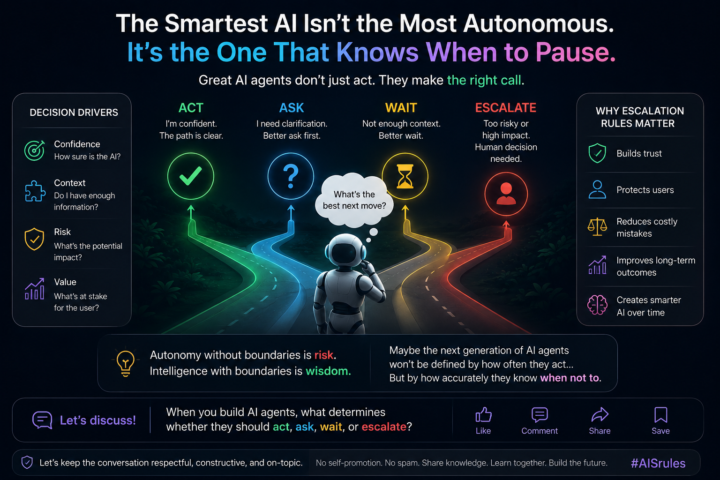
Most conversations about AI agents seem to focus on ONE GOAL: More autonomy. But I'm starting to think the bigger design challenge is something else... Knowing when NOT TO BE AUTONOMOUS. Every AI agent eventually reaches a decision point: ✅ Act ❓ Ask for clarification ⏳ Wait for more context 🚨 Escalate to a human A well-designed system isn't autonomous all the time. It's autonomous @ the RIGHT TIME. That means autonomy shouldn't be driven by capability alone... It should also be guided by CONFIDENCE, CONTEXT, and RISK. Without confidence thresholds, autonomy can quickly become uncontrolled automation. Maybe one of the most valuable skills in AI design isn't writing better prompts... It's designing BETTER ESCALATION RULES. Because sometimes the smartest thing an AI can do... Is recognize that a HUMAN should make the NEXT DECISION. Perhaps the next generation of AI agents won't be defined by how often they act... But by how ACCURATELY they know WHEN NOT TO. Curious how others are approaching this💡 When you're building AI agents, what determines whether they should act, ask, wait, or escalate?
2 likes • 3d
In electronics/robotics, there are different levels of automation. Since it is a mature field, there are a couple of things we can extract for AI automation. In summary, the level of automation depends on the task, the risk, and the resources available (money, knowledge, infrastructure, etc.). When designing an automation process, one needs to consider all relevant factors to determine when human intervention is needed. A well-designed system reduces cognitive load and risk without excluding human input.
1-6 of 6

Active 50m ago
Joined Apr 19, 2026
Colombia
Powered by