Activity
Mon
Wed
Fri
Sun
Aug
Sep
Oct
Nov
Dec
Jan
Feb
Mar
Apr
May
Jun
Jul
What is this?
Less
More
Owned by Mathew
A creative community exploring music, songwriting, sound, creativity, improvisation, music theory and the deeper side of music with Mat Creedon.
Weekly sound baths, mini meditations, frequency lessons, behind-the-scenes and creative calm with Mat Creedon. 🌿
Memberships
Skoolers
164.6k members • Free
No Labels Necessary
6.3k members • Free
Audio Artist Academy
2.1k members • Free
High Vibe Tribe
81.2k members • Free
43 contributions to Mat Creedon School of Music
2d •
🎵 Daily Reflection 012 – What Story Are You Adding to the Music?
Today, I'd like you to try a simple experiment. Before you play a single note, place a piece of music in front of you and simply notice what your mind says. Does it tell you it's too difficult? Does it tell you it's boring? Does it tell you that you're not good enough? Or perhaps it tells you this piece is beautiful, exciting or easy. Whatever arises, don't try to change it. Just notice it. One of the fascinating things about the mind is that it's constantly assigning meaning to everything it sees. I think part of the reason for this is that we all want to feel important. Sometimes we become the hero who conquers the impossible piece. Other times we become the victim who believes we were never talented enough in the first place. Every great story has drama. Without even realising it, we often create that same drama around learning music. The music becomes covered in memories—old mistakes, old teachers, old performances, old fears and old expectations. But here's the thing... Those thoughts are not the music. The notes haven't changed. Only the story has. Your mind is an extraordinary problem-solving machine. But in order to solve problems, it first has to find problems. Watch how quickly it searches for something to fix, something to judge or something to fear. Then ask yourself: Is this actually in the music... or is it only in my thinking? Today's practice is simply to observe. Notice the labels. Notice the stories. Notice the emotions. And then gently return your attention to the music itself. You might discover that what seemed so frightening a few moments ago was simply another thought passing through your mind. I'd love to hear what you noticed today. What was the very first story your mind told you when you looked at your music?
0 likes • 16h
Beautifully said, Barbara. I think you've discovered one of the biggest shifts in learning—not trying to swallow the whole mountain at once, but simply taking the next small step. 😊 It's interesting how the mind can look at something unfamiliar and immediately create a story like, "This is going to be too hard." Yet when we break it down into smaller, manageable pieces, the story changes. Suddenly the impossible becomes possible. I also love what you said about the enjoyment increasing once you get through that initial hurdle. That's often where confidence is born—not because the music became easier, but because you became more familiar with it. Thank you for sharing your experience, Barbara. I have a feeling many people here will recognise themselves in your story. 🌿🎶
21h •
🎵 Daily Reflection 013 – Does Music Need a Purpose?
Today's reflection might feel a little uncomfortable... but sometimes those are the ones that change us the most. Take a moment to ask yourself: Why did you start learning music? For me, the answer was pretty simple. When I was a kid, I thought girls liked guitar players! There was no great mystery to it. I wanted music to give me something. Love. Attention. Approval. A sense of identity. As I grew older, I realised I wasn't alone. Many of us begin learning music because we hope it will make us somebody. We imagine becoming the hero who finally masters that difficult piece, impresses an audience or proves something to ourselves. But here's a question that completely changes the conversation... What if music didn't need a purpose? What if it didn't need to make you successful? What if it didn't need to make you important? What if music was simply... music? At first, that idea can feel unsettling. If music doesn't complete our identity, then what are we striving for? The mind doesn't like that question. It quickly fills the space with stories. "I'm not talented enough." "This piece is too difficult." "I'll never be able to play like that." Notice something. Those thoughts aren't coming from the music. They're coming from your interpretation of the music. Fear isn't a feature of the notes. It's a thought. And I'd even go as far as saying it's one of the poorest guesses the mind can make. It imagines danger before it understands what's actually happening. If you're going to use something to guide your musical journey, I wouldn't recommend fear. I'd recommend curiosity. I'd recommend common sense. I'd recommend experience. 🎵 Today's Practice Choose a piece of music. Before you play a single note, spend one minute simply looking at it. Notice every story your mind creates. Don't fight the thoughts. Don't judge them. Just notice them. Then quietly remind yourself: These thoughts are not the music. The notes haven't changed. Only the story has. I'd love to hear your thoughts on today's reflection.

2d •
Easy Key and guitar?
I’m a guitar beginner ( been at it 2.5 years). I wonder how the easy key applies to guitar. I have access to a chart of the Nashville Numbering System, which seems to use the same concept of numbers for the different notes of a key. Is that true; I can use the NNS instead of the Easy Key?
1 like • 2d
Great question, Barbara! 😊 The Nashville Number System and the Easy Key definitely share the same underlying idea—they both describe the relationships between notes using numbers rather than letter names. Where the Easy Key is a little different is that it's designed as a visual learning system. It lets you see scales, chords, intervals, melodies and key changes as repeating patterns across the keyboard (and those same patterns transfer beautifully to guitar as well). So yes, you can absolutely use the Nashville Number System if it already makes sense to you. The Easy Key isn't intended to replace it; it's designed to make those relationships easier to see and understand, especially if music theory has ever felt overwhelming. In fact, I'm currently working on an Easy Key version specifically for the guitar fretboard, because the same patterns exist there too—they're just laid out differently. I think you'll really enjoy it when it's ready! 🎸🎶
8d •
🌿 Reflection 006 — The Story Between the Notes
Here’s something I’ve been reflecting on today. Imagine you play one wrong note. Nothing more. Just one note. A moment later your mind says: “Everyone noticed.” “My teacher must be disappointed.” “I’m terrible at this.” But… did any of that actually happen? Or did the mind quietly fill in the blanks? One of the biggest lessons music has taught me is that we often react, not to what happened, but to the story we’ve created about what happened. The note wasn’t painful. The story was. The next time something doesn’t go to plan, try asking yourself: 🎵 What do I actually know? 🎵 What story have I added? That simple question can change everything. Sometimes the greatest breakthrough isn’t improving your playing… it’s learning to recognise when your mind is showing you something that isn’t really there. I’d love to hear your thoughts. Discussion 🎵 Have you ever assumed someone was judging your playing, only to discover they weren’t? 🎵 What’s one story your mind likes to tell you when you make a mistake? 🎵 How might your practice change if you questioned those stories a little more often?
1 like • 7d
@Mohammed Aref Beautifully said, Mohammed. I think that’s the real art—not trying to stop the mind, but becoming so present with the music that the stories naturally become quieter. And I love what you said about the “wrong” note. Context changes everything. 🎵🙏
0 likes • 2d
I love that observation, Julie. The event is usually over in a moment, but the story can keep replaying. Becoming aware of that is such a powerful shift. Thanks for sharing. 😊🎶

3d •
Practice?
Wondering how long and how often everyone practices their particular instrument? I try for 30 to 60 minutes a day, concentrating on pieces I’m currently learning and playing things I really enjoy. I probably should devote more time to scales and appeggios etc. I like to change things up so I don’t get bored and if I don’t really like something I find it’s best to leave it for someone else to enjoy.
2 likes • 3d
Great question, Ross. Personally, I don't recommend thinking so much in terms of how long you practise. I think it's much more helpful to pay attention to where you are mentally, emotionally and physically. One of the biggest traps I see is students saying, "I don't have half an hour today," so they end up doing nothing at all. But five minutes every day is far more valuable than one hour once a week. Our brains strengthen the pathways we use regularly and gradually prune away connections that aren't being used. During sleep, glial cells help clear waste products from the brain, while the brain also reinforces frequently used neural pathways and lets weaker ones fade. In other words, consistency is what tells your brain, "This is important—keep this." I like to compare practice to eating. You wouldn't eat an entire week's worth of food in one sitting. It's much healthier to nourish yourself a little each day. Music works in much the same way. Another thought I often share with students comes from my meditation practice. Many meditation traditions suggest it can take around 20 minutes or so before the mind begins to settle into a deeper sense of rest. Of course, everyone is different—just like some people feel refreshed after six hours of sleep while others need eight. The point isn't the number. The point is learning to recognise when your nervous system has settled. That's actually how I recommend approaching music practice. Don't practise until you've run out of time. Practise until you feel settled. When you're learning a piece, you'll often know you've truly learnt it when you can play it calmly. If you're tense, rushing, frustrated or panicking, your body is telling you that the skill is still developing. When you can smile, breathe, and simply enjoy making music... that's usually a good sign the learning has become part of you. So if you reach that place in five minutes, wonderful. If it takes an hour, that's wonderful too. The important thing is to keep showing up.
1-10 of 43
@mathew-creedon-2263
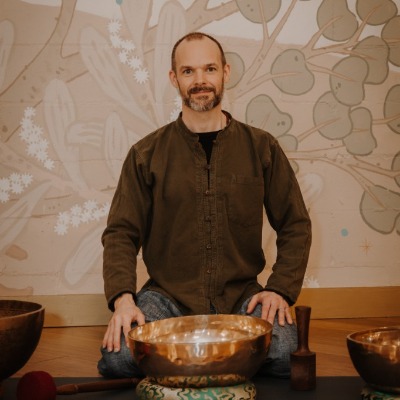
Music Teacher / Artist/Producer / Holistic Sound Practitioner.
"Transforming Lives One Note at a Time"
Active 10h ago
Joined May 10, 2026