Activity
Mon
Wed
Fri
Sun
Nov
Dec
Jan
Feb
Mar
Apr
May
Jun
Jul
Aug
Sep
Oct
What is this?
Less
More
AI Automation Vault
40.2k
Free
Easy Machine AI
4.1k
5.0
Free
The RoboNuggets Network (free)
92.3k
Free
Digital Freedom Basecamp
844
Free
AI Automation Society
469.5k
Free
REVENUE REVOLUTION
10.9k
5.0
Free
The AI Advantage
129.9k
Free
AI Automation (A-Z)
168k
Free
1% Founder (100 Mastery)
638
Free
7 contributions to 1% Founder (100 Mastery)

Dec '25 •
Before Monday: If You’re Short on Time, Read This
If you’re short on time, this isn’t about doing more. It’s about stopping the 90% of work that isn’t moving your business forward, this is what The builders Club is all about. That was the single theme that came up repeatedly talk to people about their businesses Following last week’s Builders Club Open Day, we’ve had a lot of similar questions come in. Because of the Builders Club price increasing from $999 to $1,999 yearly at close of business Monday, I’ve consolidated clear answers so you can decide quickly whether it’s a fit. – Who the Builders Club is (and isn’t) for – How it’s different from other groups – What you actually do week to week – Whether it saves time or adds more work – What happens when you join You can read everything here: 👉 https://www.skool.com/100mmastery-5227/100m-builders-club-how-it-works-who-its-for-and-why-it-creates-momentum


0 likes • Apr 22
This is the right framing. Busy is not the same as productive and most founders know that but struggle to act on it. The real work is having the clarity to identify what the 10% actually is and then protecting time for it. Eliminating the noise is harder than adding more to the calendar but it is the move that actually creates results.
Dec '25 •
Nothing kills momentum faster than starting from zero every morning.⬇️
Most founders don’t notice it happening. They just feel stuck. Leads feel inconsistent. Conversion feels random. Nothing seems to compound. So they tweak messaging. They change tools. They blame marketing or sales. But the real issue is simpler. Every day resets the work. --- Every day looks productive. Every day resets the work. New tabs. New tools. New docs. Same decisions. Same confusion. Same stall. It feels like progress. It’s actually friction. Restarting kills momentum. --- Here’s the real advantage no one talks about: Continuity beats intensity. Offers improve when you remember why the last version failed. Messaging sharpens when you build on what already worked. Decisions get faster when they don’t get re-litigated. AI only works when context persists. --- This is why one operating workspace matters. When everything happens in one place: Context accumulates. Outputs stack. Execution speeds up. You stop asking, “Where was I?” And start asking, “What’s next?” --- Operators don’t restart when things feel messy. They continue. A messy system that’s alive beats a clean one that keeps resetting. Every time. --- If growth feels slow, ask this: Where does your work live? That’s the constraint. --- 📘 Chapter 3 is live. Here here to interact https://www.skool.com/100mmastery-5227/classroom/f953b190?md=786c11a27d4b45e2bdd6223ad36678b2

1 like • Apr 22
The "starting from zero every morning" description is exactly right. It is the hidden tax on progress that most people never name. They think they need a better system or a new tool when really they just need the same system showing up consistently. Continuity is the whole game. Once you stop rebuilding context every day the work actually compounds.
Dec '25 •
1 small moment that compounds
My seven-year-old slips into the pool like he belongs there. No hesitation. No noise. The water meets him and he relaxes into it, as if it’s always known his name. When I was twelve, my friends used to swim every summer in a freezing river near my home in Waterford, in the south of Ireland. They took lessons. They learned properly. I didn’t. I announced, loudly and proudly, that I’d teach myself. No classes. No help. Just bravado. The kind that sounds strong at twelve and looks stupid in hindsight. Fast forward four decades. I can swim. Technically. But I’m cautious. Awkward. Always aware of my limits. My son, on the other hand, started swimming at six months old. No ego. No declarations. Just repetition, guidance, and time in the water. At seven, he’s a better swimmer than I’ll probably ever be. And that’s the point. Talent didn’t beat me. Fear didn’t beat me. Time didn’t beat me. Pride did. I confused independence with strength. Avoidance with courage. Saying “I’ll figure it out” with actually doing the work. Watching him glide past me in the pool isn’t embarrassing. It’s clarifying. The lesson wasn’t about swimming. It never was. It’s about how many things we’re still bad at, not because we can’t learn, but because once upon a time we decided we wouldn’t. To this day, I still catch myself saying, “I can do it myself.” But now I hear it differently. Not as strength. As a choice. Because the real difference between me and him was never talent or timing. It was willingness. Willingness to be guided. Willingness to learn out loud. Willingness to let someone else into the water. And once you see that, you can’t unsee it. I’ve watched the same pattern play out in business. Founders say “I’ll figure it out myself,” and quietly pay for it in time, money, and momentum. You’re not stuck with what you can or can’t do. You’re standing in front of a choice. And suddenly the question changes. Not “Can I do it myself?” But “Why would I want to?”

0 likes • Apr 22
This hit differently. There is something powerful about watching someone move without hesitation because they were given the right guidance early. It is a reminder that most of our sticking points are not about ability. They are about the identity we formed around avoiding the thing we were never properly taught. The pool story is a perfect way to frame that.
Jan 1 •
Dead Lead Cash Recovery Campaign - The Next 60 days
Dead leads aren’t dead. They’re usually just mishandled. Most teams either overthink recovery or avoid it entirely. We do neither. Here’s how we turn dormant demand back into real conversations. --- We start by reopening conversations where they actually began. One channel at a time. No stacking. No noise. The first message isn’t there to sell. It’s there to reopen the loop. We reference the prior interaction. We acknowledge the time gap. We ask one neutral question. We make replying easy. That’s the job of the first touch. No pitch. No urgency. No links unless asked. Automation handles timing and delivery. Humans handle judgment and tone. Email stays optional and controlled. When it’s used, it’s simple. One message. One follow‑up only if there’s a real signal. Any “not now,” silence, or unsubscribe ends the loop immediately. Responses get treated for what they are. Interest moves forward. Everything else gets closed cleanly. No chasing. No pressure. Sales comes in late. Only after interest is explicit and earned. What we track reflects reality. Replies. Conversations reopened. Booked calls. Revenue influenced. Not open rates. Not volume. Not vanity metrics. The part most people miss: Recovery only works if the original intent was real. If it wasn’t, no amount of automation fixes it. If you’re sitting on a list and know there’s revenue trapped in it, this is the work. We identify what’s recoverable, reopen the right conversations, and move only qualified interest forward. Fast recovery review first. Then execution.

0 likes • Apr 22
This is a great reframe. Dead leads are really just paused conversations. The problem is most people either never follow up or they go in too hot and come across as desperate. Reopening the loop with a neutral question and acknowledging the time gap is exactly the right approach. It removes pressure and makes replying feel easy for the other person.
Dec '25 •
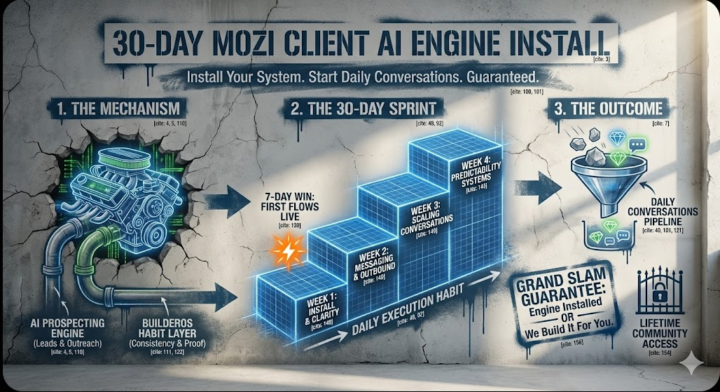
Install Your AI Client Engine in 7 Days and Start Daily Conversations — Guaranteed.
Most founders don’t have a lead problem. They have a conversation problem. No conversations → no momentum. No momentum → no clients. No clients → no confidence. So I built a 30-day program to fix this fast. What we install together: 1. Your Mozi Client AI Engine- The system that sources leads, enriches data, writes personalised AI messages, follows up automatically, and triggers conversations daily. 2. Offer, bottleneck & Messaging Clarity- Most founders under $100K don’t have a conversion issue. They have a clarity issue. We tighten your offer, help you id your bottlenecks so outreach actually lands. 3. Your First Outbound Flows (Live in 7 Days)Inside the first week, you’ll have a working engine running in the market. 4. BuilderOS Daily Execution Habit - This is where predictability comes from. AI builds the pipeline. BuilderOS makes it consistent. 5. Lifetime Community Access Group calls, 24/7 Q&A, daily proof for 30 days. Builders don’t do Build alone. My Promise Complete the weekly steps and you will finish with a fully installed Mozi Client AI Engine producing conversations — or we’ll install it with you inside Builders Club at no extra cost. Cohort Details • 30-Day Sprint • 4 Week onboarding Calls.(2 before Christ mas and 2 after Christ mas. • Skool Q&A (24/7) • Lifetime community access• Cohorts run in batches. When the current one fills, enrollment closes. Join our Live even on Thursday for More details. If you want the link, comment MOZI below. I’ll send it to you directly.
0 likes • Apr 22
The conversation problem framing is spot on. Most people I work with are not stuck because they lack a strategy. They are stuck because they never convert their intentions into consistent action. The moment you fix that, momentum builds fast. Appreciate the breakdown here.
1-7 of 7

@markus-campbell-5102
Executive coach. Deloitte background. I help driven people stop spinning and start executing. Structure, accountability, real results.
Active 4h ago
Joined Apr 10, 2026
INTJ
new york