Activity
Mon
Wed
Fri
Sun
Aug
Sep
Oct
Nov
Dec
Jan
Feb
Mar
Apr
May
Jun
Jul
What is this?
Less
More
Memberships
Vibe Coding School
799 members • Free
Society of Figurative Art
473 members • Free
5 contributions to Society of Figurative Art
Oct '25 •
How does earned points translate to levels?
I just read through the "Getting Started" page on how to level up. The post made is clear how points are earned but it did not talk about how points relate to levels. Does anyone have insight into this? I am eager to check out the classes that unlock at level 2.
1 like • Oct '25
@Chris Legaspi Thanks Chris. I should have been more clear I was looking for something like 10 points = level 2, 100 points = level 3, etc. Though this might not be something that would want to be public information. I achieved level 2 yesterday and now have access to the free lessons, which was my main driver for asking the question. So I am good. Thanks again.
1 like • Oct '25
Ok to close the loop, I found the info on the profile page. Level 1 - 0 points Level 2 - 5 points Level 3 - 20 points Level 4 - 65 points Level 5 - 155 points Level 6 - 515 points Level 7 - 2,015 points Level 8 - 8,015 points Level 9 - 33,015 points

Jun '25 •
👋 Welcome! Introduce Yourself HERE 🔥
Hello and Welcome to the Society of Figurative Art. This community is the home of the most beautiful art in the world. We are a community of: - Creators of all skill levels - Professionals, experts and masters of the craft - Art lovers and appreciators - Collectors and curators Thank you for being a part of our community and supporting our mission to restore beauty in our modern world. Reply below to get started... Step 1: Introduce yourself in THIS THREAD below! (✄ copy/paste template 👇) Where are you from and where did you study? What are you working on? Who are 3 of your favorite artists or influences? Step 2: Review the community rules and check out our resources in the Classroom...
1 like • Oct '25
@Jo Sheridan Hi Jo! Thanks you and it is good to know you are here as well. 😊
1 like • Oct '25
@Chris Legaspi thank you. Glad to be here and was glad to discover you set this up.
Oct '25 •
🎥 How I’m Winning on Instagram (and How You Can Too in 2025)
Earlier this year I did a deep dive into social media. I spent over 100 hours (and counting) and I cracked the new 'algo'. This video was a presentation for my coaching program and I never shared publicly until now. If you like this kinda thing, or want help with your IG comment below. I'm not a guru or agency but I have a decade of online marketing experience and am obsessive with this stuff. If there's enough interest I will take you down the rabbit hole with me.
1 like • Oct '25
@Chris Legaspi — thanks for posting that video. I watched it yesterday, and it was exactly what I needed. You explained the strategy clearly and made it easy to see where I’ve been missing the mark. I’ve been posting on Instagram for a while, mostly to share progress with friends and keep a visual journal, but lately I’ve been digging deeper into how the platform actually works. I’m starting to take it more seriously since I want to begin selling my work, and social media will play a bigger role in that. One thing I’ve noticed that helps is engaging with other people’s posts and commenting for about 10 minutes before uploading something new — it seems to boost reach with non-followers. I hadn’t heard about the 90-day consistency factor before, so I’m going to stick with that and keep refining my approach. Thanks again for sharing your insights — it really motivated me to rethink my strategy.
Oct '25 •
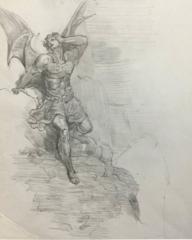
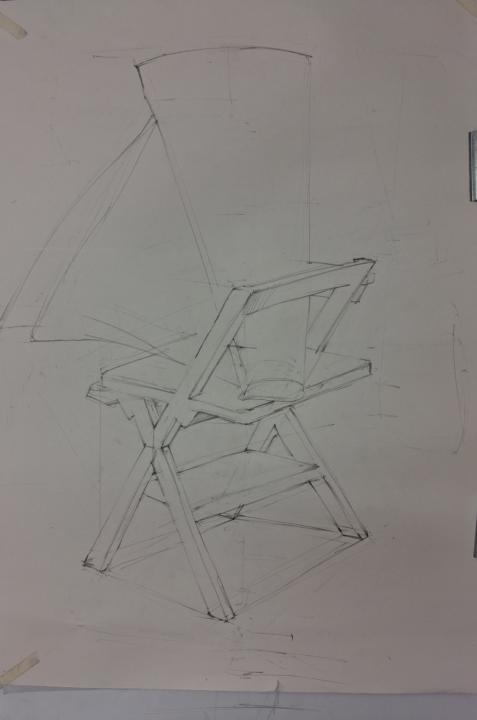
Drawing from simple live objects
Ok im comfortable in drawing from photographs but from life, im less experienced. So im only focused on capturing the proportions well. I'm not focusing on the renderings. Most of my attention now lies on capturing the proportions. Even though this is a society of figurative arts im still posting this because this will be a nice building block for any complex object. My questions are, can the first vertical marks be changed a little bit? Also how do you prefer to draw these kinds of structures which are in extreme angles in academic ways.
1 like • Oct '25
Nice work — the proportions read really well to me. I’m curious about your approach here. Were you sight-sizing, using a measuring tool, or working more from angles and relative positions? I took a class last year that covered a few different measurement methods, which helped clarify some things, but it’s still an area I’m trying to strengthen. I’d love to hear what worked for you on this study.
Oct '25 •
Can drawing without purpose still make you grow?
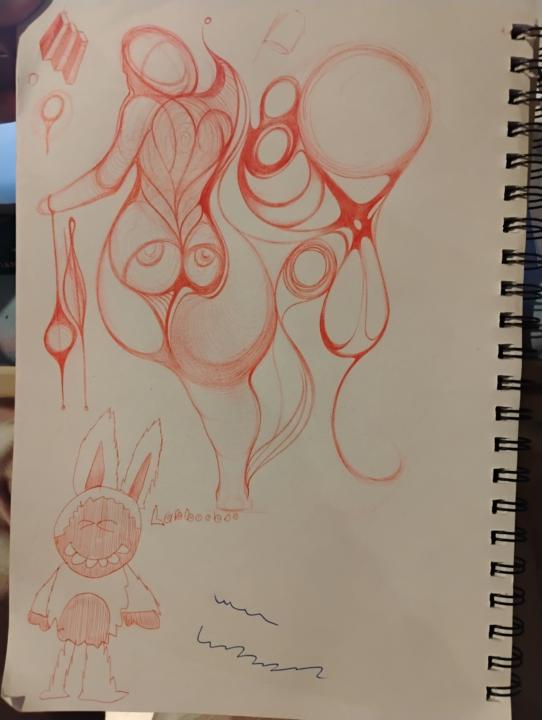
I call these my “meditation doodles.” They take quite a bit of time, but they’re my way to relax. They don’t have a specific meaning, just satisfying marks that help me unwind and enjoy the process. I did them very recently with my favourite Schneider pens, and they’re still not finished... I keep adding more details, and they keep spreading like an ivy 😊 When I do them, my inner voice keeps saying, “Stop and do more useful drawings! You're wasting your time.” But another voice whispers, “Keep doing them, they’re satisfying and make you happy.” Do you make doodles like this too? I’ve been wondering; can they actually help develop skills and spark creative ideas, or are they just a pleasant escape from structured practice? In other words, could they be an essential part of growing as an artist rather than just a distraction? I’d love to hear your thoughts. P.S. The cartoonish marks you might see are my daughter’s.. she loves sneaking into my sketchbook and adding her own touches 🤔
1 like • Oct '25
To answer the original question—yes, I think so. Over time, I’ve developed a studio rhythm where I work on three or four 9x12-inch mixed-media paintings at once. I mostly use acrylic, charcoal, graphite, colored pencil, and wax crayon—really anything that feels right in the moment. This process puts me into a flow state where I lose myself completely. It’s become a form of meditation. These works are intuitive, drawn from memory and imagination. For a while, I struggled with how much time I spent on them, feeling it might compete with my more “serious” studies. I worried I wasn’t growing. Now, I treat weekends as a space for this freer, exploratory work and weekdays for more deliberate, academic practice. Looking back over the body of work, I can see real growth—in confidence, material handling, and approach. My hope is that the two modes—the disciplined study and the intuitive play—continue to inform and strengthen each other. One thing I’ve learned, and have to relearn often, is to notice when art starts to feel stressful. That’s usually a sign I’ve become too attached to outcomes. Nothing stifles creative flow—or growth—faster than that.
1-5 of 5