Activity
Mon
Wed
Fri
Sun
Aug
Sep
Oct
Nov
Dec
Jan
Feb
Mar
Apr
May
Jun
What is this?
Less
More
Memberships
Nose Worx Detection Skool
416 members • Free
Beyond The Leash
87 members • Free
The Detection Dog Lab
810 members • Free
2 contributions to Beyond The Leash
Apr 17 •
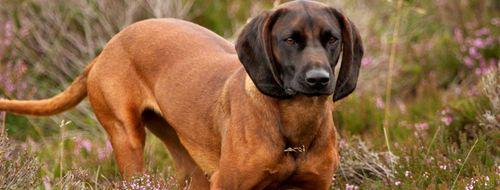
Bavarian Mountain Hound
Bavarian Mountain Hounds come from, you guessed it, Germany where they are known as Bayerischer Gebirgsschweisshund (no a cat did not just walk on my laptop). They are said to be descended from a breed called a Bracken which is “the original hunting dog”. The Bavarian Mountain Hound was bred to be lighter for more versatility and agility and this was done in the late 18th and early 19th Centuries by Baron Karg-Bebenburg when he crossed Red Mountain Hounds with Hanoverian Scenthounds. The Bavarian Mountain Hound was bred for tracking game, both wounded and bloodied, and has an amazing “cold nose” which means they possess an amazing sense of smell that they can detect older trails better than other dogs. This breed is even tempered, agile, robust and versatile. They have the stamina to pursue game until the game cannot run anymore even in mountainous terrain. They are still used for tracking game to this day but can also be used for tracking/trailing for search and rescue groups like their bloodhound counterparts. The Bavarian Mountain Hound was recognized by the UKC on January 1, 1996. The Club for Bavarian Mountain Hounds, which is headquartered in Munich, came about in 1912. The FCI published a breed standard in 1996 and they were included in the AKC Foundation Stock Service in October 2016. Sources: https://www.ukcdogs.com/bavarian-mountain-hound, https://pulsarvision.com/journal/the-original-hunting-dog-bavarian-mountain-scent-hound/, https://gundogcentral.com/hunting-dog-breeds/Bavarian-Mountain-hound,https://www.101dogbreeds.com/bavarian-mountain-hound.asp
2 likes • Apr 19
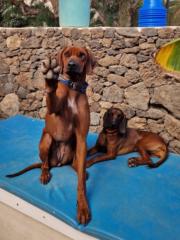
Oh dear, how I love my BGS female. Since I’m not a hunter, I keep her busy with appropriate work. I train her as a mantrailer and detection dog. Genetically, her tracking ability is very pronounced—even in her free time! Clear and consistent training is very important for this sensitive hunting dog. That is why reputable breeders only sell these dogs to experienced owners who will challenge them in ways that match their abilities. At home, she’s a cuddly, affectionate, and calm soul; outdoors, she’s a very active and vocal hunting dog. Over the past few decades, I have owned and trained a wide variety of hunting dog breeds (German Shorthair and English Pointer, Spaniels, Podencos, Rhodesian Ridgebacks), but this bloodhound type is, wonderfully enough, yet another new challenge that really pushes me in training. Dr. Google says: Bavarian Mountain Hound: Training and Care The Bavarian Mountain Hound is a true bundle of energy. Due to selective breeding, this breed has an extremely high energy level that cannot be met by daily walks alone. These dogs are passionate about hunting and want to exercise their innate talents every day through tracking, retrieving, and chasing game. To keep this friendly Bavarian breed in a manner appropriate to its nature, you must allow it to work as a hunting dog. For this reason, breeders only place these dogs with hunters and foresters. An exception is made for dog handlers who train these animals as working dogs in search and rescue operations. Due to their high need for exercise, Bavarian Mountain Hounds are not suitable as purely indoor dogs. As a robust, nature-loving dog, this hunting companion feels at home outdoors. He needs a house with a yard, preferably in a rural area. These four-legged friends were bred for the steep, rocky trails in the mountains and love nothing more than to roam through woods and fields for hours with their owners.
2 likes • Apr 19
@Christina Brewster Papillons are amazing and are very underrated. Fortunately, they never became true “fashion dogs” and thus weren’t overbred. Unfortunately, however, they are often kept solely as lap dogs. I trained my male dog, “Don Pepito,” as a medical alert dog; he is now 11 years old and has no intention of retiring. He is very empathetic, calm, and eager to work. “Calima,” whom you see in the picture above, I trained as a bed bug detection dog. She is super fast, effective, persistent, and precise in her work. The advantage of these little super-noses is that you can take them anywhere—in the cabin of an airplane, or in a hotel, where they don’t stand out while searching for bed bugs. They have more stamina than larger dogs, and you can easily lift them up when they need to search at height, etc. Strangely enough, I never wanted a small dog—I had my prejudices. But Papillons are big dogs in small bodies.
1 like • Jan 7
love, love, love it🥰 Thank you Christina😘
1-2 of 2
@liz-ott-7239
trainer for detection dogs, medical alert dogs and mantrailers
Active 3d ago
Joined Dec 24, 2025
Lanzarote/Spain