Activity
Mon
Wed
Fri
Sun
Sep
Oct
Nov
Dec
Jan
Feb
Mar
Apr
May
Jun
Jul
Aug
What is this?
Less
More
The Next Level
2.3k members • Free
Feminine Business Method™
3.8k members • Free
Brendan's AI Community
26.6k members • Free
Construction Contractors Hub
4.6k members • Free
Google Ads Masterclass
15.2k members • Free
AI Money Lab
90.3k members • Free
AI Bits and Pieces
857 members • Free
HighLevel Huddle w/ Clay
3k members • Free
AI Workshop Lite
49.5k members • Free
5 contributions to AI Bits and Pieces

9d •
One automation that generates $5K+/month extra for HVAC businesses
Small community so I'll share something specific. The highest-ROI automation I've ever built for any client: Missed Call, Text Back in 60 seconds. That's it. HVAC techs are on roofs, under units, in attics. They can't always answer. The lead calls the next company. This one automation stops that. The text: "Hey [Name], sorry we missed you - we're on a job right now. What can we help with today?" Results: - 40-60% of people reply - They get qualified via text - Booked while still in need help NOW mode Average HVAC job value: $1,500-$5,000 If this saves 3 leads/month: $4,500-$15,000 extra revenue My monthly fee: $1,500 Best ROI conversation in any sales call. Anyone else using simple single-trigger automations in niche businesses?
14d •
Most businesses don't have a lead problem. They have a response-time problem.
A business can spend hundreds or even thousands on ads every month. But if someone fills out a form at 2:15 PM and doesn't hear back until 5:00 PM, that lead has often already contacted someone else. One of the simplest automation improvements I've implemented is: ✅ Instant SMS after form submission ✅ Immediate email confirmation ✅ Internal notification to the team ✅ Automatic reminder if no one follows up Nothing complicated. Just making sure every lead gets a response within minutes instead of hours. It's surprising how much difference that alone can make.
1 like • 13d
@Sasa J That's a solid setup, Sasa. I like that you're testing it on your own business first—that usually uncovers the edge cases before it reaches clients. For my workflows, I primarily use GoHighLevel. The form submission triggers an instant SMS (via LC Phone/Twilio) and an email confirmation, while the sales team receives an internal notification. I also create or update the opportunity in the pipeline at the same time. For reminders, I don't use a fixed window for every client. It depends on the business, but I typically start with 10–15 minutes. If the opportunity hasn't been updated or the conversation hasn't started by then, the assigned user gets a reminder. For high-ticket or emergency service businesses like HVAC or plumbing, I shorten that window because every minute counts. I completely agree with your point about follow-up. The first response gets the conversation started, but it's the follow-up sequence that usually determines whether the lead becomes a customer.
1 like • 13d
@Sasa J You're welcome, Sasa! I'm glad it was helpful. It sounds like you're building a solid system already. I'd love to hear how your n8n workflow performs once you've finished the SMS and follow-up pieces. Feel free to share your results or any challenges you run into.
25d •
The fastest way to lose a customer isn't bad service.
The fastest way to lose a customer isn't bad service. It's a slow response. I've seen businesses spend thousands on marketing, only to lose leads because no one followed up for hours—or sometimes even days. In most cases, the first company to respond earns the opportunity. That's why I believe every growing business should have a system that: ✅ Responds instantly ✅ Books appointments faster ✅ Keeps every lead organized ✅ Reminds customers automatically Technology doesn't replace great customer service—it makes it more consistent. Question: What's your average response time to a new lead? Do you think it's costing you jobs?
1 like • 23d
@Michael Wacht I do the same. Instant auto-responders are the baseline today. The real difference comes after that—qualifying the lead, answering common questions, following up automatically, and making it effortless to book an appointment. That's where I've seen businesses recover a lot of opportunities that would otherwise slip away. What follow-up sequence has worked best for you?
0 likes • 23d
@Everett Michaud Thanks, Everett! That's a great real-world example. AI voice agents have improved dramatically, especially when they're well-trained and focused on a specific workflow. I agree that the biggest challenge now isn't accuracy it's making the conversation feel natural and avoiding overly aggressive upsells. I think the best implementations use AI to handle speed and consistency while handing off to a human when empathy or complex decision-making is needed. It'll be interesting to see how quickly more local service businesses adopt this approach.
28d •
What's one system in your business that saves you the most time?
One thing I've noticed while working with service businesses is that growth doesn't usually come from working harder. It comes from building systems that eliminate repetitive tasks and help your team move faster without sacrificing quality. Whether it's hiring, sales, customer follow-up, operations, or finances, every strong business seems to have one system that makes a huge difference. What's the one system or process that's had the biggest impact on your business? I'd love to hear what's working for everyone and learn from your experiences.

🔥
Jul 14 •
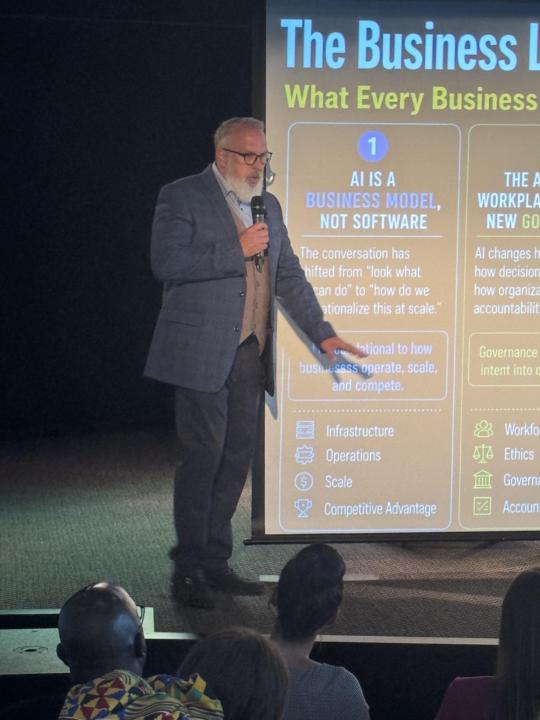
🎤 Speaking to 125 Small Businesses with NFL Great Led to an AI OS Deal
🏈 My friend @Herman Moore called me, former NFL wide receiver, Detroit Lions. "I'm speaking tomorrow to 125 small business owners. Want to join me and talk about AI?" One day's notice. I built one slide with five points. My strategy, let the room decide which ones we went deep on based on body language and reaction. No fixed script, just reading the energy and following it. Herman worked that stage right alongside me. Great public speaker, no surprise there given his career. We had an easy back-and-forth in front of the audience. 25 minutes on stage. Plain English, no hype. Here's what those 25 minutes turned into: - 12 post talk conversations - 5 leads - 2 solid appointments Results: 1. The Deal: AI OS. A 50-hour build. Not a prototype, not a pilot. A real system going into a real business. 2. The Opportunity: AI Executive Coaching. One business wants me in the room at the executive level as a fractional CAIO, not as a vendor they call when something breaks. 3. The Second Opportunity: Enterprise AI Enablement. AI opportunity mapping, then AI education for their front office professionals. Now here is the important part. I didn't walk in with just a polished pitch. I walked in with the practical AI knowledge that I get from AI Bits and Pieces, and advanced development knowledge from AIS+, and AI for Life where I learn to build complex and trending AI solutions. This is where I: try new things, explore advanced ideas, learn from other professional builder, sharpen the saw, ...and stay ready for that moment you may not expect. If it sounds like a full time plus job... it is. However, this is what enables me to walk in with one slide, a friend who trusted me enough to hand me a mic, and 125 people willing to listen for 25 minutes.
2 likes • 29d
Very impressive way to go!
1 like • 28d
@Michael Wacht You are welcome.
1-5 of 5

@liton-sarker-4404
I help home service businesses automate lead follow-up, booking, and customer communication.
Active 14h ago
Joined Jul 18, 2026
Powered by