Activity
Mon
Wed
Fri
Sun
Apr
May
Jun
Jul
Aug
Sep
Oct
Nov
Dec
Jan
Feb
Mar
What is this?
Less
More
Memberships
Non-Profit Skool
130 members • Free
10 contributions to Non-Profit Skool
Jan 14 •
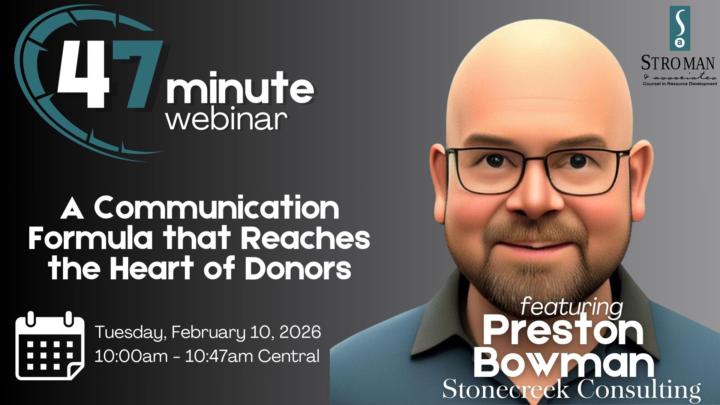
A Communication Formula that Reaches the Heart of Donors
Shout out to @Tyler Wancowicz for attending today's 47 Minute Webinar! February's webinar is going to be led by @Preston Bowman . Don't ask me how I talked him into it...just be there! Preston is Certified as a Story Brand Coach...he knows his stuff! You can find more info in the "Calendar" section of the Non-Profit Skool.
1 like • Jan 14
I never got a link to join Kent's webinar, maybe I didn't sign up correctly!
0 likes • Jan 14
I think on here.
Jan 6 •
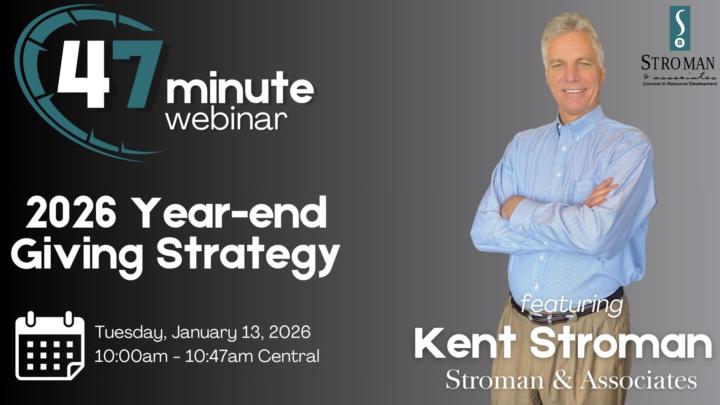
47 Minute Webinar next week!
Hey everyone. We are hosting a MONTHLY webinar for the Non-Profit Skool. This month is featuring Kent Stroman, author of Asking About Asking and The Intentional Board. We are starting with the end in mind...focusing on what we can do TODAY to prepare us for Year End Giving (2026). Here's the link for registration: https://www.linkedin.com/events/2026year-endgivingstrategy-taki7409253755679846400/ It will also be avaiable on the SKOOL calendar.
1 like • Jan 6
if you need webinar speakers let me know.
Nov '25 •
Watch this FIRST
Post your name and organization in the comments! Welcome to the Non-Profit Skool, please keep all posts and interactions focused on "non-profit" topics...and please keep every interaction positive.😃 To learn more about Stroman & Associates, visit https://stromanconsulting.com

4 likes • Nov '25
I am not a nonprofit but I consult to nonprofits
1 like • Nov '25
@Juan Bueno let me know if you need help setting up the nonprofit, I have a course on starting a nonprofit at www.LearnWithLinda.online
Nov '25 •
Fundraising as a Career: What, Are You Crazy?
What Does It Mean to Work in the Nonprofit Sector? For many people new to the whole concept of the nonprofit sector, there is a great deal of misunderstanding of what it means to be a nonprofit. Some think it means the organization can’t operate in the black, because it then becomes a “for profit.” Many people think that nonprofit staff should be paid less than standard wages because they are working for a “charity.” For clarification purposes, let’s start with what it means to be a nonprofit organization. A charitable nonprofit is usually a 501(c)(3) agency, a designation received from the Internal Revenue Service after meeting certain requirements, most importantly that the organization serves a charitable, education, scientific, or community service purpose. Individuals can deduct donations to approved nonprofit organizations when filing their federal tax returns. Most government agencies and foundations will only make grants to nonprofit organizations. Contrary to popular opinion, being a nonprofit does not mean that the organization must operate in the red or that it cannot have a fund surplus. Actually, the main characteristic that separates a nonprofit from a profit-making entity is that no individual or group of individuals can benefit financially from the profits of the agency. By receiving nonprofit status, these organizations are exempt from paying most federal and state taxes. Sometimes the nonprofit community is called the third sector (as opposed to government or the business sector) the independent sector, or the voluntary sector. All these terms are appropriate and accurate. Some nonprofits are thought of as charities, while some are huge operations such as major universities and health care systems, but they still share the commonality of being a nonprofit entity since no individual or group of individuals benefit from the surplus revenues of the organization. Volunteering and Charitable Giving One of the things that makes the nonprofit sector different from other sectors is the fact that so many people volunteer not only their money, but their time, to help these organizations succeed. While it is difficult to unearth statistics showing how many fundraising professionals there actually are, if just twenty percent of the public charities in the United States employ just one fundraising professional, that makes almost 200,000 professional fundraisers in the United States alone. And, of course, many of these charities are large ones that may have a development staff of dozens of people (universities for example) and even mid-sized organizations often employ two to ten development staff persons. I would safely estimate, therefore, that there are close to half million individuals in the United States that list their profession as fundraising, development, advancement, philanthropy or some term that involves the obtaining of funds for a charitable organization. Who are these people and how do they find their paths leading to a career in fundraising? The professional fundraiser usually enters the field from one of these possible avenues:
2 likes • Nov '25
thanks I have some courses you may want to check out on all aspects of fundraising and governance www.LearnWithLinda.online
2 likes • Nov '25
the 2nd edition should be out in a few weeks.
Nov '25 •
Level 2!
If you aren't in LEVEL 2 yet...make some posts, comments, and give likes...then reciprocate! You'll get new access to a classroom course. To become a level 2 member in Skool, you need to earn 5 points by actively contributing to the community, such as posting, commenting, and getting likes on your content. Your level is displayed next to your name and increases automatically as you accumulate points.

2 likes • Nov '25
Hello
1 like • Nov '25
I don't ship anything. Only sell online.
1-10 of 10
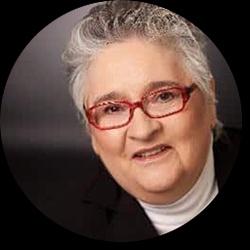
@linda-lysakowski-5661
Linda Lysakowski, ACFRE, MTS-FT. She raised $100million, trained 100,000 professionals, has published 40 books, received numerous awards.
Active 25d ago
Joined Oct 23, 2025