Activity
Mon
Wed
Fri
Sun
Nov
Dec
Jan
Feb
Mar
Apr
May
Jun
Jul
Aug
Sep
Oct
What is this?
Less
More
Owned by Liisa
Bring your website, emails, funnels—whatever marketing thing has you stuck. Get feedback, answers + clear next steps.
Connect w/ dragon boaters, learn new skills + access the USDBF Steering Certification program w/ former Team USA coaches Liisa Reimann + Joann Fegley
Kick-Ass Job Squad
336
5.0
Free
CLASSIFIEDS VIP HUB
23
$300/y
WeMeet for Women Entrepreneurs
7.4k
5.0
Free
Your First $5k Club w/ARLAN
34.2k
5.0
Free
Skoolers
152.4k
Free
19 contributions to Your Stage LIVE Studio
🔥
Aug 22 •
Social Saturday-Gamification Edition
This Saturday I want to lean in on a Substack article shared by @Keith Keller https://keith907.substack.com/p/how-can-gamification-help-you-to?utm_source=share&utm_medium=android&r=2truzn This Saturday let's help members rank up by engaging in one of the following: 1. Drop a GiF to best describe your biggest worry when going live. 2. Drop a GiF to describe your preference; on camera 📷 or off camera 📷 3. Finally Drop a GiF to best describe your favorite format: monolog, interview, panel. @Liisa Reimann I'm hosting a GiF party 🥳 and everyone is invited.


2 likes • Aug 23
@Americo Da Costa haha - i just wanted to make sure i wasn't throwing someone into a fire haha. I nominate @Carrie Crews then - we just "met" in another group!
2 likes • Aug 23
@Traci Poe haha like when you tell a joke and nobody laughs... yikes! (just me?)
🔥
Jul 25 •
It's Social Saturday - I have one question
What is one thing you're doing this week to be seen, heard, and remembered? Don't have an answer... Then ask a question of your own. Ask for content feedback - Event ideas - Video clip ideas - Ask for a profile review - A live stream review

3 likes • Jul 25
@Karin Crawford I'm keeping LinkedIn, Meta (lightly, but only because I've built my audiences there thus far), YT, Skool and email. My YT channel is: https://youtube.com/@twoeyecopy
2 likes • Jul 25
@Americo Da Costa yep! Simple is super!!
🔥
Jul 21 •
A technical glitch may have revealed an opportunity...
Sometimes the best ideas don't come from strategy, they come from mistakes. During my most recent LinkedIn Live episode, we experienced a small technical glitch. The music started as planned, but our usual static thumbnail didn't appear on screen. At the time, it was just one of those live-event moments you adapt to and move past. But when I went back to review the replay, something caught my attention. To clean up the video, I edited out the blank opening screen and queued the replay to begin almost immediately as the show started and that's when I had a realization. As livestream hosts, many of us optimize for the live audience. We create branded waiting rooms, countdowns, intro music, and opening sequences to build anticipation. But replay viewers aren't attending a live event. They're clicking on a piece of content because they're looking for value. The more I thought about it, the more I wondered: How many replay viewers are deciding whether to stay or leave before the conversation even begins? That question has led me to an experiment. Over the next several weeks, I'll be editing my LinkedIn Live replays to eliminate the pre-show experience and start viewers right at the beginning of the conversation. The goal isn't to change the content. The goal is to reduce friction. If someone clicks on a replay, I want to see if getting them to the value faster increases: Viewer retention Watch time Engagement Replay performance overall My hypothesis is simple: A replay should be optimized for the replay audience, not the live audience. What's interesting is that this idea didn't come from a marketing article or a best-practices guide. It came from a technical issue that forced me to look at the viewer experience differently. Funny how that works sometimes. Now I'm curious: If you're watching a replay, do you want the full event experience, or do you prefer getting straight to the conversation?
2 likes • Jul 21
i like getting right to the conversation (on the live too!).
0 likes • Jul 21
@Americo Da Costa tbh i've never put an intro together. As a user I hate them... i show up on time and can't stand the "pre-game" stuff LOL. But I know a lot of folks love it, so to each their own!
🔥
Jun 26 •
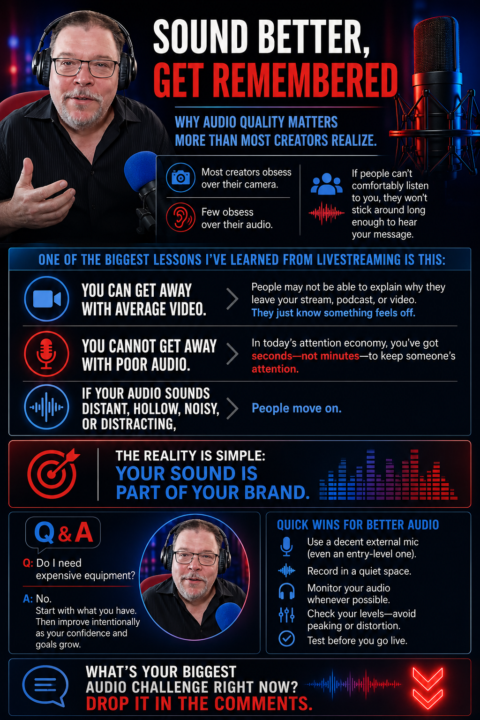
Why audio quality matters more than most creators realize.
Most creators obsess over their camera. Few obsess over their audio. If people can't comfortably listen to you, they won't stick around long enough to hear your message. One of the biggest lessons I've learned from livestreaming is this: ➡️ You can get away with average video. ➡️ You cannot get away with poor audio. People may not be able to explain why they leave your stream, podcast, or video. They just know something feels off. In today's attention economy, you've got seconds and not minutes to keep someone's attention. If your audio sounds distant, hollow, noisy, or distracting, people move on. The reality is simple: Your sound is part of your brand. What's your biggest audio challenge right now?
2 likes • Jul 13
Hey @Americo Da Costa - sorry if this is somewhere obvious but what do you recommend for cleaning up cell phone audio? Like what did you use to clean up the audio on my car video a few weeks ago? please and thank you!
2 likes • Jul 13
@Americo Da Costa thanks!
🔥
Jul 2 •
Testing A New Level of Repurposing
Let's see how Substack responds to this I combined a Substack short video with a YouTube Link in a Note. i enjoy trying and testing different things. How creative are you with notes? https://substack.com/@americodacosta/note/c-287000962?r=2truzn&utm_source=notes-share-action&utm_medium=web

1 like • Jul 2
Umm... what's a Note?
2 likes • Jul 2
@Americo Da Costa gotcha. I wasn't sure if it's a substack thing or something else. Thanks for explaining! (Also thanks for saying nice things in that note!!)
1-10 of 19
@liisareimann
Funnels + Dragons ⚡️ Fix your marketing + messaging 🔎 Learn how to steer + race dragon boats 🐲
Active 19h ago
Joined Apr 24, 2026
INFP
🇺🇸