Activity
Mon
Wed
Fri
Sun
Aug
Sep
Oct
Nov
Dec
Jan
Feb
Mar
Apr
May
Jun
Jul
What is this?
Less
More
Owned by Laura
Debate it. Learn it. Shape it. The Indy Exchange is Scotland’s space to dig into the who, what, when, where and why of independence.
Neurodivergent-led learning for life. Courses, guides & support for unmasking, self-regulation, home ed, & life skills built for ADHD, autism & beyond
Memberships
Anxiety Academy
31 members • Free
Moms of Autistic Teens
22 members • Free
Autism Parent Hub
149 members • Free
ADHD & Autism Action Group
138 members • Free
NoBrainer Ambitious ADHDers
31 members • Free
ADHD - Working From Home
43 members • $79/month
ADHDo it Club
329 members • Free
40 contributions to Scottish Indy Exchange

Jan 27 •
So when did the Union become illegitimate?
There are three defensible answers, depending on how strict you want to be. Let’s have a look at all three, from hard legal to modern democratic. 1. It was born illegitimate This is the uncomfortable one Westminster never wants examined. Why? Because in 1707: - There was no popular consent - No referendum - No mandate - Widespread public opposition in Scotland - MPs were bribed, pressured, or financially dependent - Protests were suppressed, not heeded By any modern definition of legitimacy: - The people were never asked - The decision was elite-driven - Consent was assumed, not given So strictly speaking: The Union did not become illegitimate. It never was legitimate in the first place. It was legal under elite-controlled law, but illegitimate by democratic standards. 2. It became illegitimate when democracy arrived This is the argument even moderates can’t dodge. Once democracy becomes the basis of authority, ongoing consent becomes mandatory. Key shift: - The UK evolves into a parliamentary democracy - The moral basis of rule changes from “Crown + Parliament” to “people” At that moment, something critical happens: An agreement made without the people now requires their consent to continue. But Scotland was never re-asked. No ratification. No renewal. No mechanism to withdraw. From that point onward, the Union survives not on consent — but on inertia. That’s when legitimacy starts decaying. 3. It became illegitimate the moment Scotland voted to leave and was told “no” This is the cleanest, most devastating argument. You don’t even need history for this one. In a modern democracy: - If a people express a sustained, majority desire to leave - And are blocked from doing so - The governing structure loses legitimacy immediately Why? Because consent has been explicitly withdrawn. At that point, the Union stops being a union and becomes: - A constraint - A containment - A control structure Legality may continue.
0 likes • May 20
@Duncan Reid sure can 👌🏻 apologies for the late approval
Jan 27 •
The Doctrine of Democratic Legitimacy and the Union
Foundational Principle All political authority derives from the ongoing consent of the governed. Consent is not permanent. It must be renewable, withdrawable, and respected. Definition of a Union A union is legitimate only while all constituent peoples: - Entered freely - Continue freely - Can leave freely If exit is denied, the union ceases to be voluntary. Failure of Origin The 1707 Union was formed without popular consent. It was an agreement between elites, enacted through financial pressure and parliamentary control, not democratic will. Failure of Renewal As democracy replaced crown sovereignty, the moral basis of authority shifted to the people. The Union was never re-ratified by Scotland under democratic standards. Failure of Continuance When a people express a sustained desire to reconsider or withdraw from a political arrangement and are blocked from doing so, consent is withdrawn. Authority persists only through force of law and institutional inertia. Illegitimacy by Inertia A system that survives only because it is difficult to dismantle, rather than because it is actively chosen, has lost democratic legitimacy. The Union lacks: - Democratic origin - Democratic renewal - Democratic continuance Therefore, whatever its legal status, it no longer possesses moral or democratic authority.
0
0
Dec '25 •
Messenger chats
Does anyone know (or is admin of) what’s going on with the Indy community group chats in messenger? Clearly it hasn’t been deleted but most are paused. Can they be unpaused so we can get back to our regular scheduled debates?
Nov '25 •
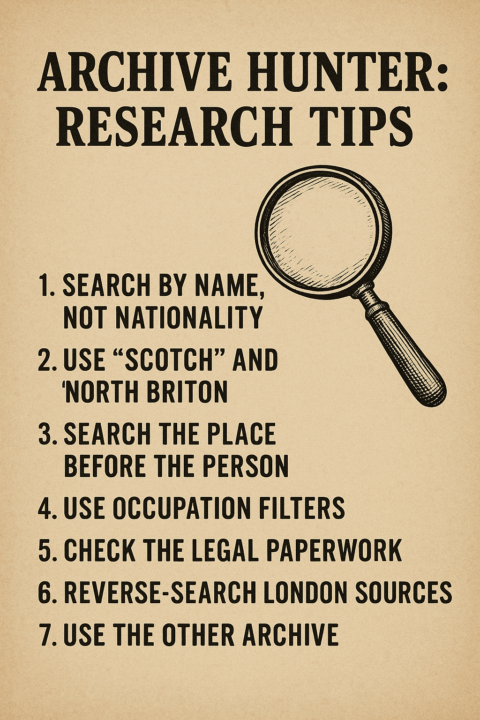
SCOTTISH ARCHIVE HUNTER CHALLENGE
Over the next two weeks I don’t have as much time for research & writing as I’d like, so I wanted to leave you all a bit of a challenge in my partial absence. This will also help us build our Northern Archives Library here on Skool. Details are as follows: 12 missions. Two weeks. Zero complacency. These tasks are designed to send you down purposeful rabbit holes, uncover hidden Scottish history, and help us build a community-sourced evidence library. RULES (short, strict, necessary) 1. Cite your sources. Screenshots, archive links, PDF page numbers, photographs, catalogue IDs — whatever you find, back it up. 2. Fact-check before posting. If a claim sounds spicy, verify it twice. If a source feels dodgy, treat it as suspect until proven otherwise. 3. Keep posts concise. What you found, why it matters, and where you found it. 4. Debate respectfully. We’re here to sharpen knowledge, not each other’s throats. 5. No conspiracy filler. Stick to evidence, not vibes. THE 12 MISSIONS 1. Follow the Bribes Find original lists, letters, or records naming who was paid during the 1707 Union negotiations and how much. 2. The Voices They Muted Locate any speeches, letters, or petitions from Scots who opposed the Union — and note where they vanished from the mainstream record. 3. The Last Parliament Dig up surviving documents from the last independent Scottish Parliament: motions, debates, attendance, anything. 4. The Censored Press Track Scottish printing presses, newspapers, or pamphlets that were shut down, restricted, or censored between 1680–1750. 5. Letters from the Colonies Find one Scottish voice in any colonial archive (Jamaica, India, Canada, Australia) and extract what they were doing there. 6. Cumberland’s Instructions Hunt for orders, letters, or first-hand accounts from the aftermath of Culloden. Compare “official” British claims with on-the-ground testimony. 7. The Not-Empty Glens Choose a Highland area and find hard evidence of its pre-Clearance population (rent rolls, kirk records, tenant lists, cattle counts).
1
0
Nov '25 •
Misfiled Voices
People like to say “the nationalists are at it again,” as if caring about your own country were a fault to be explained away. But Scottish independence isn’t about grievance or grandeur. It’s about the simple right to call what’s ours ours — our voice, our history, our future. For centuries, Scotland’s story has been filed under someone else’s heading. The records are there — ledgers and letters, ship manifests and plantation accounts — marked “British West Indies” or “British Empire,” even when the names written in them were our own. Those signatures belonged to Scots who lived, worked, built, suffered and survived. Yet their story, like ours, was absorbed until Scotland itself became a sub-clause in someone else’s history. Independence, for many of us, isn’t rebellion. It’s restoration. It’s not about walking away from anyone; it’s about walking back toward ourselves. To reclaim the right to speak in our own voice, to write our own record, and to be answerable to the people who live here — not to a government that treats Scottish confidence as insolence. Pride in your own country shouldn’t be an insult. Ownership of your own story shouldn’t need defending. Independence, in the end, is not about separation — it’s about self-respect.
2
0
1-10 of 40