Activity
Mon
Wed
Fri
Sun
Aug
Sep
Oct
Nov
Dec
Jan
Feb
Mar
Apr
May
Jun
Jul
What is this?
Less
More
Memberships
Print & Postal Profit Lab
545 members • Free
AI Income Court
215 members • Free
AI Communications Skool
247 members • Free
AEO Advantage
169 members • Free
WeScale Free Course
33.3k members • Free
2 contributions to AI Income Court

May 21 •
⚖️ Building SaaS Tools for Micro-Niche Problems
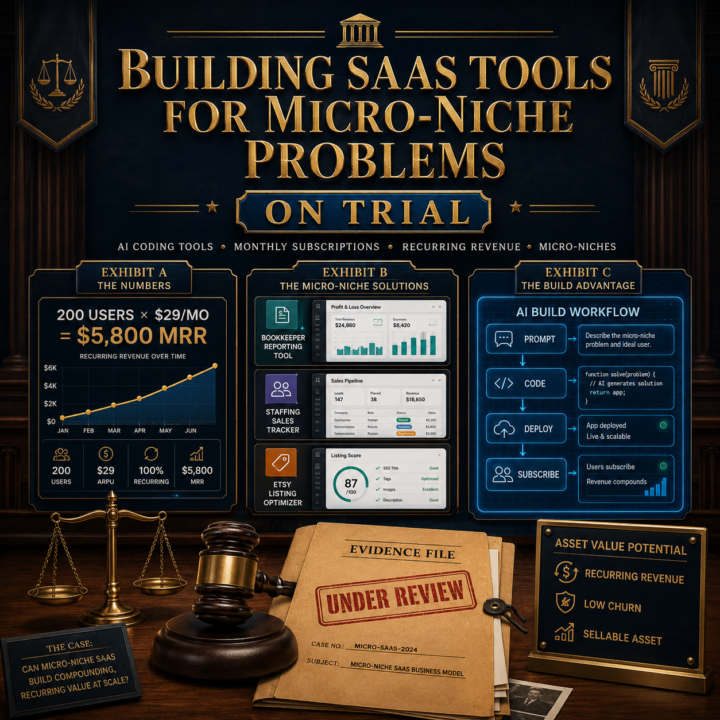
THE IDEA: Use AI coding tools to build lightweight software solving one hyper-specific problem for one hyper-specific audience — then charge a monthly subscription to the people who need it most. Understandably, the prosecution walked into this courtroom confident. It prepared arguments about technical complexity, saturated markets, and the graveyard of half-built software products collecting digital dust across the internet. It had slides. It had statistics. It had a closing argument that was going to be devastating. Then the defense started presenting evidence and the prosecution got very quiet. 🛡️ The defense calls the micro-niche argument to the stand. There is a fundamental difference between building a SaaS product for everyone and building one for a room of fifty people who all share the exact same painful, recurring problem. The first approach has killed a thousand startups. The second approach is quietly making real people real money right now. Consider the evidence. A tool that automates client reporting specifically for solo bookkeepers. A script tracker built exclusively for outbound sales teams at staffing agencies. A listing optimizer designed only for Etsy sellers in the handmade jewelry category. None of these are trying to be Salesforce. None of them need to be. They need to be indispensable to a small, specific group of people who will pay $19 to $49 a month forever rather than go back to doing it manually. 🧾 Exhibit A: The math is ruthlessly compelling. Two hundred users at $29 a month is $5,800 in recurring monthly revenue. That is not a unicorn valuation. That is a lifestyle business with real margins, minimal overhead, and a sellable multiple of 24 to 36 times monthly revenue when you are ready to exit. Getting to 200 users in a micro-niche you already understand and already have access to is not a fantasy. It is a project with a clear timeline. 🧾 Exhibit B: The tools have crossed the threshold. AI coding platforms like Lovable, Cursor, and Bolt have made the technical barrier genuinely manageable for non-developers who understand their problem domain deeply. The person who knows the problem inside and out is now the most qualified person to build the solution. That has never been true before. The court considers this a material change in circumstances.

0 likes • May 22
I have created a couple of these micro niche saas tool/apps with Bolt.new and Base44/replit
May 21 •
Welcome to AI Income Court
Court is now in session. My name is Michael Essany and I have spent years in the trenches of ecommerce and digital products building six-figure businesses, watching trends explode and collapse, and working alongside thousands of AI innovators and entrepreneurs across the digital products and physical commerce worlds. I have seen what works. I have also seen... what doesn't. And I have watched too many smart, motivated people waste their time and money chasing AI income ideas that were never going to deliver what they promised. That stops here. This is where I will drag AI money-making ideas into our courtroom. The evidence gets examined. The hype gets cross-examined. And this court delivers a verdict your wallet can actually use. Innocent means the idea holds up. It's real, valid, and realistically buildable. I'll also tell you exactly how to execute it. Guilty means it falls apart under scrutiny. I'll tell you why, and what to do instead. No gurus allowed in this courtroom. No agendas. No courses to sell you. Just honest verdicts from someone who has been in this space long enough to spot a bad idea in the first sentence. But ultimately, you are the jury. Show up, weigh the evidence, and drop your verdict in the comments. I'm looking forward to your appearance in court! Your AI Judge, Michael Essany

1 like • May 22
ALL ARISE!!! Court is in session!
1-2 of 2

@larry-king-8244
A happily married father of 3 beautiful children. A ordained youth minister. REALTOR in Western North Carolina since 2006. 2017 AMZ POD & Etsy seller.
Active 10h ago
Joined May 22, 2026
Asheville, N.C.