Activity
Mon
Wed
Fri
Sun
Aug
Sep
Oct
Nov
Dec
Jan
Feb
Mar
Apr
May
Jun
Jul
What is this?
Less
More
Owned by Lara
You wrote the book – now make it heard & reach thousands of listeners on the main platforms. Free resources, step-by-step guides. EN · DE · ES
Memberships
KI Buch Club 🔥 ⭐⭐⭐⭐⭐
760 members • Free
28-Day Action Plan™
213 members • Free
Pinterest Welt - Reichweite
55 members • $9/month
KDP Publishing
1.3k members • Free
Code your ideas - Vibe Coding
491 members • Free
Course Creator Community ❤️🔥
162 members • Free
Skoolkit
50 members • $2/month
Living The Game of Life
97 members • Free
Fitbodies After 40
19 members • Free
5 contributions to Jewish Wealth Mindset
27d •
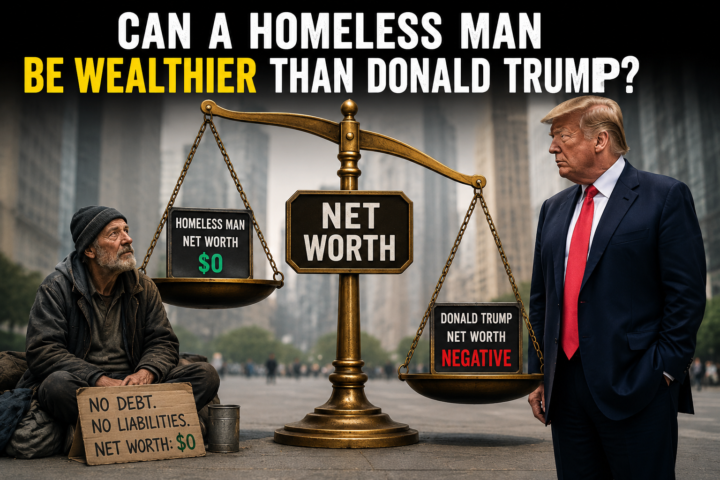
Is net worth really the best way to measure wealth?
“That homeless man is richer than me.” Donald Trump reportedly said this to someone walking down the street with him during one of his financial downturns. What did he mean?The homeless man obviously didn’t own skyscrapers, hotels, private aircraft, or billions of dollars worth of real estate. Trump did. Yet at that particular moment, Trump’s liabilities exceeded his assets, giving him a negative net worth. The homeless man, having little or no debt, technically had a higher net worth. If net worth is truly the best measure of wealth, then we are forced to conclude that a homeless man was wealthier than Donald Trump. That conclusion seems absurd. And it exposes a fundamental question: Is net worth really the best way to measure wealth? Before answering that question, we first need to understand what net worth actually is.Net worth is one of the simplest financial calculations: Net Worth = Assets − Liabilities In other words, if you sold everything you own, paid off everything you owe, and counted what remained, the result would be your net worth. It is an important financial metric because it provides a snapshot of your financial position at a particular moment in time. But notice what it measures, or what it doesn’t measure. It does NOT measure income or cash flow. It does NOT measure earning potential or financial freedom. It simply measures the difference between what you own and what you owe. And this is where things start to get interesting. Consider two people… Person A owns nothing and owes nothing. Assets: $0, Liabilities: $0, Net Worth: $0 Person B owns a $1 million apartment building financed entirely by a $1 million mortgage. Assets: $1,000,000Liabilities: $1,000,000Net Worth: $0 According to net worth, both individuals are “equally wealthy”. But are they? Person A has no assets, no investments, no cash flow, and no capital working for him. Person B controls a million-dollar income-producing asset.

🔥
0 likes • 27d
@Sami Benoliel I learned the best way to measure financial wealth is in "time". "How long can you live without earning more money"
🔥
0 likes • 27d
@Sami Benoliel thank you Sami!
May 28 •
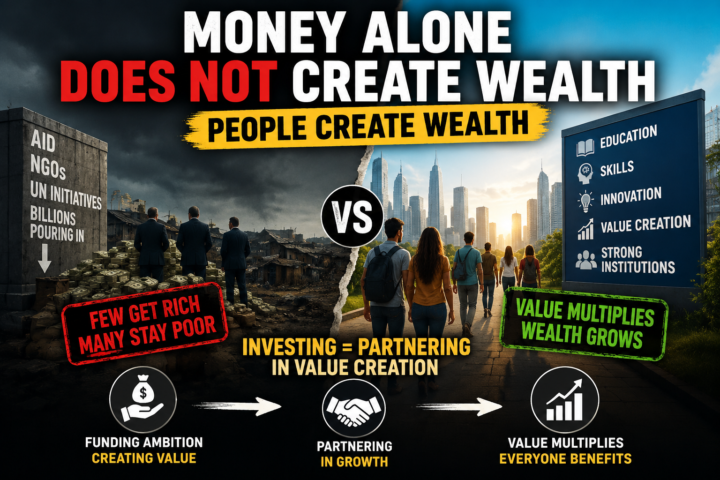
Why do some societies receive billions in aid, NGOs, and international funding… yet remain poor for generations?
Why do some societies receive billions in aid, NGOs, and international funding… yet remain poor for generations? While other societies become wealthy with far fewer external resources? Because money alone does not create wealth. People create wealth. If billions of dollars flow into a corrupt system with weak education, weak institutions, and very few value creators, the money often concentrates in the hands of politicians, oligarchs, and power brokers. The society itself doesn’t become richer. A few individuals do. But societies that invest heavily in developing human capital — skills, education, discipline, entrepreneurship, innovation, systems, and long-term thinking — become value-generating machines. They don’t just consume money. They multiply it. That’s why external investment works differently in different places. In one society, a billion dollars disappear. In another, a billion dollars funds businesses, technologies, infrastructure, jobs, and innovation that generate exponentially more value. This is also the deeper meaning of investing. The stock market is not just numbers moving on a screen. At its core, investing is partnering with people who are trying to create value at scale. And today, platforms like Skool allow ordinary people to do the same thing on a smaller scale. Almost every person has: - knowledge - skills - experience - lessons - expertise that can genuinely improve other people’s lives. The people who learn how to turn their experience into value creation stop thinking like consumers… and start thinking like builders. So here’s my question: What’s one skill, experience, or piece of knowledge you have that could genuinely create value for other people?
🔥
4 likes • May 28
Produce Audiobooks for Books. I would like to share this knowledge with a lot of authors and expand wealth with this.
🔥
1 like • Jun 10
@Sami Benoliel thank you!
Jun 4 •
Why don't most people save money?
Many people think the problem is a lack of discipline. I don't think that's true. You've probably heard the old joke: "If you stopped smoking, do you know how much money you'd have after 10 years? You could buy a BMW!" The smoker replies: "Do you smoke?" "No." "So where's your BMW?" The joke is funny because it exposes a real problem. Saving money without a purpose doesn't work. When savings are just an abstract number in a bank account, they're easy to spend. Every temptation seems more real than an invisible future benefit. But when your savings are connected to something meaningful—a child's bar mitzvah, a wedding, a business opportunity, a course that could change your life, financial independence, helping your family—everything changes. Now every dollar has a job. Overspending is no longer just "spending money." It's delaying something you truly value. This is why budgeting isn't really about numbers. It's about values. A budget answers a simple question: "Does my money reflect my priorities, or merely my habits?" One of the key ideas I explore in Think and Grow Rich Like a Jew is that wealth begins with purpose. Money follows vision. Without a clear destination, even the best financial advice rarely sticks. What is one goal important enough that it would make you think twice before making an unnecessary purchase? Share it in the comments.
🔥
2 likes • Jun 4
There are more goals I want to achieve and which I am training to visualize more concretely.
🔥
1 like • Jun 4
@Sami Benoliel oh yes. Absolutely! I see it clear and have a quite good visionboard for this goal! Most important, not to repeat once made mistakes again and again. If we do not see them clearly and understand what we do wrong, we tend to repeat the "old story" of consuming and spening in what we really do not need...
May 25 •
What do you think is the biggest thing holding people back financially?
👇 Vote below. Over the years, I’ve become convinced that financial growth is shaped by much more than income alone. Mindset, habits, discipline, education, and the beliefs we inherit about money all play a major role. This became one of the central ideas behind Think and Grow Rich Like a Jew — understanding how the way we think about wealth shapes the way we build it. Curious to see what people here think.
Poll
7 members have voted
🔥
1 like • May 28
@Javier Zemora Hi Javier. How are you? Nice to meet you!
🔥
2 likes • May 28
@Sami Benoliel Thank you for opening the door and let me be part of your group!
May 26 •
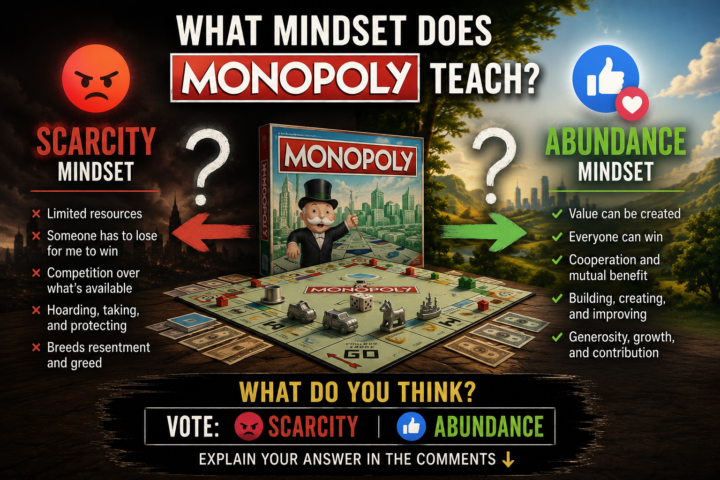
Do you think Monopoly teaches a healthy mindset about wealth?
I’ve been thinking about the difference between a scarcity mindset and an abundance mindset lately. A scarcity mindset sees wealth as limited. If someone becomes wealthy, then someone else must have lost. If someone succeeds, someone else must have been exploited. If someone wins, someone else must lose. And when people truly internalize that worldview, it naturally creates resentment toward successful people. Their gain feels like your loss. Ironically, greed itself often grows out of scarcity thinking: the fear that there is not enough to go around. - Not enough money. - Not enough opportunity. - Not enough security. - Not enough success. But an abundance mindset starts from a completely different premise: Human beings can create value. - A farmer creates food. - An engineer creates technology. - A teacher creates understanding. - An entrepreneur creates systems that improve people’s lives. A business can create opportunities, jobs, solutions, convenience, efficiency, knowledge, and growth that simply did not exist before. And people with an abundance mindset tend to focus less on taking wealth… and more on creating value. That’s why many genuinely successful people become builders, investors, mentors, philanthropists, employers, innovators, and creators. They see wealth not merely as something to possess — but as something that can expand through creativity, discipline, cooperation, and contribution. So coming back to the original question: Do you think Monopoly teaches people a healthy understanding of wealth… or does it teach scarcity, greed, and extraction?
Poll
4 members have voted
🔥
1 like • May 28
Good to have an environment to share the abundance mindset
1-5 of 5
🔥
@lara-knutzen
Author & Mentor | Building Global Audio Ecosystems 🎧
English • German • Español
Online now
Joined May 28, 2026
ENFJ
Stuttgart/ Germany