Activity
Mon
Wed
Fri
Sun
Aug
Sep
Oct
Nov
Dec
Jan
Feb
Mar
Apr
May
Jun
Jul
What is this?
Less
More
Memberships
SimplifyIAM
557 members • Free
Tech Career Study Group
613 members • Free
AgenticAI Governance Community
1.2k members • Free
Eretmis Cyber&GRC Community
335 members • Free
Learn Power Apps
2.6k members • $27/month
5 contributions to SimplifyIAM

Apr 20 •
The biggest trap in IAM right now: "Just get the certification."
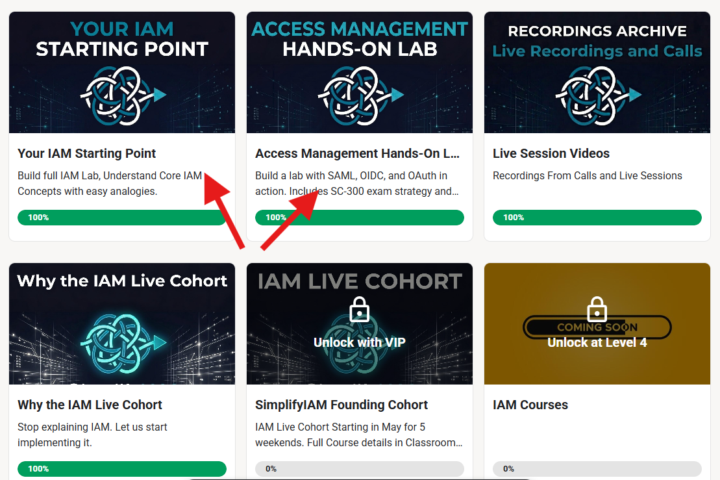
We see this constantly on Reddit and LinkedIn. Many think that passing the SC-300 or memorizing OAuth flows will be enough for IAM roles. Sure Certs help, however a certification tells you how SSO or JML works in a perfect, pristine environment. It does not tell you what to do when a client has three conflicting Active Directory forests, a messy HR system that hasn't been cleaned up in a decade, and a CISO or IAM Service Owner demanding immediate SSO integration by Friday. In the real world, IAM is messy. It requires you to know how systems actually connect, how to handle edge cases, and how to design a directory structure that won't collapse under its own weight in two years. You need to build. If you don't know where to begin, go to the Classroom tab right now. There are free lab resources in here to get you started. Use them. See screenshot. What is the biggest gap you have found between what you studied for a cert and what you actually had to fix on the job or asked differently in an interview? Drop it below. Let's discuss.

4 likes • Apr 20
@Srinath U You nailed it!! Certifications teach "How", not "Why" or "What if". To the hiring manager, a certification means you have the theoretical knowledge, but they need real answers to the following: 1. Can this candidate help me solve this SAML token errors and cryptic logs recurring problem? The solution is not in a multiple - choice question. Analyzing SAML assertions, checking certificate expiry, and talking to application support team will make senior leadership jump for joy. 2. Can I trust this candidate with our infrastructure? My 2 cents!!
Apr 14 •
Quick question for the room❓
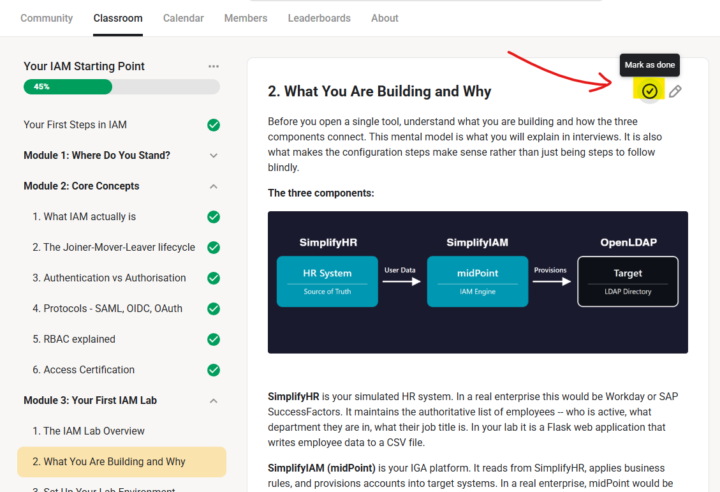
When a user leaves a company, what happens to their accounts -- in your experience or in your lab? Disable, delete, or something else - and after how long? No wrong answers. Curious what you all think. While you are here - mark your lessons complete as you go through the Classroom. See screenshot. It tracks your progress and moves you up the leader board 🏆
4 likes • Apr 14
@Olakunle Isaac Yep! In IAM, process-driven action matter. This approach, often called "soft-deletion" or suspending access balances immediate security requirements with the operational need for data retention, auditing, and potential reactivation!!
3 likes • Apr 14
@Winnie Wanjiku Legal & compliance problems = cost. Businesses/organizations hate costly lawsuits/litigation.
Apr 8 •
No One tells you about getting into IAM
Something nobody tells you about getting into IAM. You do not need to know every tool before you apply. I have interviewed dozens of candidates over the years. The ones who stood out were not the ones with the longest list of platforms on their CV. They were the ones who could explain what they built, why they built it that way, and what they would do differently. That comes from hands-on practice, not certification collecting. A IAM lab on your laptop where you built a Joiner workflow from scratch is worth more in an interview than a vendor certification you crammed for in two weeks. Because you can talk about it. You can answer follow-up questions. You can explain the decisions you made. Certifications matter eventually. Labs matter first. If you are waiting until you feel ready to start building - start now. The feeling of ready comes from doing the work, not from preparing to do the work. What is stopping you from setting up your first lab? Drop it below. We can work together. There’s no silly question.
1 like • Apr 12
I agree - hands-on practice is gold, and beats accumulation of certifications any day and most especially in this job market. Certifications tell the hiring manager you have knowledge of the IAM concepts, but that alone doesn't answer his question: "Can this person help me solve my problem or transform my business"? I like this line "why they built it". I believe the concept of "WHY" in IAM is critical because it allows practioners to focus on the business context: risk reduction, compliance, and user productivity.
Apr 8 •
5 IAM terms you need to know before your first interview.
Save this. 1. Provisioning The process of creating and configuring a user account in a target system. When a new employee joins and their laptop account, email, and application access are set up, that is provisioning. 2. Deprovisioning The reverse. Removing access when someone leaves or changes roles. The most common IAM failure point in most organisations. 3. Entitlement A specific unit of access, a role, a group membership, a permission. When you talk about what a user has access to, you are talking about their entitlements. 4. Identity Governance The discipline of making sure access is appropriate, reviewed, and auditable. Access certification campaigns, SoD policy enforcement, and audit reporting all fall under governance. 5. Target System Any system that the IAM platform provisions accounts into, Active Directory, a cloud application, an HR platform, a database. Everything downstream of the IAM tool is a target system. These five terms come up in every IAM role, every interview, and every client conversation. Knowing them precisely, not just roughly, is what separates someone who has read about IAM from someone who works in it. Which of these was new to you? Let me know in the comments.
1 like • Apr 12
Identity Governance does not only bring structure, visibility, and automation, but also take the chaos out of IAM. Infact I will argue that a proper/good identity governance & administration set up can take care of the IAM failure concern in point 2 (deprovisioning).
Apr 10 •
Welcome to the Community! Let's get to know each other 👇
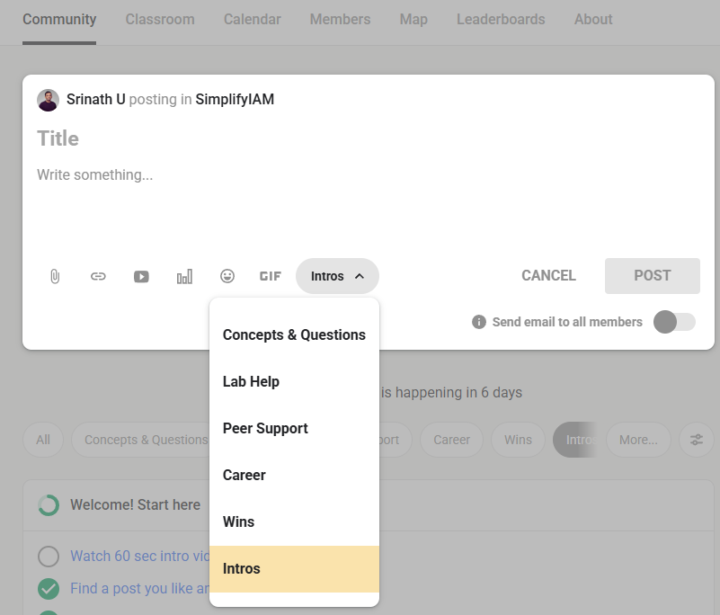
Hey all🙂 We have a great mix of people already in here, from IT Support and Sysadmins, to current IAM Analysts, to folks just starting their tech journey. Let us do a quick roll call so we know who is in the room. Go to the "Intros" category and CREATE A NEW POST with (see screenshot attached): - Your current role / background - Your #1 goal right now (e.g., pivoting into IAM, leveling up to Engineer, or just exploring): please be specific so that others can help or discuss. - Where you are joining from. Read through the Classroom modules to get started🙂 Also, the link for the weekly live call on Sundays is officially up - check the Calendar tab to add it to your schedule so you don't miss it.
4 likes • Apr 12
Hello everyone! Kwaku here - excited to join the community from Virginia. I've spent my time focusing on cloud-based physical access control as a security administrator, but I'm now diving deep into the broader world of digital IAM. My goal is to get up to speed on some of the modern identity security concepts including identity visibility and intelligence platform (IVIP) , get some hands-on skills, take some certifications, and eventually transition into IGA/PAM/Cloud IAM roles. When I'm not studying up on security, I love cooking and finding the next recipes. Looking forward to engaging and learning from the community!
1-5 of 5
@kwaku-poku-2409
Human Judgement & System Thinking Security Administrator specializing in protecting $80M+ CRE assets & risk mitigation using cloud/AI/IoT technologies
Active 38d ago
Joined Apr 10, 2026