Activity
Mon
Wed
Fri
Sun
Sep
Oct
Nov
Dec
Jan
Feb
Mar
Apr
May
Jun
Jul
Aug
What is this?
Less
More
Beyond The Leash
90 members • Free
The Detection Dog Lab
861 members • Free
18 contributions to Beyond The Leash

7d •
Norwegian Lundehund
This week we are going to talk about one of the rarest, but apparently least popular on the AKC list of official breeds, the Norwegian Lundehund. This Norway native is also considered one the oldest and most primitive of the dog breeds in the world. There are various statements on how old the Norwegian Lundehund is as one source says there is archaeological evidence of skeletal remains that go back to the Viking Age and a lineage that goes back thousands. Another source states that the furthest back is mentions of a dog with such skill being written down as far back as the 1400s or the year 1591. Regardless of which one is correct it is clear that this dog has been around for a while. These dogs have quite the fun and unique job which caused them to evolve to have some fun and unique physical features. The Norwegian Lundehund can literally be translated to “Puffin Dog” as their job was to hunt puffins in Norway all along the steep cliffs. In order to adapt well to their job they were selectively bred to have 6 functioning toes on EACH paw, be able to have their legs fan out at 90º like an airplane, fold their ears shut forward or backward to protect against water and debris and be able to flex their head back onto their spine for quick about face maneuvers in small caves. They not only were responsible for finding and retrieving puffins but also they were watchdogs and helped herd small livestock where their unique capable stability comes into play again on the rocky terrain. Much like with other types of jobs the Norwegian Lundehund became obsolete once nets and other methods were introduced plus the Norwegian authorities had a dog tax which made having a dog made life more expensive and families often had multiple Norwegian Lundehund at this time. In the 1960s the Norwegian Lundehund had barely survived a wave of distemper only for another wave of distemper to come through and almost wipe out the breed again. This left the Norwegian Lundehund with 6 that were purebred where only 4 were used to repopulate the breed and those 4 were related. This “genetic bottleneck” as it is called in the sources was and is a concern for Norwegian Lundehund enthusiasts. This level of inbreeding has caused some health issues as one might imagine and this includes low fertility and something called intestinal lymphangiectasia which basically is a digestive disorder that does not allow your body to absorb the nutrients one needs from food. Essentially a dog with this disorder can starve to death no matter how much they eat.


1 like • 5d
What a good looking dog in spite of those funky feet lol
17d •
Pet Insurance
This week I wanted to talk about pet insurance. While I am not an insurance expert I can say with confidence that animal insurance is much easier to understand than human insurance. This week’s topic was inspired by my animals and encouraged to talk about by @Katie Schobel . For those who don’t know I have 3 dogs, 3 cats and a snake and they range from the age of 2.5 years old to 12.5 years old. Dogs: - Lucas McCain – American Pit Bull Terrier – 12.5 years - Káosz – Vizsla – 2.5 years - Csili – Vizsla – 5 years Cats - Artemis – DSH – 12 years old - Aries – DSH – 11 years old - Minka – 3 years old Snake - Havoc – Thorn Scrub Rat Snake – 5 years (?) I have had Lucas on insurance since he was about 4 years old and I am so glad that I have due to him getting sick at a month short of 9 years old with a chronic auto immune disease that he still has. That first year I spent about $10,000 between food, diagnostics, medications, supplements and insurance payments. Thanks to insurance though I was reimbursed about $7000-8000. So, when I bought Káosz I immediately put him on insurance and when I adopted Csili she was covered as well. In November of 2025 I switched the vizslas to a different insurance company which I am happy with but kept Lucas on the one he has always been on due to coverage issues with his history. I will admit that I only have my dogs covered as thankfully my cats are for the most part medically boring although Minka is no longer medically boring. The blood test is pending but she is suspected to have histoplasmosis which is a fungal infection endemic to the Americas that is found in the soil that if left untreated is fatal. She is currently blind and her sight may not possibly return. I will know more about her prognosis once I get the test result hopefully later this week. In hindsight having her covered would have been beneficial as well but it won’t stop me from caring for her. Given my experience some things to note when considering insurance:
1 like • 15d
Ive had insurance since day 1 for Stryker bcos like children it’s a matter of when not if. Saving it for the big bill that will surely come someday!
1 like • 14d
@Christina Brewster Thank you 😊 No I’ll never cancel it, Murphy’s law pretty much guarantees that’s when the muck hits the fan! Lol
28d •
Xoloitzcuintli
Today we are going to talk about the Xoloitzcuintli. You may know this dog has the Hairless Mexican Dog or Mexican Hairless Dog. First let’s just get pronunciation out of the way because my God what a name! I am going to quote from the AKC website: “to pronounce this three-car pile-up of letters, try ‘show-low-eats-queen-tlee. Or just know when you’ve been beaten and use the shorthand ‘show-low’ instead.” The Xoloitzcuintli is considered another one of the oldest dogs but also one of the rarest breeds with statues that look like the hairless variety going back over 3,000 years. (I have only seen 1 that I can remember and it was over 10 years ago). They are native to Mexico and nearly went extinct in the 1950s until the Federation Cynologique Internationle (FCI) took action, recognized the breed officially and a gentlemen named Norman Pelham Wright along with a team of Mexican and British dog authorities ventured off to find any purebred Xoloitzcuintli that may have still existed in remote areas of Mexico. They ended up finding 10 strongly suited Xoloitzcuintli and became the foundation stock to revive the breed and by May 1, 1956 a breed standard was established in the breeds native land and around the world. The Xoloitzcuintli is named after the god of lightening and death, Xolotl, and it is believed they were made from a sliver of the bone of life which is where all of mankind is from, according to the Aztecs. The Xolo, being beloved by the Aztec people, believed that they would guide man to the world of death in exchange for man protecting the Xolo in life. The Aztecs also believed that the Xolo had healing abilities not only for the physical but also the spiritual and were often buried beside their custodians. This would be accomplished by killing or being burned alongside their masters to ensure safe travels in the world of death. If a person could not afford to own a dog a stature in the shape of one would be provided. The Xoloitzcuintli did also aid those in life by lending their furnace like abilities to warm aching joints and other afflicted areas. If food was scarce they were also used for food as well as they were the only domesticated animals alongside turkeys. It wasn’t just during times of scarcity but also religious ceremonies due the powers they were thought to have had.

1 like • 26d
@Christina Brewster I knew absolutely nothing about them until your article! 👏🏼😊
1 like • 26d
@Christina Brewster 🤣😂
Jul 11 •
Pug
Today we are going to explore the Pug. This breed is not known for having any sort of work history aside from not defecating on their palace floors in China perhaps. The Pug is one of the oldest breeds, going back as far as 400 B.C. and originated in China and was one of the three small flat faced dogs: Shih-Tzu, Pekingese and the Lo-Sze (the Pug who was also known as Foo dog). Pugs were highly regarded in ancient China and were given extravagant gifts and even had their own palaces. The Han Dynasty and the Ming Dynasty had strong affections for pugs and many members of the Chinese royalty kept them as pets. The Pug was bred on purpose to have round heads, short snouts and large eyes. Apparently part of their grooming included decorating their coats with pattern and designs. By the 7th and 8th centuries the Pug spread to Korea then to Japan and quickly became a status symbol. In Japan the Pug has become so popular that there is a national holiday where owners dress up their dogs in headscarves. It wasn’t until the 16th century that the Pug came to Europe where the pug proved to be more than a fancy lap dog with exquisite taste in accommodations. Pompey, one of the most well-known Pugs of the time, alerting Prince William the Silent of the House of Orange in the Netherlands, to an assassination attempt in 1572. Following Pompey’s heroism and stout alertness the Pug became the official dog of the House of Orange. In Italy it is said that Pugs rode up on private carriages adorning matching jackets and “pantaloons” of the coachman. Allegedly they were also used to track animals and people as well as be guard dogs. They seemed to have had to do a little more to earn their keep in Europe than back home in Asia. Pugs back then, according to paintings, had longer legs and longer snouts than they do today with the occasional cropped ears (in an attempt to enhance the wrinkles on their head). It is thought that around 1860 the appearance of the Pug changed to ones with shorter legs and the shorter nose we are accustomed to. It is believed that this version of the Pug was introduced after some loot was sequestered by the French and British soldiers from modern day Beijing (then Peking). The coat was different as well as they were black and white not just the yellowish fawn that was preferred.

2 likes • Jul 11
What a wonderful article. They’re not bad navigators either lol
1 like • Jul 12
@Christina Brewster That’s funny! 🤣😂
Jul 4 •
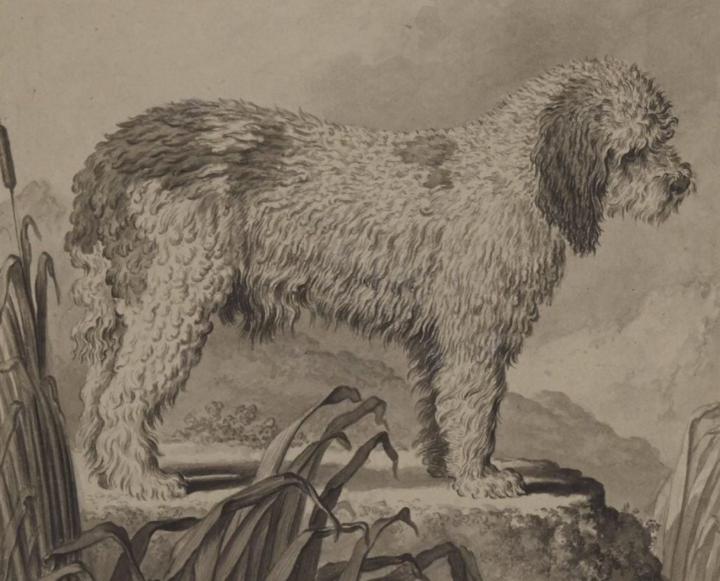
Korthals Griffon
The Korthals Griffon is also known as a Wirehaired Pointing Griffon go back as far as 1545 but were made popular by a Dutchman named Eduard Karel Korthals. He wanted to create the ultimate hunting dog. In 1917 a gentleman by the name of Dr. E.B. Ilyus said this about the breed: “The chief characteristics in which the griffon excels, and is superior over setters and pointers, are his ready adaptability to all species of game, all climates, and all varieties of terrain, his exquisite nose, wonderful vitality and endurance, and the pronounced instinct which makes him the easiest of all dogs to train on game. As a retriever he has, in my opinion, no superior, and being very intelligent and affectionate, he makes an ideal man’s companion.” The name “Griffon” was used by King Henry IV of France to describe his wirehaired dog in 1596 then in 1683 a J.E. de Selincourt divided pointing dogs into three groups: the Bracque (shorthaired), Spaniel and Griffon (wirehaired). When the middle of the 19th century rolled around there were a few varieties of wirehaired dogs. It wasn’t until 1873 that our friend Eduard Karel Korthals bought four griffon types in Amsterdam and moved to Germany. This is where he began breeding his own variation of the griffon. Over the following 15 years, through meticulous breeding and culling he created the Korthals Griffon. In 1886 Korthals wrote the first breed conformation standard and 2 years later he, as well as 140 others, founded the first Griffon Club which was based in Germany but membership was allowed internationally. After WWI France and Belgium opened their own Griffon Clubs with the original Griffon Club not surviving WWII. After WWII the French Griffon Club took ownership of the first studbook. The French club is the largest Griffon Club with over 1000 members and produces about 2000 pups a year. The Korthals Griffon came into the United States in 1887 but did not gain popularity until after WWII. In 1951 the Wirehaired Pointing Griffon Club of America was formed by Brigadier General Thomas DeForth Rogers and 19 other charter members.
1 like • Jul 4
I love seeing how old some breeds are. I had never heard of this one. Great research.
1 like • Jul 4
@Christina Brewster when you think about the times some of them lived in, most people probably thought these folks were crazy! So glad they persisted!
1-10 of 18

@katrina-aggelopoulos-1567
Detection K9 Handler, HRD K9 Handler, retired CSI, transplanted Brit in S. TX
Active 5d ago
Joined Dec 24, 2025
North of Corpus Christi