Activity
Mon
Wed
Fri
Sun
Dec
Jan
Feb
Mar
Apr
May
Jun
Jul
Aug
Sep
Oct
What is this?
Less
More
The Visible Death Worker
290
Free
4 contributions to The Visible Death Worker
Sep 18 •
Social media hell!
OMG! I just spent 2 hours creating a carousel post in Instagram. By the end I couldn’t even bear to write multiple captions - I was done! Canva is usually easy but today it was doing my head in. The text editor kept disappearing and I had to keep refreshing it. Anyway - given my pain I would love some love and comments on it!!!! 💕. Please https://www.instagram.com/p/Ddb9aocAKK-/?stkn=MXdmdzJzdGgxbzQweA==

1 like • Sep 23
Following too Beth - and a great post 💕
Aug 14 •
🐦⬛ Visible Friday #17: Socials Masterclass Snippet
I've been sitting here this week beaming like a proud mama hen. So many of you have started putting your face and voice out there in new ways, on camera, in your own words, and I just want to say I see it. It's not a small thing. So this week I'm gifting you a snippet from the Social Reels Masterclass. Eight minutes, deep dive, all about Your Profile, Your Platforms, Your Sound. Watch for free below and you can find the full course in the Classroom tab. I'm also dreaming into something bigger. A Vizzy D Video series where I challenge us all with different prompts and questions to speak to camera and share it in here first, encouraging each other across that vulnerable threshold together. Still shaping what this looks like, but I wanted to say it out loud before it's fully formed, because that's kind of the whole point isn't it... Would this be something you'd want to be part of? Curious what a prompt might look like for you, something silly, something serious, something that scares you a bit to say out loud. What is stopping you from putting your face and voice out there? What are the blocks? How can we help each other? Only love, Amy 🐦⬛
1 like • Aug 15
@Kay Collins good on you!
1 like • Aug 15
Thank you so much Amy - tbh I can't stand the sound of my voice - but know I really need to push through it. I could listen to you talk all day!!
Jul 24 •
Visible Friday #14: Guardians Of Language In Death Care
Vizzy D Darlings, This week we're jumping into language and I'm inviting you to embrace this prompt in two ways: 1. Reflect on your own relationship with language in your corner of death and grief care. What's changed and evolved in you and your work? 2. How might you share this as advocacy? On socials, in a blog post, in an interview, in a conversation with someone. How can you more concisely weave and speak the evolution of death care language into your work and world? 🐦⬛ There's so much within language that's nuanced to who we are, where we work and what we do. A funeral director in a regional town carries different words than a chaplain in a city hospital, than a doula sitting with someone dying at home. None of us are working from the same script, and I don't think we should be. And yet, reflecting on the language we uphold and perpetuate in this work is relevant no matter where we live and what we do. It's culturally nuanced and our responses will all be different. It's something we should all keep tending to. For example, a lot of the western Anglo-centric grief language encourages us to "ask their name", or to "speak their name" to honour that person's loss and keep their memory alive. Some of my ‘best performing’ social posts are about exactly this. And yet, when I support First Nations families here in Australia, the cultural protocol is the opposite. In some communities you DON'T speak their name for the first year, to ensure their spirit can be free in the Dreamtime and not unsettled during a time when it needs to move on undisturbed. When supporting Sorry Business (the Indigenous name for death care and funeral rites), I always ask permission to speak their name or ask how best to refer to the person who has died. There will be nuance with this in all countries and communities. 🐦⬛ Here's some more examples from me if helpful. I haven't quite worked out how I want to share this as advocacy, but feel free to borrow or apply anything that resonates for you.
2 likes • Jul 25
Thanks Amy, agree with all of the above. I was with a daughter who's mother had died at an elders age, and when asking what time her mother had "died" she recoiled - visibly. I apologised and said would she prefer that I said "passed away" and the answer was yes. It's interesting that some families insist on using the word "death" and "the body" and yet some feel that language is so harsh. Slowly slowly!
Jun 1 •
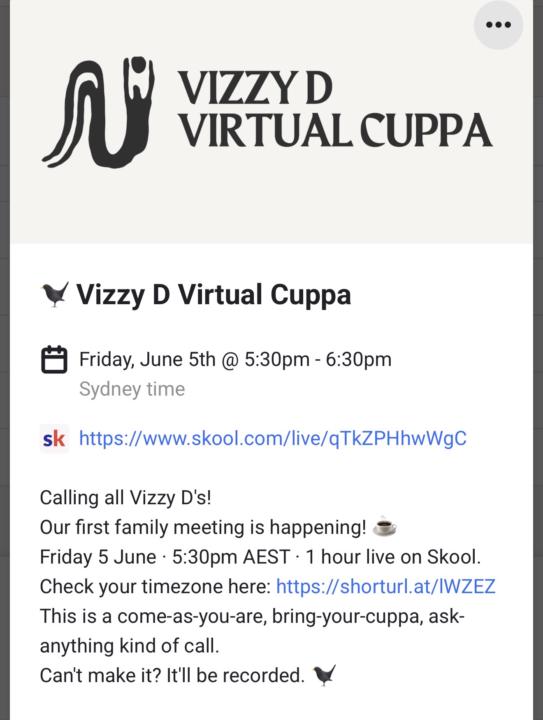
Vizzy D Family Meeting: Virtual Cuppa this Friday!
Gentle reminder we will hold our first free online gathering this Friday 8th June - you can view the link & time zone details in the CALENDAR tab on Skool. Bring your questions / ideas / reflections - will be so nice to be together. ☕️
0 likes • Jun 2
Thanks so much for organising Amy - hopefully I'll be back from the Central Coast by then or very much look forward to the recording. Thank you xx
1-4 of 4

@kath-breusch-8068
Funeral and Marriage Celebrant of 20+ years. Funeral Director and Death Doula for 10+ years (can supply cooling bed). Based in Sydney.
Active 3d ago
Joined Apr 30, 2026
Powered by