Activity
Mon
Wed
Fri
Sun
Aug
Sep
Oct
Nov
Dec
Jan
Feb
Mar
Apr
May
Jun
Jul
What is this?
Less
More
Memberships
AI Social Studies Lab
24 members • Free
2 contributions to AI Social Studies Lab

Jan 8 •
AI Poll
Give us some insight into what you are working on with AI in your classrooms. Answer the poll question and then comment on what tools you may be experimenting with.
Poll
4 members have voted

1 like • Feb 2
I've been using lm notebook. The podcast feature has saved so many of my students. We read a lot of primary sources and a lot of them are from the Revolution era so they can be tough to read. I have not checked out Flint. It is on my to do list this week. I'm also currently reading "Teaching with AI for Success" and "Embodied AI Integration in Education." AI truly is here to stay and we need to learn how to embrace it, and also makes our lives a little easier. :)
1 like • Feb 2
@Jeff Peterson they really are! I have NO desire to return to school, however what an amazing time to be a student!
Jan 2 •
SCIM-C: Your Secret Weapon for Teaching Students to Actually READ Historical Sources
Let's be honest—getting students to critically analyze primary sources instead of just skimming for facts is hard. Enter SCIM-C, a protocol that breaks down source analysis into manageable steps that students can actually follow (and that you can actually teach). SCIM-C isn't new—it's been around in history education for years. But here's what IS new: AI can help you model it, practice it, and give students personalized feedback on it. Let's break it down. What is SCIM-C? SCIM-C is a scaffold that guides students through a deeper, more methodical reading of historical sources. Think of it as a checklist that keeps students from just reading the surface and calling it a day. Here's what each letter stands for: S — Summarize What type of source is this? What's the basic content? What key information jumps out? C — Contextualize When and where was this created? What was happening at the time? What's the broader historical backdrop? I — Infer What's between the lines? What attitudes, biases, or perspectives can you detect? What isn't being said outright? M — Monitor What questions do you still have? What gaps or uncertainties does this source leave you with? What does it NOT tell you? C — Corroborate How does this source compare to other evidence? Does it confirm or contradict what you've learned elsewhere? Why SCIM-C Works SCIM-C forces students to slow down and engage with sources the way historians actually do. Instead of racing to "the answer," they're building a habit of questioning, contextualizing, and comparing evidence. And here's the kicker: SCIM-C makes AI useful instead of dangerous. When students just ask ChatGPT "What does this document mean?" they get a shallow summary and call it done. But when they use SCIM-C as their framework, AI becomes a thinking partner instead of a shortcut machine. Watch Out For: The SCIM-C Pitfalls ✅ DO: Require students to complete their own analysis BEFORE using AI for feedback or modeling. ❌ DON'T: Let students skip straight to asking AI for answers. That's not analysis—that's outsourcing their brain.
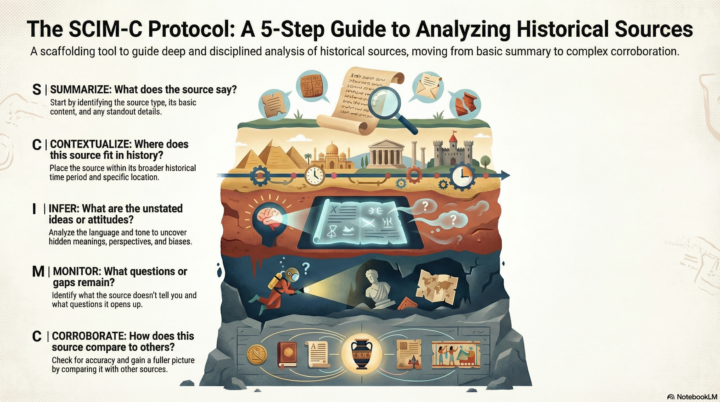
0 likes • Feb 2
Any ideas how to SCIM-C Slaves and the Courts, 1740–1860, “The case of Dred Scott in the United States Supreme Court,” Library of Congress. On March 6, 1857, Chief Justice Roger B. Taney delivered the opinion for the Supreme Court in the case Dred Scott vs. John F. A. Sandford. The case was decided by a 7–2 majority and each justice—other than Taney—wrote his own separate statement of concurrence or dissent. The court ruled that Scott had no standing in federal court because he was not an American citizen, that the Missouri Compromise was unconstitutional, and that slaves were a form of property and that the Fifth Amendment protected slave owners right to preserve this property. Document “The question is simply this: Can a negro, whose ancestors were imported into this country, and sold as slaves, become a member of the political community formed and brought into existence by the Constitution of the United States, and as such become entitled to all the rights, and privileges, and immunities, guarantied by that instrument to the citizen? One of which rights is the privilege of suing in a court of the United States in the cases specified in the Constitution. “It will be observed, that the plea applies to that class of persons only whose ancestors were negroes of the African race, and imported into this country, and sold and held as slaves. The only matter in issue before the court, therefore, is, whether the descendants of such slaves, when they shall be emancipated, or who are born of parents who had become free before their birth, are citizens of a State, in the sense in which the word citizen is used in the Constitution of the United States. And this being the only matter in dispute on the pleadings, the court must be understood as speaking in this opinion of that class only, that is, of those persons who are the descendants of Africans who were imported into this country, and sold as slaves. “The situation of this population was altogether unlike that of the Indian race. The latter, it is true, formed no part of the colonial communities, and never amalgamated with them in social connections or in government. But although they were uncivilized, they were yet a free and independent people, associated together in nations or tribes, and governed by their own laws. Many of these political communities were situated in territories to which the white race claimed the ultimate right of dominion. But that claim was acknowledged to be subject to the right of the Indians to occupy it as long as they thought proper, and neither the English nor colonial Governments claimed or exercised any dominion over the tribe or nation by whom it was occupied, nor claimed the right to the possession of the territory, until the tribe or nation consented to cede it. These Indian Governments were regarded and treated as foreign Governments, as much so as if an ocean had separated the red man from the white; and their freedom has constantly been acknowledged, from the time of the first emigration to the English colonies to the present day, by the different Governments which succeeded each other. Treaties have been negotiated with them, and their alliance sought for in war; and the people who compose these Indian political communities have always been treated as foreigners not living under our Government. It is true that the course of events has brought the Indian tribes within the limits of the United States under subjection to the white race; and it has been found necessary, for their sake as well as our own, to regard them as in a state of pupilage, and to legislate to a certain extent over them and the territory they occupy. But they may, without doubt, like the subjects of any other foreign Government, be naturalized by the authority of Congress, and become citizens of a State, and of the United States; and if an individual should leave his nation or tribe, and take up his abode among the white population, he would be entitled to all the rights and privileges which would belong to an emigrant from any other foreign people.
1-2 of 2

@kat-reguero-vandeventer-1877
Hi! I go by Professor Kat. I teach US History in Dallas College. I am thrilled to utilize ETHICAL use of AI in my classrooms!
Active 140d ago
Joined Feb 2, 2026