Activity
Mon
Wed
Fri
Sun
Apr
May
Jun
Jul
Aug
Sep
Oct
Nov
Dec
Jan
Feb
Mar
What is this?
Less
More
Owned by John
Independent peptide research, education, and discussion. Built with Stack Tracker and supported by n1 Aminos for verified research supply.
Memberships
The Peptide Tactical Playbook
348 members • Free
Longevity and Biohacking Labs
220 members • Free
Biohacking Elite
278 members • Free
Hub Biohackers
127 members • Free
Peptide Association Community
960 members • Free
Longevity Lab
719 members • Free
Tony Huge Evolution
3.7k members • Free
Precision Health w PA Courtney
159 members • Free
Biohackers Buyers Club
141 members • Free
11 contributions to KRISTINA’S PEPTIDE JUNKIES 24
8h •
Don't miss the our all satire Instagram page
@n1.Aminos Memes. Jokes. Pop culture references. Dramatic overreactions for entertainment purposes only. We discuss science. We laugh at oversimplifications. We do not give medical advice. If you detect sarcasm… good. If you detect humor… excellent. If you’re reporting memes… maybe touch some grass and get over it.
0
0

2d •
🚀 STACK TRACKER 2.0 — TESTERS, CREATORS & WELLNESS PROS WANTED
We just completed a full rebuild of Stack Tracker. This isn’t a cosmetic update. It’s a new infrastructure layer for people who build, track, and publish stacks. We’re opening two lanes right now: 1️⃣ 2-Week Soft Launch (User Testers) 2️⃣ Creator + WellnessPro Early Access If you track supplements, peptides, protocols, or coach clients — this may be relevant. 🧪 1️⃣ 2-WEEK SOFT LAUNCH — STRUCTURED TESTING WINDOW The new build is live. Now we need real users to: • Pressure test performance • Catch bugs or friction • Validate onboarding • Confirm integrations behave properly • Tighten small UX details This isn’t a rough beta. It’s polished — we just want it airtight before scale. 💎 EARLY ADVANTAGE If you join during this window and stay: • You lock in best pricing • No future tier jumps • No surprise increases If you’ve ever wanted to shape a platform before it grows — this is that moment. Comment “IN” after you submit so we know to watch for you. 🧠 2️⃣ CREATOR + WELLNESSPRO EARLY ACCESS This is where it gets interesting. Stack Tracker 2.0 isn’t just a tracking app. It’s becoming a distribution + monetization engine for stack builders and educators. If you are a: • Creator • Influencer • Coach • Wellness Professional • Lab reviewer • Biohacker educator You’ll soon be able to: 🔹 Publish Structured Protocols Make them: • Free to import • Preview-only with paid unlock • Fully monetized digital stacks No PDFs. No messy Google Docs. No screenshots. Structured. Importable. Clean. 🔹 Build an In-App Profile • Add website + socials • Build followers • Notify them when new stacks drop • Offer exclusive paid content Owned distribution — inside intent. 🔹 Monetize Directly (WellnessPros) • Paid protocol reviews • Lab + wearable data review • Monthly coaching • Promotions + discounts • Paywalled stacks After 30 days with a client, engagement continues without added platform friction. You scale. The system scales with you. 🔹 Get Discovered Inside Stack Tracker users will see:
1
0

4d •
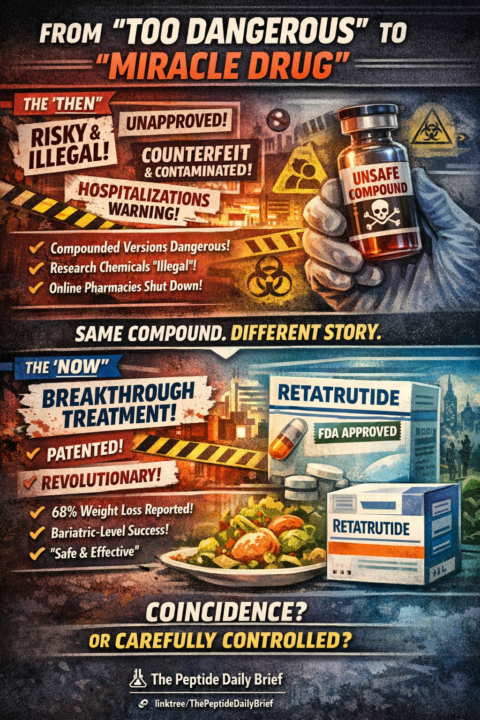
🚨 BREAKING: The “Too Dangerous” Molecule Is About to Become a Miracle 🚨
They said it was risky. They said it was illegal. They said it was counterfeit, contaminated, reckless, life-threatening. Now? They’re preparing to patent it, brand it, and call it revolutionary. 🧬 The Data They’re Celebrating Eli Lilly’s Phase 3 TRIUMPH-4 data on retatrutide shows: 📉 28.7% average body-weight reduction at 68 weeks (12 mg dose) 🦵 Significant reduction in knee pain (WOMAC improvements) ❤️ Improvements in triglycerides, non-HDL cholesterol, hs-CRP, and systolic BP 🔥 ~23–24% of participants lost ≥35% body weight (bariatric-range outcomes) That’s not incremental. That’s surgical territory. And yes, tolerability issues were there: Nausea ~38–43% Diarrhea ~33–35% Vomiting ~20% Discontinuation rates up to ~18% New signal: dysesthesia Some participants reportedly stopped because they lost too much weight. Let that sink in. ⚖️ Now Remember the Messaging From Not Long Ago… Before commercial approval was realistic, the narrative was very different. The tone was: “Unapproved GLP-1 products are dangerous.” “Compounded versions cause hospitalizations.” “Research-use ingredients are illegal and harmful.” “Online sales = counterfeit, contamination, overdoses.” Regulators and corporate PR leaned heavily into: Counterfeit scare language Hospitalization statistics Cease-and-desist campaigns Litigation against telehealth and compounders Anything outside the branded channel? Framed as reckless. Even retatrutide as an API was explicitly warned against in FDA communications. The emotional positioning was clear: If it’s not ours, it’s unsafe. 🔄 And Now? Now the same molecule is being positioned as: Historic Breakthrough Bariatric-level Cardiometabolically transformative Soon it will likely be: Patented Exclusively distributed Marketed as the future of obesity treatment “Well tolerated and effective when used appropriately” Same compound. Different control. 🧠 The Pattern This isn’t about denying safety concerns. Large-scale human data matters.
2
0
11d •
🚀 Stack Tracker 2.0 Is Coming
This isn’t an update. Share this post and update with your greater peptide communities to help us spread the word!!!! It’s a rebuild. Stack Tracker is moving onto its own dedicated servers — fully rebuilt from the ground up, fully HIPAA compliant, and engineered by a world-class development team. New architecture. New design language. New UI/UX. Massively improved reliability. Way faster performance. And functionality that finally matches the long-term vision. This is the version we always intended to launch. 🧬 Bigger Than Tracking Stack Tracker 2.0 isn’t just a tracking tool anymore. It’s infrastructure. For years, optimization conversations have lived on platforms that throttle content, shadow ban discussions, censor nuance, and disconnect providers from serious clients. That era is ending. The rebuild introduces the ability to connect directly with providers and coaches who actually understand this space — inside a structured, data-driven environment. Your full protocol visible. Compliance tracked. Wearable data integrated. Real conversations happening without algorithm interference. Optimization with freedom. Not censorship. And yes — we already have several key providers lined up who are ready to join the cause. 🎤 Official Debut We’re unveiling the full rebuild LIVE at Biohacker World Conference, March 28–29. [https://www.biohackers.world/](https://www.biohackers.world/) If you’ve never been, it’s one of the highest-signal gatherings in the biohacking space. Founders. Researchers. Builders. Real operators. We’re not just attending. We’re launching. 🎟 Who’s In? Last time, we were able to secure a couple of free tickets for the community. If we can make that happen again… Who would actually go? Find this post on The Peptide Daily Brief and drop an, “I’m in,” your city, and why you should get the ticket. Stack Tracker 2.0 isn’t just better software.

0 likes • 11d
FYI You can still join the beta launch now at StackTracker.info and lock in lifetime pricing and early access on 03/02/2026 to help us test and work out any bugs in the system... We would love that 🥰
14d •
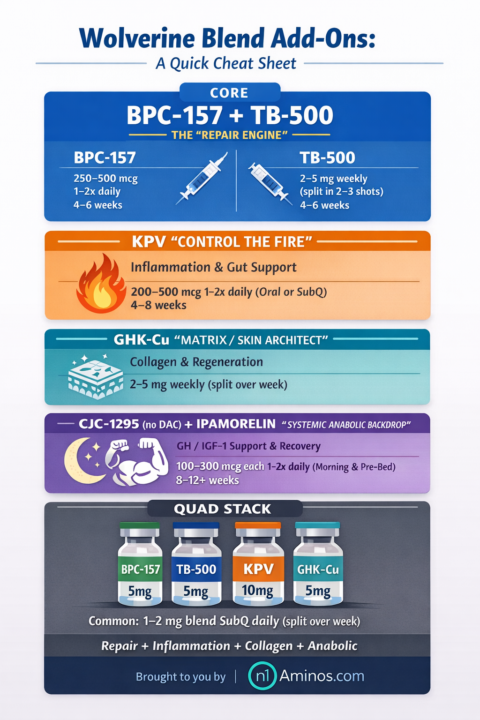
Wolverine Blend “Build-Outs” — what people actually stack on top (and why)
Wolverine Blend “Build-Outs” — what people actually stack on top (and why) Most “Wolverine Blend” stacks aren’t one protocol — they’re a plug-and-play template. The add-ons (KPV, GHK-Cu, CJC/IPA, etc.) usually follow mechanistic logic, not controlled trials. So if you don’t know what each add-on is supposed to do, you’re just collecting vials. The Core: Wolverine Blend = “Repair Engine” The classic pairing is BPC-157 + TB-500, because clinics/vendors frame it like this: - BPC-157 → more local repair bias (connective tissue + gut/mucosal talk is common) - TB-500 → more systemic recovery bias (cell migration/angiogenesis/collagen-rich tissue remodeling is the marketing narrative) Commonly cited dosing conventions: - BPC-157: 250–500 mcg once or twice daily (often “near injury”), ~4–6 weeks - TB-500: 2–5 mg/week, split 2–3 injections, often “front-loaded” ~4–6 weeks Sources people reference in the wild: preferredregen, Women’s Health of MD, Drip Hydration, Swolverine, etc. The 3 Most Common Add-Ons (and the “logic” behind them) 🧬 1) KPV = “Control the fire” KPV gets layered when the goal is inflammation + barrier issues (gut/skin) — the pitch is: reduce inflammatory “noise” so the repair stack can remodel tissue. Commonly mentioned ranges: ~200–500 mcg once or twice daily (oral or SubQ) for 4–8 weeks (wide variance; no standardized human trials). 🧬 2) GHK-Cu = “Matrix / skin architect” GHK-Cu is used when the goal includes ECM/collagen remodeling, scar appearance, skin quality, or cosmetic regeneration alongside injury recovery. Commonly mentioned conventions: Injectable protocols vary widely; people cite ~2–5 mg/week split dosing. 🧬 3) CJC-1295 (no DAC) + Ipamorelin = “Systemic anabolic backdrop” This combo gets added when someone is chasing recovery capacity, sleep, body comp, or “GH/IGF axis support” on top of local repair. Frequently cited template: 100–300 mcg of each, once or twice daily (often night/pre-sleep), 8–12+ weeks.
3
0
1-10 of 11
@john-bastiat-1751
John | The Peptide Daily Brief — Powered by Stack Tracker - research peptide insights, protocol vault & exclusive deals. No hype, just research.
Active 2h ago
Joined Jul 19, 2025
Powered by