Activity
Mon
Wed
Fri
Sun
Aug
Sep
Oct
Nov
Dec
Jan
Feb
Mar
Apr
May
Jun
Jul
What is this?
Less
More
Memberships
Learn to Draw With Pastels
2.6k members • Free
Dakoda Herbals Academy
133 members • Free
2 contributions to Dakoda Herbals Academy

May 14 •
Happy Thursday, everyone!
One of the most beautiful parts of herbalism is realizing that plants don’t always work in loud or dramatic ways. Sometimes the most powerful herbs are the ones that work slowly, gently, and consistently over time. Think about herbs like nettles, oatstraw, lemon balm, or raspberry leaf. They often aren’t “quick fix” herbs. Instead, they nourish, strengthen, and support the body little by little, almost like building a foundation brick by brick. Modern culture often teaches us to look for immediate results, but traditional herbalism reminds us that healing and nourishment can also come through rhythm, consistency, and relationship with the plants themselves. Even something as simple as: drinking a daily mineral rich infusion, growing one medicinal plant at home, earning one new herb each week, can slowly reconnect us to both nature and ourselves. Herbalism is not just about symptoms. It’s also about observation, patience, nourishment, and learning the language of the natural world around us. 💙 🍀 Question for everyone! What’s one herb you feel personally connected to lately, and why? And what topics would you want to learn about, specifically?

2 likes • Jun 2
Lately I feel really connected to motherwort. Her unique appearance and her beautiful medicine with an edge. ❤️
May 26 •
Happy Tuesday everyone!!
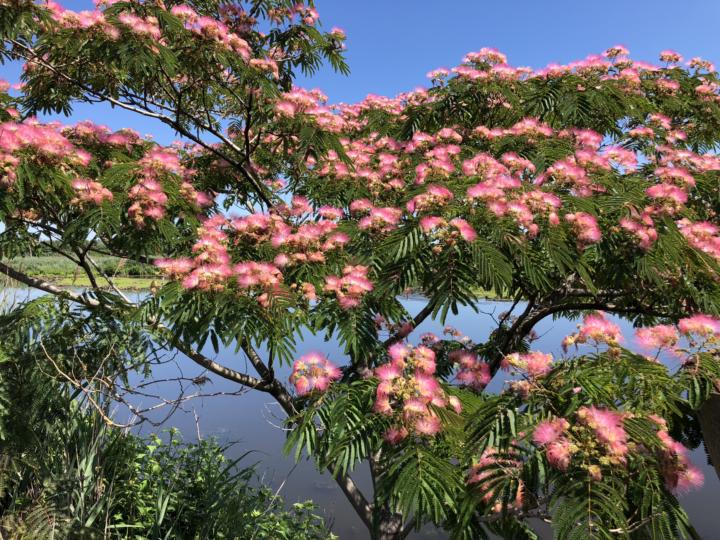
Welcome new members!! I hope those of you in the United States had a wonderful Memorial Day weekend. Over Memorial Day weekend I went out of town on a little girls trip, and one thing that caught my attention the entire drive were the Persian silk trees blooming everywhere along the highways and roadsides! Those fluffy pink flowers almost look dreamlike when they are in full bloom this time of year. Seeing them everywhere reminded me how badly I have wanted to talk about Albizia julibrissin again, commonly called the mimosa tree, Persian silk tree, or silk tree. I did a video last year on Albizia julibrissin. If you want to check it out, I'll link the video in the post! I completely sold out of 5 ounces of harvested mimosa flower from that video and am eager to harvest more to dry, as there are very little to no trustworthy sellers online. One thing that can get confusing in herbalism is the word “mimosa,” because multiple plants share that common name. When people talk about “mimosa flowers” in herbal preparations, they are often referring to the flowers of Albizia julibrissin, not necessarily the sensitive plant Mimosa pudica that folds its leaves when touched. Common names can overlap a lot in the plant world, which is why botanical names matter so much. Although she's beautiful, Albizia julibrissin is not native to the US. It originally comes from parts of Asia and the Middle East and was introduced here as an ornamental tree because of its beautiful flowers and fast growth. Over time it naturalized in many areas across the South and eastern United States, which is why so many of us see it lining roadsides every summer. Traditionally, the flowers and bark have been used in Chinese herbal traditions, where the tree is sometimes called the “Tree of Happiness.” Historically it has been associated with emotional support, calming the spirit, easing grief, supporting sleep, and helping with melancholy or emotional heaviness. The flowers in particular are often viewed as uplifting and heart soothing. I honestly love the flowers so much and a tincure of it tastes like heaven.
2 likes • Jun 2
I love learning about new plants 😍 now a new friend to keep my eyes peeled to spot in the world lol
1-2 of 2

@jessica-c-7675
My name is Jessica and I am a year and half into my herbal studies.
Active 2d ago
Joined Jun 1, 2026