Activity
Mon
Wed
Fri
Sun
Oct
Nov
Dec
Jan
Feb
Mar
Apr
May
Jun
Jul
Aug
Sep
What is this?
Less
More
Owned by Jesse
Free AI lab for doctors, PAs, NPs, and healthcare teams. Build a simple AI toolbelt, check real sources, and make safer drafts. No coding.
Skoolers
161.2k members • Free
Automatable Free
23.2k members • Free
AI Automation Vault
36k members • Free
Kev's No Code Academy
155 members • $99/m
Growing Pro Community
415 members • Free
AI Agent Developer Academy
2.9k members • Free
Automate Business AI
6.2k members • Free
AI Pioneers
8.4k members • Free
Tinocode
2.1k members • Free
1 contribution to 5minAI

Feb '25 •
🧠 Building Smarter RAG Agents – Key Strategies
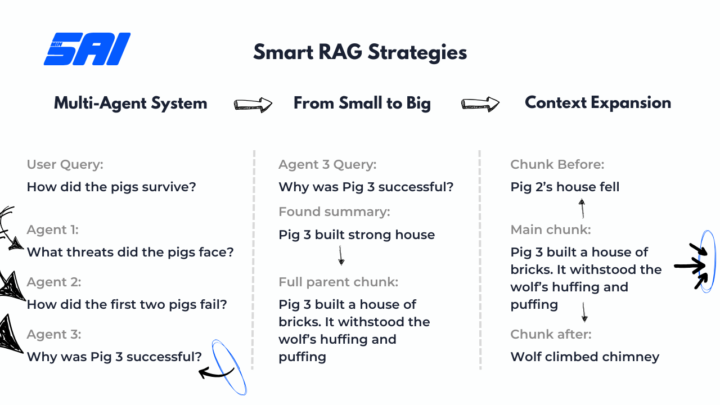
Many businesses are struggling to build truly smart RAG agents that can efficiently process large knowledge bases with hundreds (or even thousands) of files. The basic vector search approach is too weak—it often retrieves irrelevant chunks, lacks deeper context, and struggles with large datasets. To improve accuracy, additional steps are needed to enrich the context before answering user queries. So I started researching ways to enhance RAG systems and whether these strategies could be implemented in N8N. One of my initial ideas was pre-filtering the data before vector search. Instead of blindly searching across the entire database, we could first categorize files, add metadata links, and apply tag-based filtering to narrow down the search scope before retrieving relevant vector chunks. During my research, I came across a presentation from a LlamaIndex employee (they specialize in RAG for large enterprises) and discovered three practical techniques for improving RAG performance: 1️⃣ Context Expansion Instead of pulling only the most relevant vector, the system can retrieve adjacent vectors (e.g., 2 before and 2 after) to preserve context rather than extracting isolated fragments. ✅ Extra Idea: AI validation can be used to check if the expanded context is useful—if not, it can refine the search and output only the truly relevant chunk. 2️⃣ From Small to Big: Layered Search Instead of running vector search on raw chunks, add metadata summaries, tags, and categories to chunk metadata or a separate table. Then: 🔹 Step 1: Run a vector search only on the metadata layer to identify the most relevant sections. 🔹 Step 2: Retrieve the actual data only from these filtered sections. 📌 This approach requires well-structured metadata summarization based on common user queries and niche specifics. For example, in legal cases, metadata might include facts, dates, names, and key arguments. 3️⃣ Multi-Agent System Instead of retrieving a static dataset, the system can break down the query into multiple sub-questions and distribute them across different AI agents (or loop them iteratively).

3 likes • Feb '25
That’s super interesting. Do you have an example of how to do that in N8n?
1-1 of 1

@jesse-dashe-2270
Orthopedic hand surgeon building practical AI workflows for clinicians. Start with one small win. Use fictional data. Open every source.
Active 2d ago
Joined Feb 3, 2025