Activity
Mon
Wed
Fri
Sun
May
Jun
Jul
Aug
Sep
Oct
Nov
Dec
Jan
Feb
Mar
Apr
What is this?
Less
More

Owned by Jeromy

Unshakable

32 members • Free

Mastering the Art of Emotional Fluency

Memberships

Skoolers

195.5k members • Free

Somawise: Connect to yourself

346 members • Free

14 contributions to Unshakable
Hope vs. Expectation: The Subtle Difference That Saves Your Peace
We often use these two words interchangeably, but mixing them up is a recipe for internal chaos. Here’s the breakdown of why one sets you free while the other keeps you bound. The Anatomy of Hope Hope is a "felt sense" of something that is lacking mixed with the desire to fill it. It’s an interesting emotional cocktail because it requires acquiescence. - The Drive: You want something better. - The Peace: You accept the state of affairs exactly as they are right now. - The Magic: Hope leaves space for a better future while fully embracing the present—even if things never change. The Rigidity of Expectation Expectation is hope’s more demanding cousin. It is rigid, unwavering, and—honestly—a bit of a bully. - The Trap: Expectation refuses to accept the current reality. - The Result: It leaves no room for pivot or peace; it only leaves room for disappointment when the world doesn't align with your blueprint. The "Havoc" Check Have you ever let these two become synonyms in your mind? When we turn a hope into an expectation, we stop being present and start being entitled to a specific outcome. That’s usually when the havoc starts. How to keep them separate: 1. Audit your "Musts": If you feel like a specific outcome must happen for you to be okay, you’ve drifted into expectation. 2. Practice Presence: Hope says, "I'd love for this to happen." Expectation says, "This has to happen." 3. The Pivot: If you see them overlapping, take a breath and "release the grip." Return to the state of being okay with the now, regardless of the next. The takeaway: Hope is an open hand; expectation is a clenched fist. Have you experienced this? How did it play out? What did you learn about your own hopes and expectations? How has this influenced you in your current life?
2
0
Emotional Hurdles and Obstacles
There are moments when life just hits us. Sometimes, we get so caught up with things that we can't express what we're feeling. Sometimes, we go through so much that we don't even have the energy to even feel anything but exhaustion. We keep going, though. We make it through (somehow), and if we are still standing (even if it's doubled over), we slap the word "FINE" on it and call it a day. These hurdles and obstacles, while impressive to make it through and survive, can actually hurt us more than help us. They hold us back more than push us forward, at least emotionally speaking. It doesn't seem like it will, until we crash. Becoming "unshakable" isn't about withstanding anything. It's about noticing when something is trying to shake us, and we don't let it. We don't get hurt falling over the hurdles and keep going. We are learning to notice that we are hurt and take care of it. We don't ignore the emotional, mental and physical fatigue and force ourselves forward. We are learning to listen to our bodies and minds, and let it rest when needed. We learn to be kind with ourselves. AND we are learning that suppressing our feelings and just saying "I'M FINE" is only prolonging the inevitable "I'M NOT FINE!" What hurdles and obstacles have you gone through or are going through that trip you up, hold you back or just straight up block you from connecting to what you're feeling?
Emotional Hurdles and Obstacles
1 like • Mar 6
@Rubin Prophete This is such a great observation. I know from my own personal experiences, these obstacles and hurdles show up when I have the experience of being invalidated. Grief and then someone says, "Yeah, but it's not that bad." or "You'll be back to normal in no time." Why bother sharing what I'm really feeling if someone is going to try to talk me out of it, minimize my experience or "make me feel" bad for what I'm feeling. I absolutely agree with you that recognizing this is a huge key in moving forward. Thanks for sharing!
0 likes • Mar 6
One obstacle that I have when it comes to blocking my emotions is when I'm overwhelmed. It's such a weird state to be in, for me. It's something that I'm sure happens progressively throughout the day or week or whatever, but when overwhelm hits me, it's like it hits me all at once. As if in the very second before it hit, I was totally on top of my game and then boom... OVERWHELM. When I'm in this overwhelmed state, I have no emotional expression. I feel completely disconnected from my emotions and my body. It's that stage just past fatigue and exhaustion that I ignored for too long. There were many warning signs that I either missed or chose to ignore. Regardless, when overwhelm hits and I have no resources, no energy.... I am in zombie mode and it usually creates friction between me and others, but I can't feel it in that moment. At that point, up is down, happy is sad, left is right. And this has held me back many times from being able to express what I'm feeling. Finding a way to be in contact with myself more regularly and checking in with how I'm feeling has been the hurdles I've had to jump over in order to stay connected. I still trip over them though, every now and then.
0 likes • Feb 27
I'm posting a video later in the Emotional Toolkit section that you can find in the classroom. It's going to talk about "conflict". I encourage you to check it out.
0 likes • Feb 27
For me, managing conflict, is more about managing myself. Lots of feelings arise when we are in conflict. Lots of feelings arise when we face conflictual people. And, lots of feelings arise when we feel conflicted. For me, making this distinction helps in how I manage "myself" in conflicts. For example, what do these feelings tell me about the situation, about me and about what I need. Sometimes in conflict, we need to feel validated. Being able to communicate this (with practice) can turn conflict into a disagreement and then into a discussion. Sometimes, it blows up in my face. We're all human ☺️. What is it like for you?
Self-talk
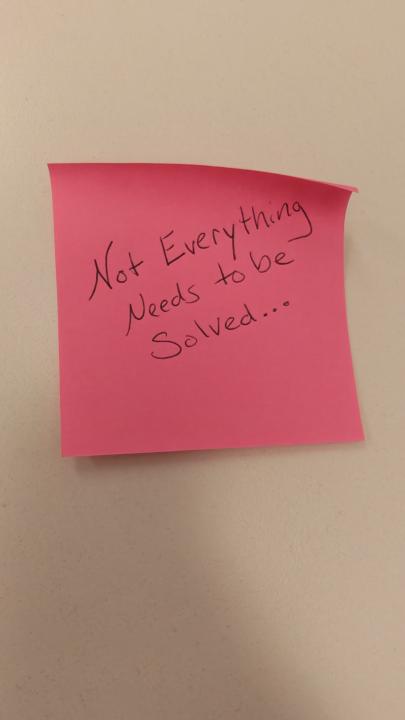
Sometimes, I need to remind myself that there's nothing to fix. There's just something that compassionately needs its own space...
4
0
Self-talk
Uh-uh... I don't wanna...
Nope! No Way! Not Ready! That wide-eyed, stiff and out-of-breath response to emotions... Welcome to the world of feeling. That resistance is the surface of an emotion and is a sign of something important. Sometimes, we think we can push our feelings down, but here's the kicker... those are feelings too. No matter what you do, you ARE feeling something. It may come out a bit different than the way most people talk about emotions, but that doesn't matter. What matters is that you are feeling something. What might your resistance be telling you?
Uh-uh... I don't wanna...
0 likes • Feb 9
@Sarah Molli Thank you for sharing. I'd like to add something to your comment that I think is extremely pertinent, and it comes from our upbringing. I don't just mean in our homes, but also at school and in society as well, we often hear in many different contexts how important it is to be tough. We are very often shown how valuable a person is if they don't make a fuss. We get shown through rather innocent means that other people have it worse. All of this contributes to resistance. Why? Because if we can shove it all down, then it somehow proves our worth. Does it though? I'm pretty sure all of us know at least one person who wore their suffering like a badge of honor, like a symbol of pride. But we often never put that into question. We often don't reproach the usefulness of this because of either the role this person had in our lives or because we were too young to think about it differently. If I think of those who showed me that stuffing my feelings down was a point of value, I sadly have to also admit that those same people were actually worse off for it. I'm not trying to throw shade on anyone, but I do think it's important to start exploring where we learned what we believe, why we believe it and whether or not is exemplary of the kind of life we want to lead. More importantly, even if a certain tool or approach worked for someone else in our lives, this does not mean that it should necessarily work for us. I like the idea that you mentioned about "fight or flight" and "waiting too long." I know in my life, this translates into being out of touch with my emotions, not being able to set up healthy boundaries and not knowing how to assert my own worth. As I learn better tools, this gets much healthier, but if I stayed with what I learned growing up, I'd still be struggling to manage my feelings and my relationships. Accessing what is actually occurring inside you, what it means, and what you need helps in crossing the resistance boundary to a place of expression and safety. However, I must admit that the journey is a rather messy one. "You can't make an omelet without cracking a few eggs..." well we can't get to emotional fluency without allowing ourselves to become a mess from time to time. If I don't ever really delve into it, how can I ever really process it?
0 likes • Feb 20
@Michele McLaurin that's a great start. It's also a hard one to start from, but it does add another level of emotions. Some of these emotions can seem out of place or even a bit exaggerated, so I'm going to talk about my experiences with resistance a bit, and then let me know what you think. Resistance to not want to feel or tell someone what I was feeling ended up being that I was scared. I was scared to tell someone how I was feeling because of how they might respond to me, how I might be treated, how it might affect them. My fear was really present, but that fear wasn't alone. I was sad too. I was sad that I couldn't tell someone. I was sad that the person I wanted to say it to wouldn't have valued my feelings or would have rejected them. So being afraid and sad in this context actually built in a sense of disappointment in myself (which I turned into shame) and then just loneliness. I couldn't function, so I suppressed and resisted feeling anything until like @Sarah Molli mentioned, it was too much, too late and then... explosion. And somehow, even though I know this wasn't safe either, in the moment, it somehow felt safer because I was the danger then. There was no safety, but then there was no safety for anyone and I guess instead of feeling any of these emotions, I rationalized that that was better than nothing. How about you?
1-10 of 14
Jeromy Hrabovecky
3
18points to level up
@jeromy-hrabovecky-1897
American expat psychologist living in Brussels, Belgium.

Active 12h ago
Joined Jan 9, 2026