Activity
Mon
Wed
Fri
Sun
Nov
Dec
Jan
Feb
Mar
Apr
May
Jun
Jul
Aug
Sep
Oct
What is this?
Less
More
57 contributions to ThisLocale

May 14 •
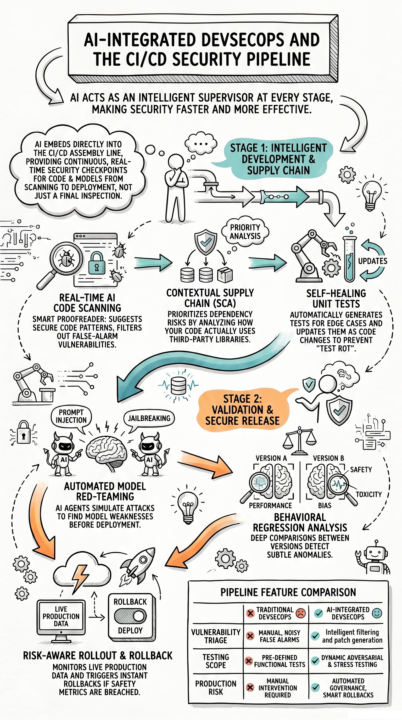
Foundations of AI & Cybersecurity - Lesson 60: Module/3.3.7 AI-Integrated DevSecOps - CI-CD Security Pipeline
Foundations of AI & Cybersecurity - Lesson 60: Module/3.3.7 AI-Integrated DevSecOps - CI-CD Security Pipeline Security can no longer be a checkpoint at the end of software development. It has to exist throughout the entire pipeline. In reality, modern applications and AI systems move too quickly for manual security reviews to keep pace. AI is now being embedded directly into DevSecOps workflows to continuously test, validate, monitor, and govern software before it reaches production. The challenge is no longer building software fast. It’s building secure software fast. Today’s module shows and explains this: AI-Integrated DevSecOps and the CI/CD Security Pipeline This matters because AI now enhances code scanning, software composition analysis, automated testing, regression analysis, model red-teaming, deployment governance, and automated rollback, creating a continuous security layer across the entire software and AI lifecycle. If you’re responsible for AI, security, project management, governance, or technology decisions, this is where software delivery evolves from static review cycles into intelligent, continuously verified release management. Because in modern development… security is no longer a final step, it is part of every commit, every model, and every deployment. — #AI #Cybersecurity #AIProjectManagement #AIGovernance #AISecurity #AICybersecurity
0
0
May 13 •
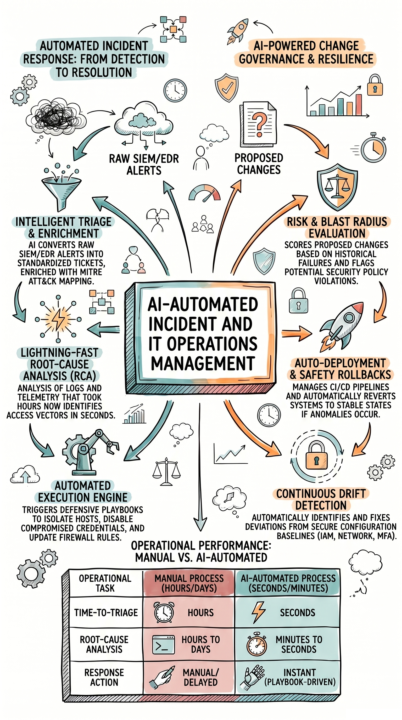
Foundations of AI & Cybersecurity - Lesson 56: Module/3.3.5 AI-Automated Incident & IT Operations Management
Foundations of AI & Cybersecurity - Lesson 56: Module/3.3.5 AI-Automated Incident & IT Operations Management Security operations were never designed for today’s speed and complexity. AI is changing that by turning operations into continuously executing systems. In reality, incident response and IT operations can no longer rely on slow, manual workflows when threats, changes, and configuration drift happen in real time across cloud, identity, endpoints, and AI systems. The challenge is no longer visibility alone. It’s operational execution at scale. Today’s lesson shows and explains this: AI-Automated Incident and IT Operations Management This matters because AI now automates ticket creation, triage, enrichment, root-cause analysis, remediation, rollback, drift detection, and governance workflows, reducing response times from hours to seconds while improving consistency and compliance. If you’re responsible for AI, security, project management, governance, or technology decisions, this is where AI becomes more than a support tool. It becomes the operational backbone of the enterprise. Because modern resilience is no longer built on manual response… It is built on intelligent automation. — #AI #Cybersecurity #AIProjectManagement #AIGovernance #AISecurity #AICybersecurity
0
0
May 12 •
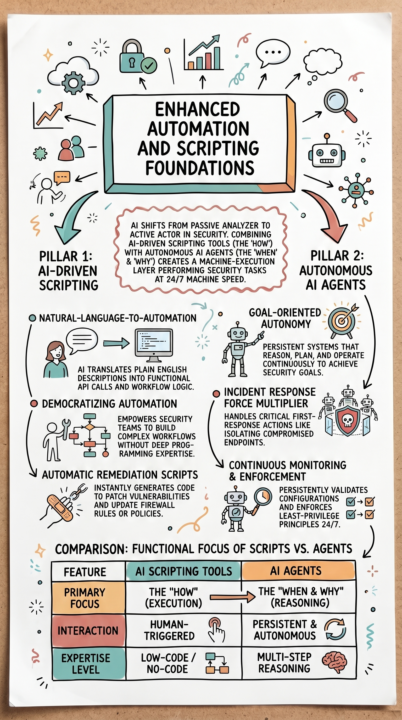
Foundations of AI & Cybersecurity - Lesson 54: Module/3.3.1 Enhanced Automation & Scripting Foundations
Foundations of AI & Cybersecurity - Lesson 54: Module/3.3.1 Enhanced Automation & Scripting Foundations AI is no longer just analyzing security problems. It is executing the response. In reality, the shift is from insight to action, where AI translates intent into automated workflows and continuously operates as the execution layer across security, IT, and governance. The gap is not awareness. It’s the ability to act at machine speed and with consistency. Today’s module shows and explains this: Enhanced Automation and Scripting Foundations This matters because AI-driven scripting and autonomous agents now handle everything from remediation and incident response to continuous monitoring, policy enforcement, and attack surface management, creating a 24/7 automation layer that reduces human error and accelerates outcomes. If you’re responsible for AI, security, project management, governance, or technology decisions, this is where AI becomes the operational backbone, not just the analytical layer. Because the future of security is not just knowing what to do… it’s executing it instantly and consistently. — #AI #Cybersecurity #AIProjectManagement #AIGovernance #AISecurity #AICybersecurity
0
0
May 11 •
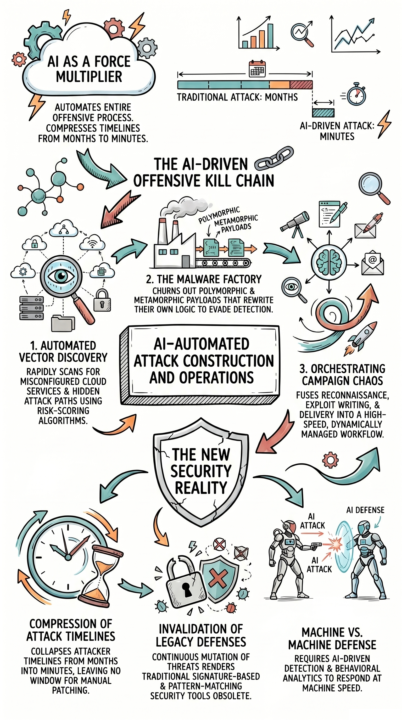
Foundations of AI & Cybersecurity - Lesson 52: Module/3.2.4 AI-Automated Attack Construction & Operations
Foundations of AI & Cybersecurity - Lesson 52: Module/3.2.4 AI-Automated Attack Construction & Operations Attacks no longer require deep expertise. They require the right automation. In reality, AI has transformed cyberattacks from isolated actions into fully orchestrated, end-to-end operations that can discover vulnerabilities, generate payloads, mutate malware, and execute campaigns with minimal human involvement. The gap is no longer tools. It’s the speed and scale at which attacks can now be constructed and deployed. Today’s lesson shows and explains this: AI-Automated Attack Construction and Operations This matters because AI can scan environments, prioritize weaknesses, generate customized exploits, produce endless malware variants, and coordinate multi-stage attacks that adapt in real time across the entire kill chain. If you’re responsible for AI, security, project management, governance, or technology decisions, this is where cybersecurity shifts from defending against threats to defending against systems that generate them. Because in this environment… attacks are no longer executed, they are manufactured. — #AI #Cybersecurity #AIProjectManagement #AIGovernance #AISecurity #AICybersecurity
0
0
May 8 •
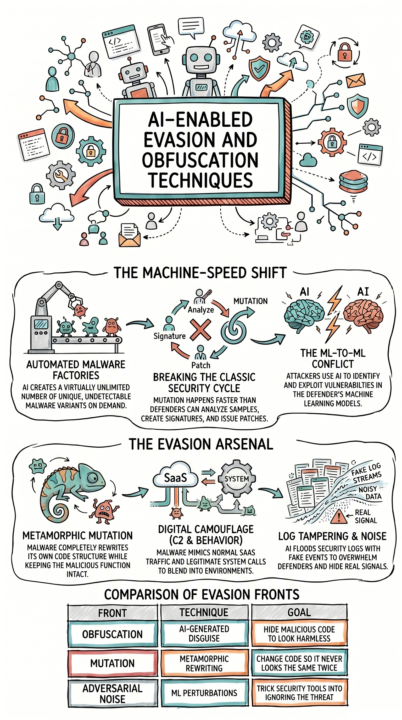
Foundations of AI & Cybersecurity - Lesson 51: Module/Chapter 3.2.3 AI-Enabled Evasion & Obfuscation Techniques
Foundations of AI & Cybersecurity - Lesson 51: Module/Chapter 3.2.3 AI-Enabled Evasion & Obfuscation Techniques Most defenses are built to detect known threats. The problem is threats no longer stay the same. In reality, AI has shifted malware from static code into adaptive systems that rewrite themselves, mimic normal behavior, and evolve faster than detection models can keep up. The gap isn’t a shortage of tools. It’s the inability of defenses to keep up with AI-driven speed and adaptation. Today’s lesson shows and explains this: AI-Enabled Evasion and Obfuscation Techniques This matters because polymorphic and metamorphic malware, adversarial inputs, behavioral evasion, and traffic obfuscation allow attackers to bypass signature-based detection, confuse machine learning defenses, and operate undetected across the entire attack lifecycle. If you’re responsible for AI, security, project management, governance, or technology decisions, this is where cybersecurity becomes an AI vs AI problem. Because in this environment…it’s not just about detecting threats, it’s about keeping up with how fast they change. — #AI #Cybersecurity #AIProjectManagement #AIGovernance #AISecurity #AICybersecurity
0
0
1-10 of 57

@james-dutcher-6548
Expertly using AI by incorporating Cybersecurity, Project Management, and Governance
Active 155d ago
Joined Jan 2, 2026
ENTJ
Endicott, NY 13760