Activity
Mon
Wed
Fri
Sun
Jun
Jul
Aug
Sep
Oct
Nov
Dec
Jan
Feb
Mar
Apr
What is this?
Less
More
Memberships
Healing After Harm with Dr Sam
73 members • $22/month
2 contributions to Healing After Harm with Dr Sam

3d •
Starting the Trauma Bond Worksheet: My Early Insights & a Question for the Community
I just started working through this new trauma‑bond worksheet and… wow. Even the first few prompts brought up things I didn’t realise my body had been holding onto. Mapping the nervous‑system responses has been especially eye‑opening. I’m noticing how quickly my body goes into “alert mode” even when nothing is actually wrong. The part about longing and withdrawal really landed for me too. Seeing it framed as a pattern rather than a personal flaw feels strangely relieving. It’s helping me understand myself with a lot more softness. I’m taking it slowly, and pausing when things feel tender. It’s already helping me make sense of why certain dynamics felt so powerful and why they were so hard to step out of. I do have a question for the community: When you first started recognising your own trauma‑bond patterns, what was the hardest part to sit with - the emotional pull, the nervous‑system activation, or the meaning your mind attached to it? Would love to hear how others navigated those early insights.

6d •
New in the Classroom: The Neuroplasticity Workbook — Rewire Your Mind
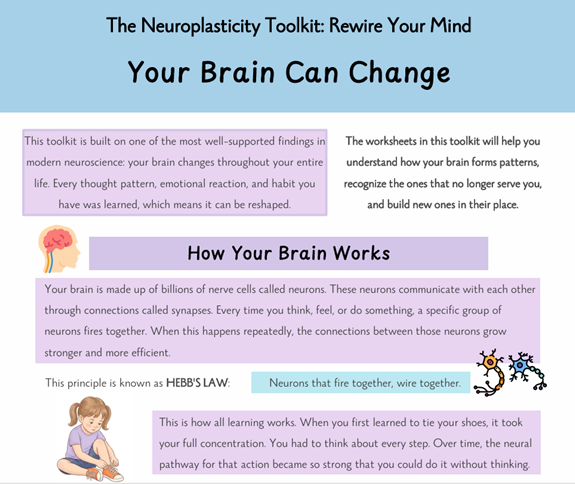
Hi everyone! I’ve just uploaded a powerful new resource to the Classroom - The Neuroplasticity Workbook: Rewire Your Mind, a neuroscience‑based workbook designed to help you understand your patterns and gently reshape them over time. This toolkit is built on one of the most important findings in modern brain science: your brain can change throughout your entire life. As the workbook explains, “Every thought pattern, emotional reaction, and habit you have was learned, which means it can be reshaped.” Inside, you’ll explore: - How your brain forms and strengthens patterns - Why certain emotional or behavioural loops repeat automatically - The five‑stage self‑reinforcing cycle that keeps old patterns alive - How to identify your “rewiring window” - the moment between body alarm and old story - How to use interoception (body signals) as early warning - Step‑by‑step worksheets to build new neural pathways - Why setbacks happen and how to recover without losing progress - A weekly rewiring tracker and a personal Rewiring Blueprint - 40 quick, practical strategies for interrupting old patterns and strengthening new ones One of my favourite lines from the workbook is: “A well‑worn path feels comfortable because it’s familiar, not because it’s better.” Such a grounding reminder that discomfort doesn’t mean you’re doing it wrong - it often means you’re doing something new. This toolkit is perfect for anyone wanting to understand their mind more deeply, interrupt old loops, and create real, sustainable change through small, consistent shifts. Feel free to share any insights, reflections, or “aha” moments as you move through it - your experiences often help someone else feel less alone in theirs.
1 like • 3d
Hi, I’ve just started working through this and it’s already bringing up some really interesting insights for me. I’m noticing patterns I didn’t realise were so automatic, especially around that “rewiring window” moment you talk about. I do have a question though - when you catch yourself in that window, how do you tell the difference between your old story kicking in and a genuine intuitive signal you should listen to?
1-2 of 2