Activity
Mon
Wed
Fri
Sun
Jul
Aug
Sep
Oct
Nov
Dec
Jan
Feb
Mar
Apr
May
Jun
What is this?
Less
More
Memberships
4 contributions to Bible Scholar

Oct '25 •
The Downward Spiral: How Iniquity Bends Trust, Breeds Self-Reliance, and Masquerades as Faith
“Many will say to Me on that day, ‘Lord, Lord, did we not prophesy in Your name, and in Your name cast out demons, and in Your name perform many miracles?’ Then I will declare to them, ‘I never knew you; depart from Me, you workers of iniquity.’” — Matthew 7:22–23 The most dangerous form of rebellion is not open defiance — it’s self-dependence dressed in devotion. Jesus’ warning in Matthew 7 exposes the heart that works for Him but not from Him. These are not atheists or skeptics; they are religious performers who mistake spiritual activity for spiritual intimacy. Their outward righteousness conceals an inward curvature — a bent heart. The Bible calls this condition iniquity (Hebrew: עָוֹן, avon). It means “crookedness,” “perversity,” or “bentness.” It is deeper than wrongdoing — it’s the distortion that produces wrongdoing. Iniquity is the inward deviation from God’s straightness (Psalm 5:5; Isaiah 53:6). By contrast, sin (chattat) literally means “to miss the mark,” while transgression (pesha) refers to the deliberate stepping over of a known line. Together, they describe the anatomy of rebellion: • Iniquity is the inward curve, • Transgression is the deliberate step, • Sin is the resulting fall. The story of humanity’s fall in Genesis 3 is the prototype for this pattern — a cycle that continues in every heart apart from the Spirit’s regeneration. ⸻ The Whisper That Bent the World “Did God really say…?” (Genesis 3:1) The serpent’s opening words are not a declaration, but a distortion. His target is not the intellect but the intimacy between humanity and God. This question plants suspicion where trust once thrived. In Hebrew thought, sin is not first a behavioral problem — it’s a relational fracture. The serpent’s tactic was not to make Eve hungry, but to make her hesitant about God’s goodness. That subtle shift — from trusting God’s heart to questioning His motive — is where iniquity begins. It is a warping of the yetzer ha-tov (the “good inclination”), the moral orientation God planted within humankind. Once this inward alignment bends, obedience becomes conditional, and the Word of God becomes optional.


0 likes • Dec '25
Awesome! 🙏🏾📖✝️ Thanking God for sending son Jesus Christ to die completely for our sins! 🙌🏽🙌🏽🙌🏽
Oct '25 •
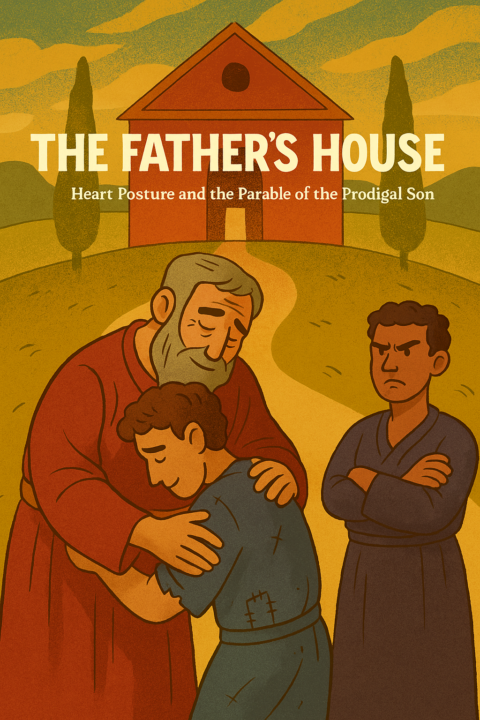
🏠 The Father’s House: Heart Posture and the Parable of the Prodigal Son
🕊️ Introduction: More Than a Story of Rebellion The Parable of the Prodigal Son in Luke 15:11–32 is often summarized as a tale of rebellion, repentance, and forgiveness. But beneath the surface lies something even more profound — an invitation to examine the condition of our hearts. Jesus tells a story not just of one son who runs away and returns, but of two sons whose responses to their father’s love reveal something crucial. One approaches in brokenness, the other retreats in bitterness. Both misunderstand the father’s heart, and in their own ways, both are distant from him. Through their contrasts, Jesus holds up a mirror to our own assumptions, asking us not simply where we are, but what kind of heart we carry toward the Father. ⸻ 🧳 The Younger Son: Humility Through Brokenness The younger son’s journey begins with a request that would have shocked Jesus’ audience. By asking for his inheritance early, he is effectively saying he wants the benefits of his father’s life without the relationship. He takes the inheritance, leaves home, and squanders everything on reckless living (Luke 15:13). Eventually, a famine hits, and he is left not only broke but spiritually and physically bankrupt. His return is marked by one critical phrase: “When he came to himself” (Luke 15:17). This awakening is more than regret. It is a realization that he cannot fix his condition, and that the only hope lies in returning to the one he left behind. He plans his speech carefully, not to manipulate, but because he genuinely feels unworthy: “I have sinned against heaven and before you. I am no longer worthy to be called your son. Treat me as one of your hired servants” (Luke 15:18–19). It is important to note that this is not legalism. He is not trying to earn his way back, but he assumes that forgiveness, if offered, would only come with humiliation. His heart is contrite, but his understanding of his father’s grace is incomplete. This posture mirrors Psalm 51:17, where David says, “A broken and contrite heart, O God, you will not despise.” What redeems the younger son is not that he performs his way home, but that he turns toward home at all. His humility opens the door for restoration, even before he can complete his confession.
0 likes • Nov '25
Amen, great illustration! Power story of how God see us no matter how broken or un-broken we are… 🙏🏾📖😇
Nov '25 •
🕊️ Written on Hearts: Grace, Obedience & the Law Fulfilled in Christ
A Lawless Grace or a Law-Filled Heart? We are living in an age where grace is often misunderstood—not as a power that transforms, but as a pass that excuses. Many believers today find themselves in a fog of theological tension: Are we under the law or not? Does obedience matter if we’re saved by grace? Is fruit expected, or is faith alone enough—regardless of our lives? This confusion often arises from conflating categories: mistaking legalism for holiness, or grace for passivity. But in Christ, grace is not the absence of discipline—it is the presence of a deeper, Spirit-born allegiance. The question is not whether the Law still applies in its old form, but whether its essence is now fulfilled in us through the indwelling Spirit. The law once revealed God’s standards; now grace empowers us to walk in them. The tension between law and grace was never meant to divide the believer—but to draw them into the fullness of Christ, where mercy and obedience kiss. ⸻ Fulfilled, Not Forgotten: The Law and the Spirit When Jesus declared, “Do not think I came to abolish the Law or the Prophets. I have not come to abolish them but to fulfill them” (Matthew 5:17), He clarified forever how the believer should approach the commands of God. He did not come to discard the law’s moral substance but to embody and complete it, thereby enabling us to walk in alignmentwith its true intent. The Law is holy—but it cannot make anyone holy. It can diagnose sin, but not remove it. It can expose our condition, but not renew our hearts. The Spirit, however, can. Through Christ’s fulfillment, the demands of the law are now written on our hearts (Jeremiah 31:33; Hebrews 10:16). Romans 8:4 states that the righteous requirements of the law are now “fulfilled in us, who walk not according to the flesh but according to the Spirit.” This is not “freedom from” holiness—it is “freedom for” holiness. Jesus transforms law from external obligation into internal orientation. He doesn’t erase the call to righteousness—He animates it with power.

0 likes • Nov '25
Amen 🙏🏾📖
Sep '25 •
📜 Once Sealed, Always His? Wrestling with the Seal of Salvation, Sin, and Assurance
The Seal and the Son: What Secures Us in Christ When we talk about salvation, we must begin with the source: God’s will, not human effort. Ephesians 1:13–14 makes it clear: “When you believed, you were marked in Him with a seal, the promised Holy Spirit, who is a deposit guaranteeing our inheritance…” The Spirit is not a symbolic stamp. He is a living Person who indwells the believer and secures the promise of redemption. Paul echoes this in Romans 8:38–39: nothing — not death, life, angels, demons, things present or to come — can separate us from the love of God in Christ. This isn’t conditional security. It’s covenant loyalty from a God who cannot lie (Titus 1:2). But this seal isn’t cheap. It was bought by blood, applied by faith, and results in transformation — not perfection, but direction. A sealed believer is not sinless, but submitted. Jesus told His disciples in John 10:28–29 that His sheep are held by the Father’s hand — and “no one can snatch them.” That includes Satan. That includes you. To be sealed is to be claimed — forever. Peter, the Betrayer Jesus Prayed For Luke 22:31–32 provides a window into divine intercession: “Simon, Simon, Satan has asked to sift all of you as wheat. But I have prayed for you, Simon, that your faith may not fail.” Jesus doesn’t pray for Peter’s sin to be avoided — He prays for his faith not to be extinguished. And Peter fails — miserably. Three denials. Cursing. Fear. He weeps bitterly, not because he lost salvation, but because he broke the heart of the One who called him. Yet Jesus restores him in John 21 — not with condemnation, but with commission. This is what the Spirit does. Romans 8:26–27 says the Spirit “intercedes for us with groanings too deep for words.” He is not waiting for your perfection — He is preserving your faith. You may stumble, but you are not forsaken (2 Corinthians 4:9). Peter’s story reminds us: security is not in performance, but in possession. Jesus prayed — and the Spirit sealed. Peter didn’t lose his salvation because the One who began the work was faithful to complete it (Philippians 1:6).

1 like • Nov '25
I really enjoyed this study!
1-4 of 4

Active 7h ago
Joined Nov 22, 2025