Activity
Mon
Wed
Fri
Sun
Jul
Aug
Sep
Oct
Nov
Dec
Jan
Feb
Mar
Apr
May
Jun
What is this?
Less
More
Owned by Natalee
A faith-centered sisterhood for women committed to spiritual discipline, accountability, and deeper alignment with God.
Memberships
The King’s Table
36 members • Free
Christian Wives & Girlfriends
69 members • Free
37 contributions to Kingdom University

7d •
Deliverance
It’s 1:28 am and I need to be sleep but unfortunately my mind tends to run at night especially when there is a lot on it. I need prayer. I am fighting a battle of alcohol addiction. I quit smoking cold turkey 3 years ago and it seems I have ran from one addiction to another. Not on purpose though. I suffer from Post partum PTSD & bipolar depression type 2 and take medication and counseling but somehow I am still struggling! I want to break this curse of mental illness and addiction in my family but I seem to be struggling like my father and also like my late mother did and as much as I love her I can’t afford to be like her in those ways ya know? Anyways, I manage a neurodivergent household. I am trying to set better examples for my kids as well as doing them for myself but I get lost in the sauce so quickly. My husband God bless his heart works from sun up to sundown two jobs Monday- Friday so I hate to say this but I feel like a single married woman. And it’s not his fault because he wants to be here and knows his place as a man of God and his family but this economy has once again found another way to keep the man out the home. We have no village. We are the village despite a few small friends we’ve made. We just want to jumpstart the change of our legacy aside from what we were handed down. A house of our own is one. We can’t rent where we are anymore after December 24, 2026. We are desperately working to try and finally buy a house for our big family despite not having thousands of dollars. If anything guys, I just ask for prayer in our finances, my husbands job ( that he may be able to work just one that provides for all our needs and allows schedule flexibility to be here for his family), prayer to help me get thru school, prayer for provision & stability, prayer for my role of what God wants me to do with my life & finding his purpose for my life, prayers to allow me to be able to bring some type of financial help to my family so my husband doesn’t have to carry the burden by himself, prayer for patience and discipline with potty training my autistic twins & my 1 year old daughter, prayers for supplies transportation, prayers for a peaceful mind because I’m tired of these voices in my head and running to alcohol to quiet them, prayers for obedience to what God wants us to do or to talk into our Devine assignment. I can’t type it all but just please pray for my family and I. Thank you 🙏🏾

1 like • 2d
I stand in agreement with this prayer concerning you. May the Lord do so and more on your behalf.
2d •
🎧 “Maintain” – A Prayer for the In-Between Places
Life be lifing 🙏🏻but lately, this song “Maintain” by Jonathan McReynolds has been ministering to me deeply and I thought to share. This song is not loud or dramatic, it’s honest. It doesn’t pretend as though everything is fine. It doesn’t rush you into “I’m already healed” language. Instead, it sits in a very real place: “God, I’m not falling apart completely, but I need you to help me hold it together.” And that hit me, because so much of life is lived in that middle space, the in-between. It shows where we are still functioning, still showing up, still believing, but internally we are asking God for strength to simply maintain. 🧠 What this song has been reminding me: Sometimes the deepest prayer is not “change everything right now,” but: Lord, help me maintain - Maintain my mind - Maintain my peace - Maintain my joy - Maintain my heart - Maintain my focus when life feels loud - Maintain my sanity It’s a prayer of stability, not just breakthrough. 📖 A Kingdom Truth This aligns so strongly with Proverbs 4:23 “Keep thy heart with all diligence; for out of it are the issues of life.” There is a kind of grace that God gives to us, he will not always to remove the pressure immediately, but he has the ability keep us steady under it. 🙏 Reflection Maybe today you don’t need a full reset. Maybe you just need grace to maintain. To stay grounded. To stay prayerful. To stay aligned. To stay present. And God promises to be our very "present" help, so he is always with us. Be Encouraged!
2
0

3d •
War Room Prayer Against Feeling Like I'm Not Enough
Father, Today I come against the lie that I am not enough. Not a good enough parent. Not a patient enough parent. Not a present enough parent. Not a strong enough parent. Lord, I confess that sometimes I measure myself by my mistakes. I replay the moments I lost my temper. The moments I missed it. The moments I should have listened more. The moments I should have corrected differently. And if I'm not careful, I start believing those moments define me. But today I reject that lie. I am not a perfect parent. But I am a parent who loves my children. I am a parent who is trying. I am a parent who keeps showing up. And Father, my qualification does not come from perfection. It comes from You. You entrusted these children to me. Knowing my weaknesses. Knowing my flaws. Knowing every area where I would need Your help. And You still chose me. So forgive me for questioning what You already decided. Forgive me for believing I have to be perfect to be effective. Forgive me for carrying guilt You never asked me to carry. Today I release the pressure. The pressure to have all the answers. The pressure to never make mistakes. The pressure to get everything right. Father, heal the places where comparison has stolen my confidence. Heal the places where shame has stolen my joy. Heal the places where fear has convinced me that I'm ruining my children. Because I am not raising them alone. You are helping me. You are guiding me. You are covering what I miss. You are redeeming what I get wrong. And You are working in my children even when I cannot see it. Lord, teach me to focus on progress instead of perfection. Help me celebrate growth instead of obsessing over mistakes. Help me parent from confidence instead of fear. I declare: I am not failing. I am learning. I am growing. I am being equipped. I am being refined. I am becoming the parent my children need. And where I am weak, God's grace is sufficient. My children do not need a perfect parent. They need a present parent. A praying parent.
3 likes • 2d
Thank you for this. Amen 🙏🏻
7d •
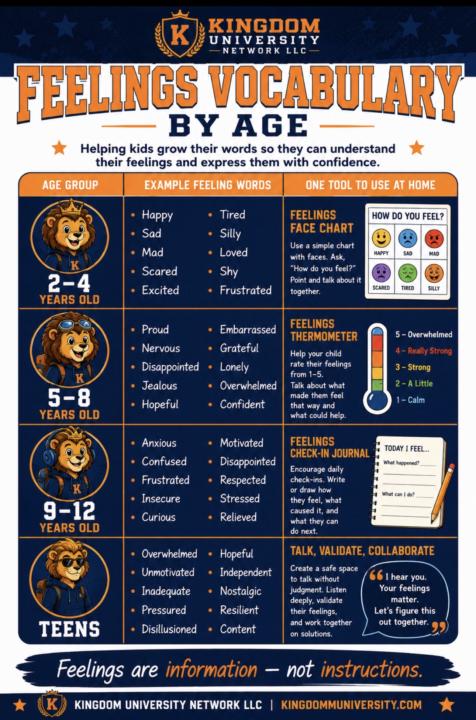
Teaching Your Child To Name What They Feel
You cannot regulate what you cannot identify. Most children and honestly most adults walk around with a constant undercurrent of feeling that they have never been given words for. So instead of saying 'I feel overwhelmed', they slam a door. Instead of saying 'I feel embarrassed', they shut down completely. Instead of saying 'I feel left out', they act out at school. Instead of saying 'I feel scared', they rage. The behavior is not the problem. The behavior is the communication. And the reason they are communicating with their behavior instead of their words is because nobody gave them the words. Today we fix that. THE FEELINGS VOCABULARY — BY AGE AGES 2–4 — Start Simple: Happy. Sad. Mad. Scared. Surprised. Silly. That is enough for this age. Do not overwhelm them. Just name it when you see it. 'You look mad right now. Is that what you're feeling?' Let them confirm or correct. 'It looks like you might be scared. That's okay. I'm right here.' The goal is to build the habit of NAMING before reacting. AGES 5–8 — Go Deeper: Add words like: frustrated, nervous, excited, embarrassed, left out, proud, disappointed, confused, overwhelmed, lonely. Play a feelings guessing game. Show them a face — real or in a book — and ask what feeling they see. When they act out ask: 'What happened right before you felt like doing that?' Teach them to trace the feeling back. AGES 9–12 — Get Specific: Now they can handle nuance. Introduce words like: anxious, humiliated, resentful, jealous, hopeful, insecure, grateful, conflicted. Ask bigger questions: 'What did that situation bring up for you?' 'What were you afraid was going to happen?' Help them see that most big reactions come from smaller feelings that were ignored too long. TEENS — Make It a Conversation: Stop asking 'how was your day.' Start asking 'what was the best moment and the hardest moment today?' Introduce the concept that one situation can produce multiple feelings at the same time. 'You can be excited AND nervous about the same thing. Both are real.'
3 likes • 6d
This is wonderful, thanks @Ashley Lunnon I will definitely be using this.
8d •
Can I Pray??
I don't know who needs this tonight, but I'm going to pray for you the same way I'm praying for myself.Father God, Lord, I'm not asking for the easy route. I know that's not how growth works.I know that's not how faith is built.I know that's not how You shape us. But Father, I am asking You to keep my mind. Don't let me lose my way in the middle of the battle. Don't let disappointment make me bitter.Don't let waiting make me wander.Don't let loneliness make me settle.Don't let exhaustion make me quit. Keep me. Your Word says You will keep in perfect peace those whose minds are stayed on You. So tonight, I'm seeking what You promised. You promised to lead me beside still waters. Lead me there. Because my mind has been Loud. My heart has been heavy.And my soul is tired. But You promised to restore my soul. And I believe You. Even when I don't see it yet. Even when the evidence hasn't shown up yet. Even when my circumstances are trying to tell a different story. I choose Your Word over what I see. I stand on Your Word for myself. I stand on Your Word for my children. I stand on Your Word for my finances. I declare that lack is not my portion. I declare provision over my household. I declare wisdom over every financial decision. I declare that my barns are full and my cup is running over. I thank You that You are teaching me how to steward what You place in my hands. And Father, when loneliness tries to visit me, remind me of Your promise. You said You would never leave me. You said You would never forsake me. So even when the room feels empty, I am not alone. Even when I feel unseen, I am not forgotten. Even when I feel weak, I am still carried by You. Tonight I lift my eyes to the hills. My help is not coming from people. My help is not coming from circumstances. My help is not coming from my own strength. My help comes from the Lord. The Maker of heaven and earth. The God who has never failed. The God who has never broken a promise. The God who is writing a story bigger than what I can currently see.
2 likes • 7d
Amen! Thank youuuu
1-10 of 37
@iamnatalee-pinnock
I help christian women grow in spiritual maturity, leadership, and Kingdom identity through Bible-based teachings, community support and resources.
Active 5h ago
Joined Mar 11, 2026
Jamaica 🇯🇲
Powered by