Activity
Mon
Wed
Fri
Sun
Jul
Aug
Sep
Oct
Nov
Dec
Jan
Feb
Mar
Apr
May
Jun
What is this?
Less
More
Owned by Heather
This space is for current and future microschool founders who want clarity, real systems, and honest support, not hype or gatekeeping.
Memberships
27 contributions to Microschool Founders Grove
Mar 1 •
Hello and let’s connect!
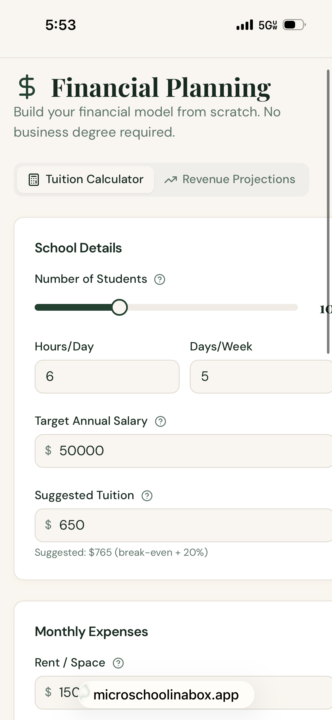
I’d love to support you all more and see you all sharing how you can help each other! On my end, I’m building an app called microschool in a box and I’m so excited to launch it soon! Think operations, ESA research, compliance, school HQ, resources, community, financial modeling, grant tracking, student tracking, parent communication and so much more! Taking apps for beta testers now! Book a call with me to see if it’s a good fit for you. https://calendly.com/consulting-with-heather/microschool-hybrid-homeschool-founder-consulting
0
0
Feb 23 •
Microlaunch App
Check out this state by state guide I put together on getting your program open! https://navigator.heatherminiello.com/
0 likes • Feb 24
It's been improved!
Feb 15 •
Happy Valentine’s Day, Founders!💕
Today feels like a good day to say this out loud… What you’re building matters more than you probably realize on the hard days. Every family who finds you, every child who finally feels seen, every moment a learner says “I get it now” or “I actually like learning” … that’s real impact. Starting and running a microschool takes courage. It takes heart. It takes showing up even when things are uncertain, messy, or slower than you hoped. I just want you to know I see the work you’re doing, and I’m really glad you’re here in this community. Drop one win from this week below, big or small. Let’s celebrate each other a little today.
1
0
Jan 26 •
Hello from Texas & Microschool Registration Question
Good morning from a snowy and frozen DFW ❄️ My name is Silviya, and I am so grateful to be part of this group. To be honest, it took me some courage to finally introduce myself. I am in the very beginning stages of opening a small microschool for Kindergarten, 1st, and 2nd grade. I recently created a Facebook business page and am planning to send a survey to local community groups to better understand interest and needs in the area. One of my biggest questions right now is this: Should I register the microschool as a private school so families can apply for Texas School Choice funding once it launches? If anyone has experience in this area, I would greatly appreciate any advice you could share. I would truly appreciate any insights or experiences you are willing to share - I am really thankful to learn from you all.
0 likes • Feb 7
Hi Silviya, and welcome. I’m sorry for the delay in responding on my end, I was in my last week of worldschooling in Portugal and tried to stay off my phone and be really present. I wanted to share this link because Texas has started publishing details about the Education Freedom Accounts program: https://educationfreedom.texas.gov/ From what’s currently published, families can use TEFA funds for private school tuition, tutoring, and other approved educational services, but schools do need to be approved providers. For private schools specifically, the requirements include accreditation, being in operation for at least two years, and administering a norm-referenced assessment, so that’s something to consider when deciding whether to register immediately or phase into that later. Another path some microschools are considering is starting as a provider or vendor first (offering classes or services families can pay for with ESA funds) while building toward private school status, since provider applications are opening more broadly as the program rolls out. You’re absolutely on the right track with surveying families first, that step helps clarify demand and pricing before committing to structure. Happy to share what I’ve seen founders do in other states if it would help.
Jan 22 •
What stage are you in?
Would love to know where everyone is at! Please comment your biggest “stuck” point too if you feel comfortable to share! We would love to help you get unstuck!
Poll
10 members have voted
0 likes • Feb 7
For those planning, what’s your biggest hurdle?
1-10 of 27
@heather-miniello-7196
A rooted space for microschool founders to grow sustainable schools, aligned leadership, and real community.
Active 23d ago
Joined Jan 15, 2026
ENFJ
Brooksville, FL