Activity
Mon
Wed
Fri
Sun
Sep
Oct
Nov
Dec
Jan
Feb
Mar
Apr
May
Jun
Jul
Aug
What is this?
Less
More
NEXT-GEN ROVERS
24 members • Free
15 contributions to NEXT-GEN ROVERS
Apr 4 •
ONE SKILL AS AN ROV PILOT
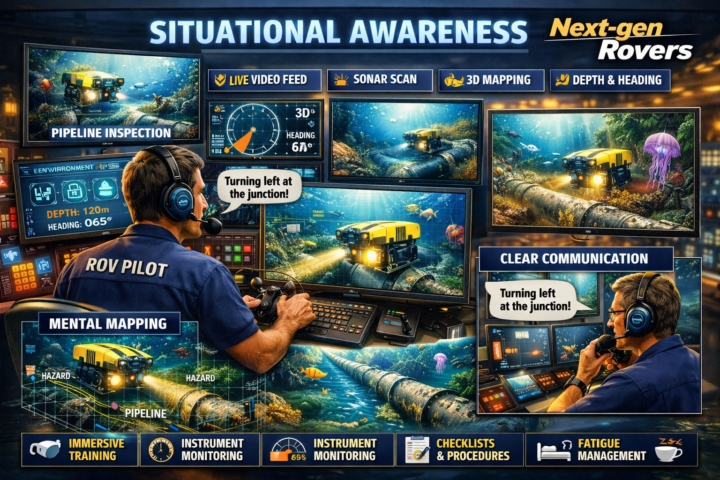
One of the most critical skills an ROV pilot must have is situational awareness. This goes far beyond simply watching the video feed it’s about maintaining a mental map of the ROV’s position, orientation, environment, and mission objectives at all times. WHY DOES SITUATIONAL AWARENESS MATTER? Situational awareness is so key because you are working in a complex environment, ROVs often operate in deep water, near subsea structures, pipelines, or wrecks where visibility is limited and hazards are numerous. So, a lapse in awareness can lead to collisions, entanglement, or damage to expensive equipment. This is why pilots who can anticipate movements and environmental changes complete tasks faster and with fewer errors. Another excellent positive aspect of situational awareness is that situational awareness allows smooth communication with topside engineers, scientists, or divers who rely on accurate updates. HOW TO IMPLEMENT SITUATIONAL AWARENESS To keep a great situational awareness a good habit of situational awareness must be maintained which include, Training and Simulation which include use advanced simulators to practice navigation in low-visibility and high-current conditions. Another point is Instrument familiarity which include learning to interpret sonar, depth sensors, and positioning systems alongside video feeds. Another point is Mental Mapping which involves continuously build a 3D mental model of the ROV’s environment. Also track orientation (yaw, pitch, roll) and relative position to structures or seabed features. Another point is communication discipline which involves to provide clear, concise updates to the surface team, also confirm instructions and repeat critical information to avoid misunderstandings. Another point is checklists and protocols, which include use a pre-dive and mid-dive checklists to ensure awareness of mission goals and environmental conditions. Also establish a pause point during operations to reassess surroundings and risks.
1
0
Mar 30 •
THE NEXT FRONTIER: "IS THE ROV INDUSTRY HEADED TOWARD A GOLDEN AGE OR OBSOLESCENCE?
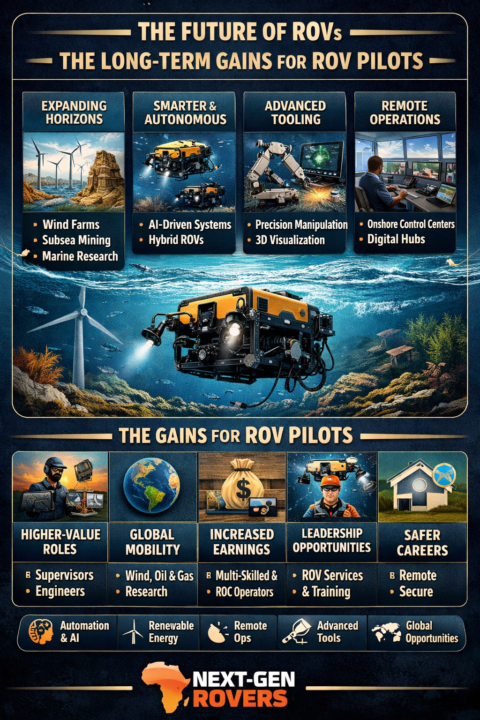
The ROV industry is entering a new era that is shaped by automation, deeper operations, renewable energy, and advanced sensors. Here are a few major shifts that are already defining the next decade. One of these shifts is the Expansion beyond oil and gas that has made the demand shift towards sectors like, Offshore wind farms Marine archaeology Aquaculture Subsea mining Environmental monitoring This diversification means more job opportunities and more growth in the ROV industry, creating more room for interested persons to join the ever-growing industry. Another major shift is the introduction of Smarter, Hybrid, and Autonomous ROVs, this recent introduction wasn’t made to replace pilots rather it was made to increase efficiency and shift pilots into higher‑skill supervisory roles. Another recent shift is the advancement of tooling and manipulators, with more precision, real-time 3D visualization, more dexterous manipulator and more. This pushes the job from manual flying to technical operations and mission management. WHAT ROV PILOTS STAND TO GAIN? Advancement wasn’t made to take humans out of their job roles, rather it was made to make life and operation easier. And the evolution of the industry actually increases the value of skilled pilots and create opportunity for growth, which could involve more understanding in: • ROV Supervision • Remote Operations Specialists • Subsea Robotics Engineers • Mission Planners • Digital Twin/Simulation Operators These roles command higher pay and greater responsibility.
1
0
Mar 30 •
WHO IS AN ROV PILOT?
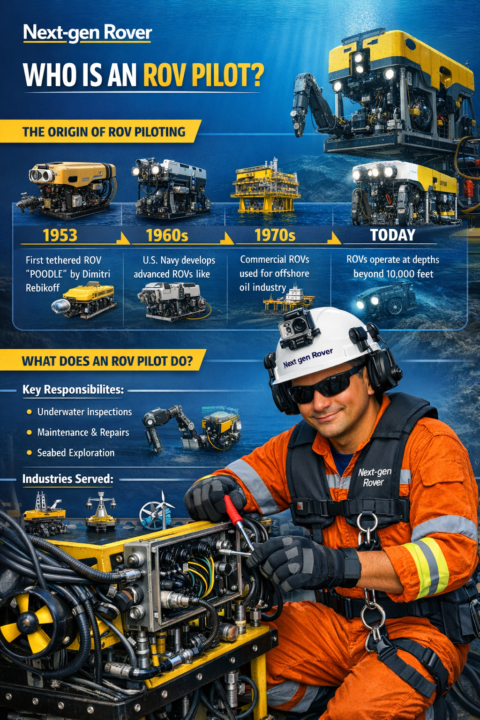
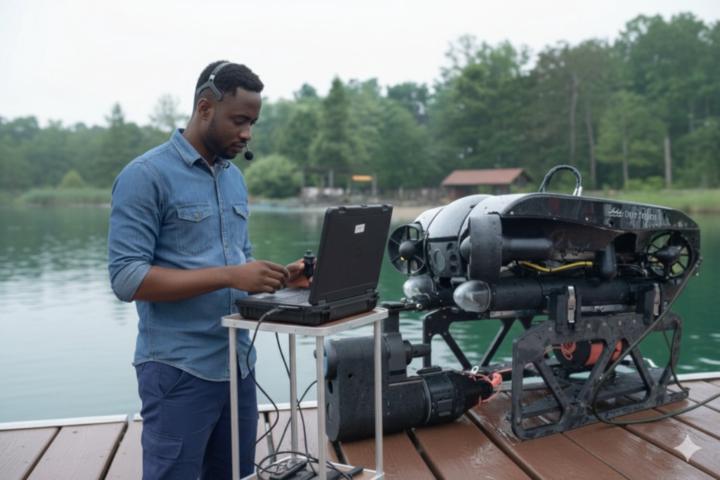
An ROV pilot is a highly skilled technician who remotely operates underwater robots (ROVs) for tasks ranging from deep-sea exploration to offshore oilfield maintenance. The role emerged in the 1960s, following early ROV development by the U.S. Navy and pioneers like Dimitri Rebikoff. An ROV pilot is responsible for controlling Remotely Operated Vehicles from a surface vessel or platform. These submersible robots are used in environments too deep or hazardous for human divers. WHAT ARE THEIR RESPONSIBILITIES? • Maneuvering ROVs using joysticks and control consoles • Operating cameras, sonar, and manipulator arms • Performing underwater inspections, repairs, and data collection • Collaborating with engineers, geologists, and marine archaeologists INDUSTRIES WHERE ROV PILOTS ARE NEEDED • Offshore oil and gas • Marine archaeology • Renewable energy (e.g., offshore wind farms) • Environmental monitoring • Military and search-and-rescue operations SKILLS REQUIRED TO BE AN ROV PILOT • Technical proficiency in hydraulics, electronics, and robotics • Strong spatial awareness and hand-eye coordination • Experience with subsea operations and marine safety protocols • Certifications in ROV operation, offshore survival, and PPE compliance
0
0
Mar 25 •
SONAR AS A PILOT
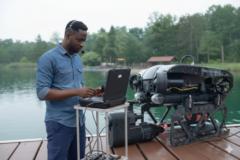
Working with sonar as an ROV pilot is all about turning sound into vision. Since ROVs often operate in deep or murky waters where cameras are limited, sonar becomes the pilot’s eyes. When is comes to navigation and awareness sonar helps you build a mental map of the environment. As a pilot, you interpret sonar returns to avoid obstacles, track seabed features, and maintain safe positioning around structures like pipelines or rigs. When it then gets to target identification, you use sonar to locate objects of interest wrecks, subsea equipment, or even marine life. The skill lies in distinguishing between real targets and false echoes caused by currents or debris. And when it involves precision operation maybe, when visibility is poor, sonar guides delicate tasks such as docking, tool deployment, or inspections. It allows you to maneuver with confidence even when cameras show nothing but darkness. And the key focus is team coordination; pilots often work closely with sonar operators or supervisors. Clear communication is key translating sonar data into actionable movements for the ROV. In short, mastering sonar as an ROV pilot is about blending technical skill with intuition: you’re not just steering a machine, you’re interpreting an invisible landscape.

0 likes • Mar 30
@Maria Barladeanu you are absolutely correct. thats the pilots secondary eye.
Mar 23 •
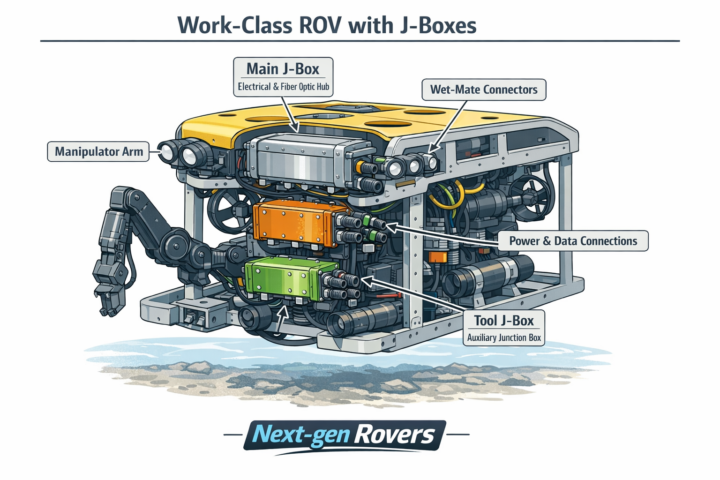
WHAT IS J-BOX’S?
On a work-class ROV, the J-box (junction box) is a critical subsea electrical and communication hub that allows multiple sensors, instruments, and tools to be connected and powered through wet-mateable connectors. It essentially acts as the distribution centre for signals and power, enabling the ROV to perform complex subsea operations efficiently. So, what is a J-box? A junction box is a subsea pressure housing mounted on the ROV frame that contains electrical and fiber-optic connections. It also provides a safe, watertight environment for routing power and data between the ROV’s main systems and external payloads. It is typically built with wet-mateable connectors so that tools and sensors can be plugged in or swapped underwater without bringing the ROV back to the surface. The functions of the J-box are direct and precise, it represents its purpose which include, Power Distribution, Signal Routing, Flexibility and Protection. Also, without a J-box, operators would face significant limitations in connecting and managing multiple subsea tools during Deepwater missions.
0
0
1-10 of 15
@harmony-dikeocha-3314
A Professional ROV Pilot Experience on Variety of ROV Vehicles Certified on Hydraulic, Electrical, and Mechanical with experience on the Job.
Active 89d ago
Joined Jan 8, 2026