Activity
Mon
Wed
Fri
Sun
Jul
Aug
Sep
Oct
Nov
Dec
Jan
Feb
Mar
Apr
May
Jun
What is this?
Less
More
Memberships
AI Automations by Jack
3.1k members • $87/month
⚡️ Lock in with Adam
1.5k members • Free
Claude Code Club
5.6k members • $9/month
Jack Vs. AI Workflows
7.2k members • Free
Clief Notes
38.8k members • Free
REVENUE REVOLUTION
10.3k members • Free
Lead Gen Secrets
23.6k members • Free
The RoboNuggets Network (free)
52.5k members • Free
PublicAI
4.3k members • Free
6 contributions to Clief Notes

3d •
I scoped $60K of work for under $20K (and 3 other mistakes)
Quick note for those of you in here just starting out and chasing your first clients: it ain't all roses and rainbows on the other side. Most of what gets posted in this community are the wins. Tonight you get one of the harder nights. Take it however you take it. Last night a client sent me a "you didn't deliver" email at 11pm. Hard read. The kind where your stomach drops and you start rereading every contract clause you signed three months ago. Spent the next 9 hours running an audit of every deliverable across two Fractional CMO contracts and a brand + website project. By 2am I had numbers on it. They paid us a bit under $20K combined. The audit showed I'd scoped out closer to $60K of work for that price. That number is the painful one. Four mistakes got me here. Maybe one of them is sitting in your shop too. ------------------------------------ 1. I ignored the human flags. ------------------------------------ (EDIT: My team encouraged me to remove details from this first point out of an extreme abundance of caution. I don't think I'm whitewashing this point, but if you disagree, letm know in the comments. PS. Update incoming.) Early on I saw how this person treated people who weren't in the room. How they talked about the people closest to them. How they described their own team when those folks couldn't hear it. That's a personality profile in a handful of data points. I noted it. Then I told myself "everyone has their style" and kept building. And I still think there are real human reasons they operate this way. Doesn't make it right. Just explains it, instead of a throwaway "they're a narcissist." I've dealt with actual narcissists. This person doesn't fit the box. Regardless, bad call. The way someone treats the people closest to them is the way they'll eventually treat you. The clock just hadn't started. ------------------------------------ 2. I handed my thinking to AI. ------------------------------------ I let AI draft proposals without putting the same eyes on them I would've put on a 2019 proposal. Three different proposals from the same business in the same month, with three different ways of describing the same deliverable. Vague names. Duplicate items. One column literally called "SEO Content Alignment" that nobody on my team could actually explain to a client.

🔥
1 like • 1d
That’s a tough post, but a really valuable one. “AI without my brain on top of it is the problem.” That’s such an important lesson.

2d •
File system access across devices
TL;DR How can I build my folder/file system so that it can be accessed and used across devices? I am always on the go, sometimes working from my phone, sometimes my laptop, sometimes my husbands laptop, sometimes my desktop. I'm looking for a central hub to store my files on that will sync across devices. Is anyone already doing this? I've been using Obsidian Sync with a backup to GitHub but since I want to be able to use Jake's ICM system with the third layer of files and artifacts, Obsidian doesn't seem to be working great for that. Is anyone building their whole knowledge base right on GitHub or using a different cloud solution?
🔥
0 likes • 1d
I’d probably keep it simple and use a normal cloud folder first. For ICM-style folders/artifacts, I’d want: Cloud drive = daily access and syncGitHub = backup/version history if needed

3d •
Your AI doesn't read. It finds the paragraph and bluffs the rest.
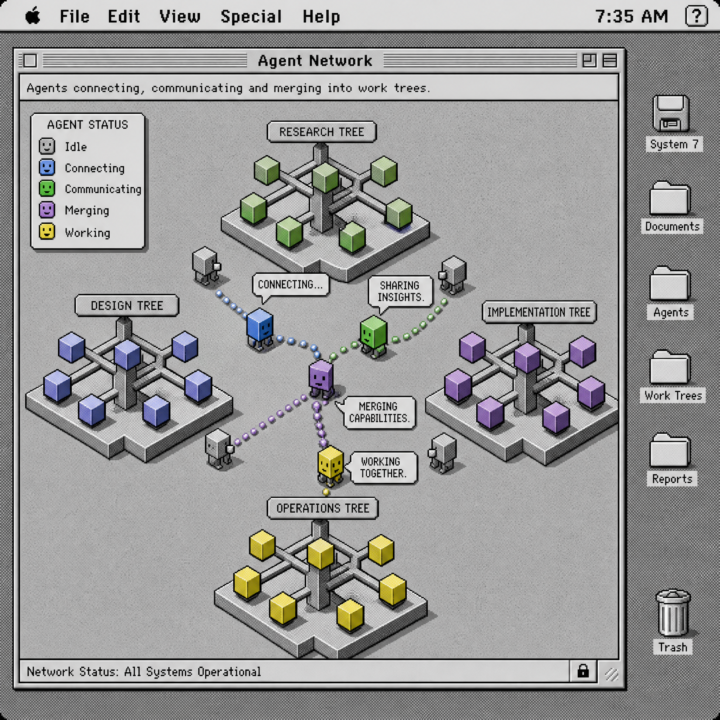
Search finds. It never reads. Every "AI that knows your stuff" runs the same trick: embed the material, grab the paragraph nearest your question, bluff the rest. For easy questions the bluff holds. For the ones that matter, it doesn't. So I'm building the missing layer. Call it a reading swarm. Instead of paying one expensive model to read a whole mountain, I cut the corpus into slices and send a swarm of cheap workers, one per slice. Each reads its slice properly and hands back a single finding. A deterministic harness merges them into one verdict. The expensive model only steps in if I ask it to sharpen the final call. Not shipped yet. Still smoke-testing the edges, and I read every verdict myself. But the law already holds: finding isn't comprehending, and comprehension doesn't need a bigger brain. It needs more cheap eyes, one slice each. What's the biggest pile of material you wish your AI actually read, not skimmed? //A<3
🔥
0 likes • 1d
This is great so helpful.. made a simple /read skill thank you!

May 16 •
Ship one populated example, document the structure, let others fork
The reflex of the solo practitioner who builds something useful is to keep the populated version private. The fear is obvious: if the populated version is the product, publishing it gives the product away. The reflex is wrong, and Realtor Copilot v2 (published on github) is what publishing it the other way looks like. The framework is MIT-licensed and on GitHub. Four populated case studies ship in the repo. Other practitioners are explicitly invited to add their own market as a new example. The first author owns the canonical examples. The template becomes the category standard. Every fork is inbound. What is in the repo: Four markets, three of them deliberately nothing alike. The point of shipping four is not coverage; it is proof that the architecture survives wildly different market structures. A diaspora-driven city, a monolingual U.S. suburb, a foreign-dominant resort, and a mainstream European capital. If the structure works across those four, the structure works. Why the case studies are the moat: A framework with no populated examples is a README. Anyone can fork a README. A framework with four populated examples is a working pattern, and the four examples are the part nobody can copy without redoing the work. The populated regions encode local market data, vendor list shape, regulation-surfacing language, and tone choices that a forker has to replicate from scratch for their own market. The first author of any of these case studies owns the canonical version. Every later fork in that geography is downstream of the canonical. The populated Khao Lak pack is more than a Khao Lak install; it is the reference template every other Thai-coastal-resort agent works from when they build their own. The fork invitation as a moat-builder: The README ends with an invitation: “Adding your market as a new example.” Other practitioners are encouraged to populate the framework for their own market and submit it back. Counterintuitive on the surface — invite competitors? In practice, every accepted contribution does three things at once.
🔥
1 like • 6d
Thanks @Gabriel Azoulay What a great post!
7d •
Fable made me start using Codex
Fable made me start using Codex. Well, actually Claude, Codex, Kimi and MiniMax M3 together. Not because Fable is weak. Because it is the first model strong enough to run the others properly. The shift: stop asking which model is best. Start matrixing every model to the task it performs best at. - Claude (Fable): the seat. Orchestration, judgement, context. - Codex: the coding powerhouse. - Kimi: long-video understanding. - MiniMax M3: the looping build system. For the first time the multi-model workflow is truly effortless. Local models included. It all just works. The model at the top is not doing the work. It is routing it. All of it, loops included, lands in an ARI-OS update. The intelligence is the routing, not any single model. Read the deep-dive: https://aris-space.com/documents/workflows/fable-made-me-start-using-codex [[EDIT]] I wanted to just clarify what I said of in this post by saying that the infrastructure I've built with Fable and the way that it can solve problems when you give it a tight brief and the thoroughness of the model allowed me to create a seamless system. But ultimately, every step of this has been tiered with the model we had. //A<3

🔥
0 likes • 6d
WOW - what a setup, i need to learn more about how your system works thanks for the share! Loving the deep dive and Ari,
1-6 of 6

Active 49m ago
Joined May 24, 2026
Hong Kong
Powered by