Activity
Mon
Wed
Fri
Sun
Jun
Jul
Aug
Sep
Oct
Nov
Dec
Jan
Feb
Mar
Apr
May
What is this?
Less
More
Memberships
DI
DXB Investors
490 members • Free
AGENCY U
1.6k members • Free
Lifestyle Founders Group™
12k members • Free
Altus Millionaire Club
356 members • $9/month
AI Money Lab
73.3k members • Free
Davie's Free Ecom Course
72.7k members • Free
SaaS Titans
1.5k members • Free
AI-Powered Business
360 members • Free
The Sweaty Startup Community
266 members • Free
2 contributions to AI Money Lab

Jan 27 •
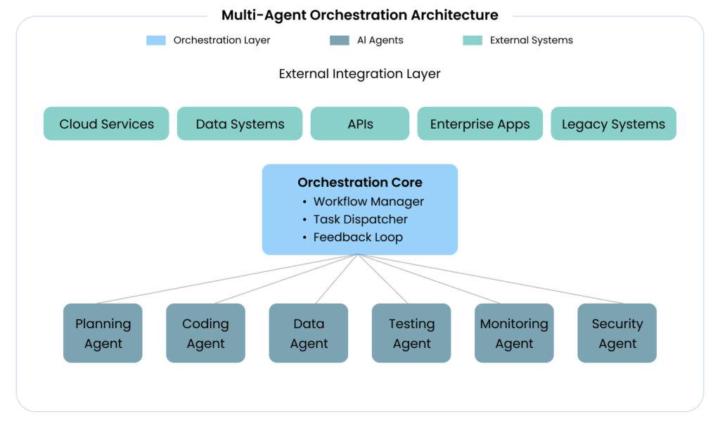
Best Multi-Agent Orchestration Platforms for Enterprise AI Workflows
The ecosystem of enterprise AI is witnessing a massive transformation. Traditional AI workflows, once limited to single-model applications, are evolving into sophisticated multi-agent systems that coordinate specialized AI agents to automate complex business processes. Multi-agent orchestration platforms are revolutionizing how enterprises approach AI implementation, enabling 40–60% efficiency improvements through context-aware, collaborative AI automation. Enterprise organizations are discovering that the future of AI lies not in isolated models, but in orchestrated teams of specialized agents working in concert. These platforms coordinate multiple AI agents—each with distinct capabilities—to solve problems that no single agent could tackle alone. From software development and DevOps automation to customer service and financial operations, multi-agent orchestration is reshaping what's possible with enterprise AI. Key Takeaways - Multi-agent orchestration platforms enable enterprises to achieve 40–60% efficiency improvements through coordinated AI automation of complex business processes. - Leading platforms like Microsoft AutoGen, IBM watsonx Orchestrate, Kubiya AI, SuperAGI, Kore.ai, Nected, OpenAI Operator, LangGraph, and CrewAI each serve distinct enterprise needs and use cases. - Platform selection should align with organizational priorities—whether that's Microsoft integration, regulatory compliance, DevOps automation, conversational AI, or low-code accessibility. - Successful implementation requires structured planning, robust governance frameworks, continuous performance monitoring, and alignment with existing enterprise architecture. - Multi-agent systems represent a paradigm shift from single-model AI to collaborative intelligence, transforming enterprise automation and enabling human-AI collaboration at scale. Understanding Multi-Agent Orchestration Multi-agent orchestration refers to the systematic coordination of multiple AI agents, each with specialized capabilities, working together to accomplish complex business objectives. Unlike traditional single-agent systems that operate in isolation, orchestration platforms enable agents to communicate, share context, delegate tasks, and collaborate towards common goals—much like how different departments in an enterprise work together to achieve organizational objectives.
1
0
Jan 22 •
Excited to join this community.
Hi everyone. I’m an AI Full-Stack Developer specializing in building scalable, intelligent applications powered by modern AI technologies. I’ve worked across the full product lifecycle — from system architecture and backend development to frontend interfaces and AI-driven automation. I’m currently looking for new opportunities where I can contribute my expertise in: - AI integration & LLM-powered applications - Full-stack web & mobile development - Automation, agents, workflows, and system design - MVP development and rapid prototyping I’m also interested in collaborating. If you’re working on something exciting in AI, SaaS, or automation, I’d be happy to connect and explore how we might work together.
1-2 of 2

@george-fox-3014
I build systems that learn, automate, and occasionally surprise me.
Active 83d ago
Joined Jan 22, 2026
Powered by