Activity
Mon
Wed
Fri
Sun
Aug
Sep
Oct
Nov
Dec
Jan
Feb
Mar
Apr
May
Jun
What is this?
Less
More
Memberships
Chase AI Community
70.6k members • Free
AI Automation Vault
19.6k members • Free
AI Automation Society
419k members • Free
AI Automation Agency Hub
328k members • Free
79 contributions to AI Automation Society

🔥
3d •
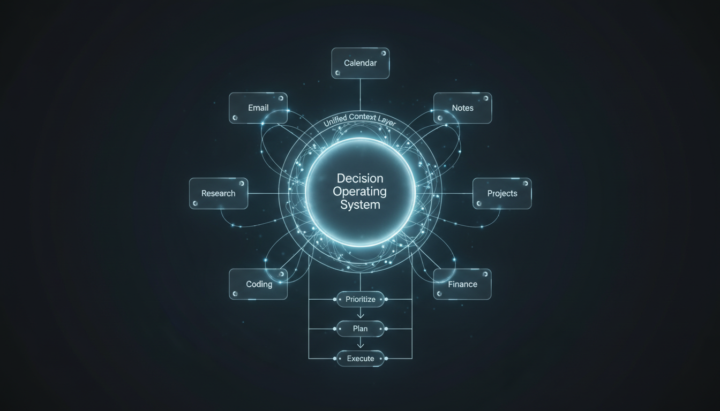
What If We've Been Building the Wrong Layer of AI?
I've been thinking about where AI is heading. Most of us are building AI assistants. They write emails. 🔍 Research topics. 💻 Generate code. 📅 Schedule meetings. They execute tasks well. But I wonder if the next evolution isn't a smarter assistant... It's a Decision Operating System. The DIFFERENCE? An assistant answers:🔷 "What do you want me to do?" A Decision Operating System asks:🔷 "Given everything I know, what's the highest-value action right now?" That requires a very different architecture. Instead of optimizing individual tasks, it continuously orchestrates context across your: 📧 Email 📅 Calendar 📝 Notes 📚 Research 🚀 Projects 🎯 Long-term goals Not as separate tools... But as one coordinated decision layer. At that point, the AI isn't just executing work. It's helping prioritize attention, reduce decision fatigue, and surface what matters most. Maybe the next competitive advantage won't come from building assistants that can do more... Maybe it'll come from designing systems that decide better. Curious how others see it:🔷 WHERE DO YOU THINK AN AI-ASSISTANT ENDS... AND A DECISION OPERATING SYSTEM BEGINS?

1 like • 2d
People need help with tasks. Give away the easy things and buy back your time for harder things requiring emotional quotient intelligence. HOWEVER. a decision support system requires a bona fide method from requirements development to solutions analysis, paired with risk/issue/opportunity (RIO) management. It's a heavy lift for the typical person. My advice? Deep research decision support systems and processes, locate a skill or two, then experiment. AI can't learn it for you...no other human can learn it for you either.
1 like • 2d
@Nigel Vargas well said!

2d •
New pc
Hey guys, I’ve finally got a new PC, any tips on setting it up to not lose my work from my MacBook? Appreciate the help and tips ❤️🥰
1 like • 2d
Keep it simple. Back up to the cloud (database or git), local & secure storage device, don't f' with automation. People get carried away trying to AI the shit out of what's not needed.

3d •
Multiagent Systems
Hi everyone, I'm trying to understand the best way to set up multi-agent systems and would love to hear how you do it. Mainly on structure and orchestration, I'm torn between two models: 1. One main agent that directly controls subagents, so a single layer. 2. One main agent that coordinates several full agents in their own sessions, which in turn have their own subagents, so a nested setup. What do you use in practice, and when is each one better? And how do you handle the orchestration itself (handing off tasks, sharing context, collecting results)? On tooling: do you keep everything in Claude (Claude Code, Agent SDK), or bring in external orchestrators? I often hear n8n, LangGraph, CrewAI and Claude Flow, but I'm not sure what people actually use and for what. Thanks for any tips!
1 like • 3d
Option 2 is overkill. No need for a "middleman" LLM. Option 1 is ideal because it's one "architect" (Greek for chief builder" and many specialists (subagents as subject matter experts). I'm using VS Code for tooling with Cline as my CLI and model manager. I'm thinking about Hermes next because it learns and grows unlike all others...Claude is Gucci, so I'm looking up free models now that are "good enough" like Llama LLMs or Mistral.
4d •
Fast beats Fancy
"Our new AI model is 10% smarter!" Small business owner: "Cool. Can it answer my customers before they leave my website?" 🤔 That is exactly why I've been paying more attention to Groq lately. Their custom LPU (Language Processing Unit) architecture isn't trying to build the biggest model. It's trying to deliver responses ridiculously fast, and they even offer a free tier so you can prototype without pulling out a credit card. ⚡ Fast inference means happier users, quicker iteration, and lower costs while you're validating an idea. Insight: Businesses don't win because they use the smartest AI. They win because customers don't have to wait. The faster you can test, learn, and ship, the faster you discover what actually creates value. Business lesson: Competitive advantage isn't always a better model. Sometimes it's simply removing friction between a customer asking a question and getting an answer. Source Groq. (2026). GroqCloud. https://groq.com/groqcloud
1
0
5d •
AI News & Business Insight 20260701
The AI race is getting smarter. Your business should get pickier. 💰 AI company: "Our newest model is almost as powerful as our flagship, at a lower cost." Small business owner: "Now we're talking." 🤝 💡 Insight: Today's release of Claude Sonnet 5 highlights a shift in the AI market. Vendors are no longer competing only on capability, they're competing on value. Businesses buy outcomes, not benchmark scores. 📊 Business lesson: The question isn't, "What's the smartest model?" It's, "What's the cheapest model that consistently solves my problem?" 📈 Competitive advantage comes from cost per completed outcome, not model prestige. Source Anthropic. (2026, July 1). Introducing Claude Sonnet 5. https://www.anthropic.com/news/claude-sonnet-5
2
0
1-10 of 79

@frank-jurado-5629
enginerd at work, 🏋🏼 for funsies, here to operationalize AI 🫡
Smash that 👍🏼 and Follow!
Active 6h ago
Joined May 16, 2026
ENFJ
Virginia
Powered by