Activity
Mon
Wed
Fri
Sun
Nov
Dec
Jan
Feb
Mar
Apr
May
Jun
Jul
Aug
Sep
Oct
What is this?
Less
More
Dopamine Digital
9.7k
Free
AI Income Maxxing
2.7k
Free
Automatable Free
25.9k
Free
AI Scaling
47
Free
HYROS Ads Forum
5.7k
Free
Space Entrepreneurs
816
Free
Elite Capital Raiser
1.5k
Free
Accelerator University
10k
Free
3 contributions to AI Scaling

Feb 4 •
You Must Master Culture & Strategy to Run Your Quests
You can split the nature of work between two areas. Strategy and Culture. Why is this important? Because it helps you build working systems if you understand how business systems work. Strategy is the "what do we do and what to do next" and Culture is the how we behave while working. Strategy is using the axe (the skill) and culture is how to carry the axe right, how we train ourselves using the axe, and how NOT to act. Culture is more important than strategy. You might have heard "Culture eats strategy for lunch". So let me break it down using some hormozi vids. Strategy is "how do we prioritize and take action among unlimited things we can do". Its saying "among all the problems of the business, we have one constraint that is limiting the business the most". There can be 10000 tasks and ideas but there is a limit of capacity and even then only one task being done at a time per person. Culture is the "Culture are the rules spoken and unspoken that govern the rules of an organization". THis can be distilled into value statements like "Run Your Quests" or "Speed is King" that can tell a story of what a company is a bout needs its team to perform to run the organization at peak performance. For us, a person needs skills to do both, but its an entirely different type of skillset. Soft skills, like being attentive to calendar events, completing tasks or obligations, breaking small problems into solutions, and more or less staying attentive, organized and tracking your work as you go can be chunked up to "run your quests"... which chunk up to an entire company-wide organizational model that runs everything. Having the specific technical skills to "get clients" fits within these things, so another cultural value can be added to "master your own strategy", but that too also gets chunked up to "Run Your QUESTS". So many things ladder up to this to the point where we hire and fire based on how people can well... "RUN THEIR QUESTS". Its Culture that we as operators are setting up and maintaining and curating with the CEO that usually don't think about culture as an entire department. The business is splitup into those two halves, the frontend customer journey (Revenue model) and the backend shared capacity that we want to up LIFT. This is the culture side, the shared services of work and tasks we do to not just get people in and doing stuff, but to get people to be at their peak performance.

1 like • Feb 16
Love this break down
Feb 9 •
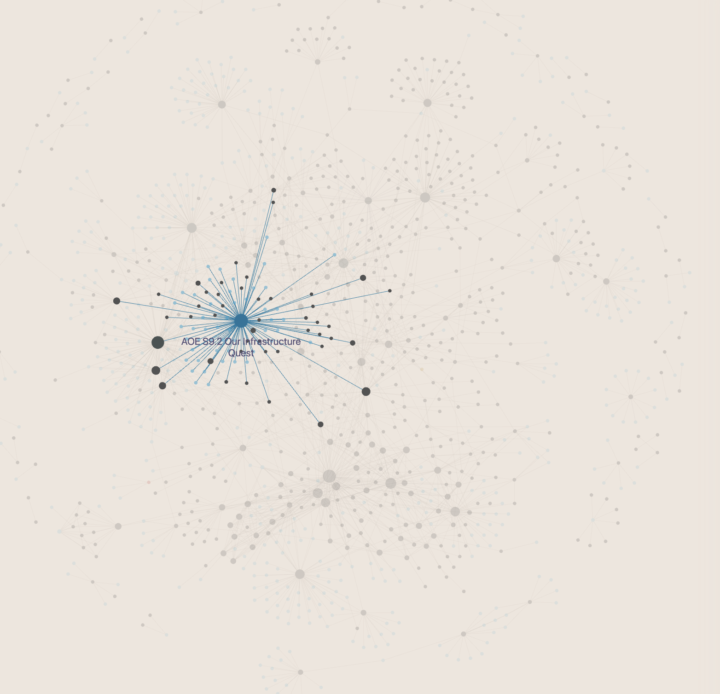
How I use Obsidian as a Dashboard to scale your "thinking"
Here are all of my notes from just the last few months of applying the QUESTS way to think. The big nodes are the specific areas or quests of thinking... and they may have a specific quests under them. Whenever I have an idea, I jot down an idea, or journal, or keep it in a note, and if its worth making its own unique note, I link each idea up to one higher order note. E.g. a note about sales would maybe link under a sales quest note, or could go directly in a "sales script" note which is linked up to. You feel lost, its fine. The goal is not to know where everything is, but that to capture ideas you need to make it easy (lazy af even) to add notes and link. Now If I needed to find that idea I can go into my sales quest note (duh) and find all notes that link to it. If its not there, it might be deeper. I'd go from Sales Quest (which is split best the 5 QUEST categories). If its a note that is about a specific engine or stage, I might link to there. So under Sales Quest -> Sales Engine -> Sales Closing Script. Or maybe it would be under Quest/Support (as it talks about a template). The idea is it can be found, and you should link to it in the way that you think. And if you can't find it, and you return back to that note out of necessity, you can simply update the link or simply add a (Related link) so you can have multiple links point out from it so you're more likely to return to it. Whenever you write a lot, any proper nouns, statements, main ideas get their own note, and link to eachother. This is the Atlas part of the Obsidian, or the timeless concepts. This is where I Talk about [[My Frameworks]] and other things. I talk about how concepts relate or are similar or help or influence by others. Ideas get close, contrast, collide or cluster together to form new ones. Over time, this rule starts to centralize (bigger dots have bigger link gravity) where the biggest notes are the main hubs of where you think, act, and reflect, and gather ideas.
0 likes • Feb 16
I will love to add this to my business
Feb 3 •
Recognizing Mukhtar & Dom (100 unique visits /week)
Public giving props to @Mukhtar Dalhatu for inviting members, and taking over the outreach from @Domenico de Pinto . We hit 100 unique visits this week and on track to hit 100 visits a day, and we'll hit 100 joins a day very soon. I see a lot of new faces here. I see a ton of new bookings come in from his outreach. We have 3 other DM outreachers that see the vision too that offered to help trained in to help scale, to earn money working alongside us, and building this out. So thanks -- I SEE YOU. Keep it going :).

1 like • Feb 4
im here from youtube
1-3 of 3
