Activity
Mon
Wed
Fri
Sun
Oct
Nov
Dec
Jan
Feb
Mar
Apr
May
Jun
Jul
Aug
Sep
What is this?
Less
More
Small Daily Habits
59 members • $9/month
Grow With Evelyn
3.5k members • $29/month
Sage Grayson's LEAP
1.4k members • Free
Connected Through Play
311 members • Free
Weight Loss After 40
500 members • Free
🧬Age Well with Dr. G and Amy
119 members • $49/month
Stop Starting Over Women 50+
111 members • Free
UW
Unshakeable Woman
11 members • Free
Business Synergy Sisterhood
5k members • Free
31 contributions to Connected Through Play

🔥
8d •
First Saturday Share
We have some amazingly talented and creative folks in this community. On the first Saturday of each month, I invite you to share your business. This could be a Skool community, an Etsy shop, a book you’ve written, an app you built, etc. Here are the rules: 1. You can only post in the comments of this thread, this makes it easy for members to find you. 2. If you do share, don’t just drop a link and ghost. Tell us a little about your product or service. Ideally, it’s family friendly. 3. Reply to one or two posts that genuinely interest you. While you may be here for ideas, getting to know folks is also a benefit. 4. Have fun.


2 likes • 6d
So sweet of you @Mary Nunaley. 🩷 I'm pausing my Skool group for a bit, but parents of strong-willed kids who can use some support can still find me at www.flippedparenting.com. And for those parents who are losing their 💩 a little more than they'd like 😅, I highly recommend checking out my Calm Parenting Reset. It will help you calm things down and feel more confident and parenting more intentionally.
2 likes • 6d
@Mary Nunaley You are the best. Seriously. 🩷
30d •
When quality time sounds great... but the reality is different.
Play and connection are so important, they're the foundation of so many beautiful family memories. But for so many families, "quality time" is anything but.😫 👉🏼 Maybe your kid pushes back the second you suggest doing something together. 👉🏼 Maybe they say yes, then flip out five minutes in. 👉🏼 Or maybe they flat-out refuse to spend time with you. 👉🏼 Maybe what is supposed to be "fun" family time leaves everyone drained and miserable. 👉🏼 Maybe you've stopped suggesting things altogether because you're tired of the drama that follows. If you relate to any of these, believe me, you are NOT alone. Promise. Hi!! I'm Janell, a Certified Parent Coach. I help parents of strong-willed, emotionally intense kids find their way back to connection and cooperation, without the yelling or power struggles. On Thursday, August 20 at 8 a.m. CDT, I'm sitting down with @Mary Nunaley during the Unplug and Play Summit to discuss "When Connection Time Meets Resistance." We'll chat about some of the reasons kids push back during connection time, and how to start creating the moments you're actually hoping for. 🩵 ⬇️ I'd love to hear, what's your biggest challenge when it comes to play or quality time with your kid?

2 likes • 28d
@Cynthia Rodriguez Wonderful! Definitely keep us posted. 😊
3 likes • 28d
@Dan Mowinski 3 is tough!! 🤪 But fact that they enjoy different things is also an opportunity. Instead of focusing on one time for everyone (where they are all competing for attention), do one thing a week independently with each child. It doesn’t have to be long or complicated. Sort of like what I suggested to Cynthia in this thread- you can create little separate traditions with each of them. Maybe your 8 year old enjoys a specific type of book and maybe you read a few pages together every night. Maybe one of your four year olds loves dogs and you do a Sunday park stroll to go look at the dogs walking by Maybe the other loves food and you do a weekly grocery trip to pick out one new item to try that week. Little, quality moments go a long way. And gives each child a moment to have your undivided attention and be recognized for makes them unique. 😊
🔥
Jun 29 •
🌡️ It’s Too Hot to Go Outside. Let’s Play Anyway.
If you’ve got kids climbing the walls this week because it’s just too hot, this one’s for you and for my friends down under, where it’s a wee bit cold, join the fun starting with Day 2 I’m dropping a brand new 5-day activity series called Heatwave Hideout one indoor play idea per day, no screens, no oven, no backyard required. I’ll return to build lab next week. Each activity uses stuff you already have at home (cardboard, ice cubes, paper, tape that’s basically it), and every single one comes with variations so it works whether you’ve got a 4-year-old, a 10-year-old, a teenager, or all three at the same time. Here’s what’s coming: 🧊 Day 1: The Melting Mission — Science-y, hands-on, and surprisingly competitive 📦 Day 2: The Box City Build — One box. Infinite worlds. 🗺️ Day 3: The Indoor Treasure Map — No words allowed 🎭 Day 4: The Freeze Frame Story — Slow motion improv for the whole family 🏆 Day 5: The Heatwave Hideout Challenge — The kids run this one I’ll post one each day. Save this post so you can find them easily, or follow along in the Random Ideas classroom. Drop a 🌡️ in the comments if you’re in and let me know how old your kids are so I can cheer you on with the right variations!

1 like • Jun 30
I’m in Las Vegas for the day and it’s HOT. Love that you put this together!
🔥
Jun 20 •
Good morning, Unpluggers!
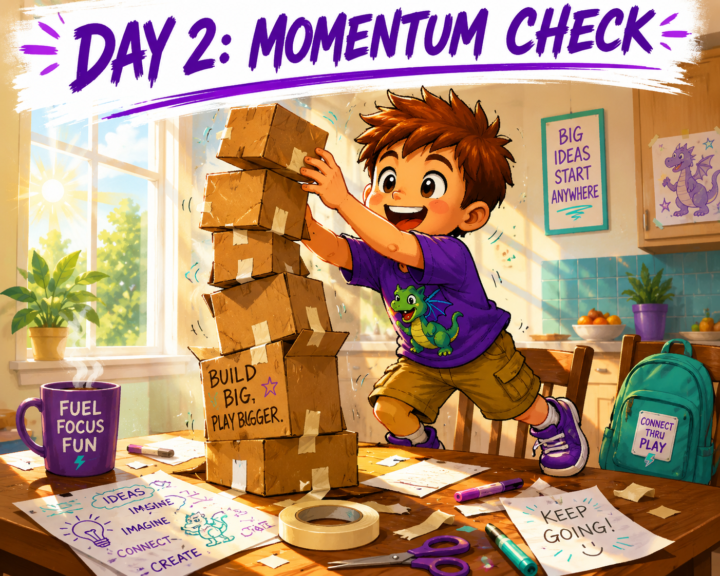
Day 2 starting line. How's everyone feeling? If you tried something yesterday and it went sideways, remember that's not a loss, that's a Beautiful Failure bonus waiting to be claimed. Document the wreckage and post it. If you haven't started yet, no stress. Today is a great day to knock out something quick. The Floor is Lava and The Kid Has Left the Building are both fast, low-lift, and ridiculously fun for the under-8 crowd. Feeling ambitious today? Trash to Treasure and the Free Little Library are bigger builds that pair well with a free afternoon. Two days down, two to go. Let's see what Day 2 brings. Drop your progress below, even a half-finished tower counts as momentum.
2 likes • Jun 20
I just shared your group with a friend who desperately needs screen free activities for her 2nd grader this summer. I told her she must check this out. 😀
🔥
Jun 19 •
The List
Here it is! The Grand Unplugged list. Over the next four days, set aside some time to complete 1, 2, 5, or however many you like. We want to see the “fails” and the wins. No one to “play” with? That’s okay. Solo participation is also welcome. The goal is to have fun. As you complete the tasks, post them here. If you have questions, ask but know each item is open to your interpretation.

2 likes • Jun 19
Mary - this is brilliant. Literally. Soooo good. You need to write a book with play ideas. So damn good.
1 like • Jun 20
@Mary Nunaley it’s seriously so good.
1-10 of 31

@janell-bitton-8150
Parent Coach helping parents of strong-willed, intense kids be confident in how they respond & engage so life is calmer & cooperation comes naturally.
Active 22h ago
Joined Jan 16, 2026
Mission Viejo, CA
Powered by