Activity
Mon
Wed
Fri
Sun
Aug
Sep
Oct
Nov
Dec
Jan
Feb
Mar
Apr
May
Jun
Jul
What is this?
Less
More
Memberships
AI Automation Club
806 members • Free
AI Automation First Client
1.8k members • Free
Ai Titus
914 members • Free
AI Automation Society
420.9k members • Free
DIGITAL EMPIRE
109 members • $39
AI Automation Agency Hub
328.2k members • Free
AI Automation (A-Z)
164k members • Free
AI Automation Mastery
30.1k members • Free
AI Automation Agency Ninjas
21.1k members • Free
9 contributions to AI Automation Club

May 24 •
4 Simple Fixes for your Claude Sessions
Imagine hiring someone and briefing them from scratch every time they showed up. Before I built these four files, every Claude session started the same way. 500-word prompt. Re-explain who I am. Re-explain what I'm building. Re-explain what I hate. Get a first draft that's close but slightly off. Fix it. Move on. Repeat next week. After: 2–3 lines per prompt. Claude asks me what it needs. I answer. The draft comes back right. One setup session made that switch. File 1: about-me.md Who you are. How you write. How you think. The working identity Claude reads before it does anything. Open Cowork. Use Opus 4.7 with Adaptive Thinking. Prompt: "Build my about-me.md. Interview me with 20 questions via AskUserQuestion." File 2: anti-ai-writing-style.md Every word you ban. Every structure you reject. The tone that sends you back to a blank page. 80% of this file is what you do not want. Claude needs to know your floor before it can find your ceiling. I'll share my own version at the end of this post. File 3: my-company.md Yearly targets with real numbers. Quarterly focus. The decisions already made, so Claude stops suggesting them. Prompt: "Build my my-company.md. 6–8 questions on goals and decisions. Under 1,000 tokens." File 4: global-instructions.md Settings → Cowork → Global Instructions. Paste this exactly: "Before every task, read every file in ABOUT ME/. Never touch OUTPUTS/ or TEMPLATES/ unless I point you to a file. Save deliverables in OUTPUTS/. If unclear, use AskUserQuestion." These files work across Claude Cowork, Claude.ai, Claude Code, ChatGPT, Gemini, Codex. Any LLM you use. Build them once. Carry them everywhere. Four files. One session. Claude already knows you after that. Want my anti-ai-writing-style.md? Comment "ANTI" and DM with me. I'll send it directly.
1 like • 16d
@Stefan Pinzariu ikr
0 likes • 14d
@Minal Gupta can you say it again, i didn't really understand
May 25 •
Most automations fail in the first week. Here's why.
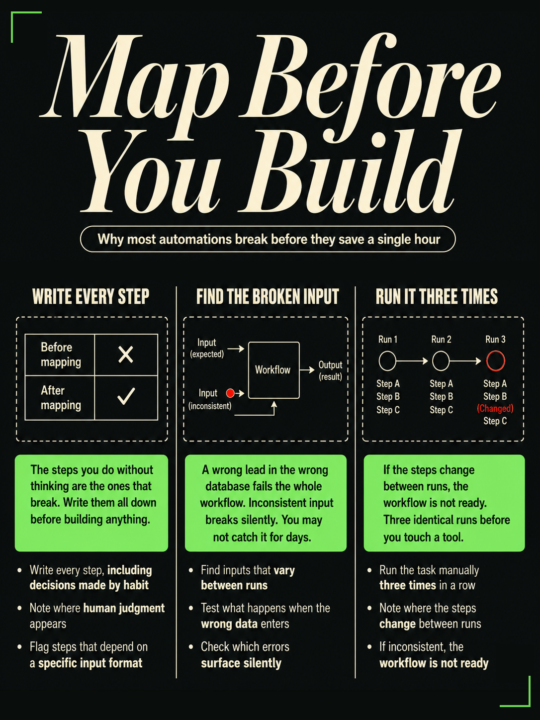
Every founder automates the same task twice. Once to build it. Once to fix what the first build missed. The automation looked fine. Notion connected to Slack. The trigger fired every time a row was updated. Summaries went out automatically. By day four, half the summaries were wrong. The rows were being updated three times. When a task was created, when it was assigned, when the status changed. Nobody had mapped that before building. Three days to build. Two weeks to debug. If you are just starting to bring AI and automation into your business, this is the mistake that costs the most time. You automate before you understand what you are actually automating. Before you touch any tool, run this first: 1. Write every step by hand. Every single one. Include the decisions you make without thinking. Those are the ones that break. 2. Find where the input is inconsistent. A wrong lead dropped into the wrong database, one that your workflow was built for a specific lead type, breaks the whole sequence silently. You may not catch it for days. 3. Find the step you skip when you are in a hurry. That shortcut is invisible to the automation. When you skip it manually, the output looks right and is wrong. 4. Run the task manually three times before building anything. If the steps change between runs, the workflow is not ready. A broken workflow automated is still a broken workflow. Map the task first. That step saves more time than the tool does.
1 like • Jun 3
@Zubeir Abdulqadir
0 likes • Jun 3
@Sam Azizi
May 31 •
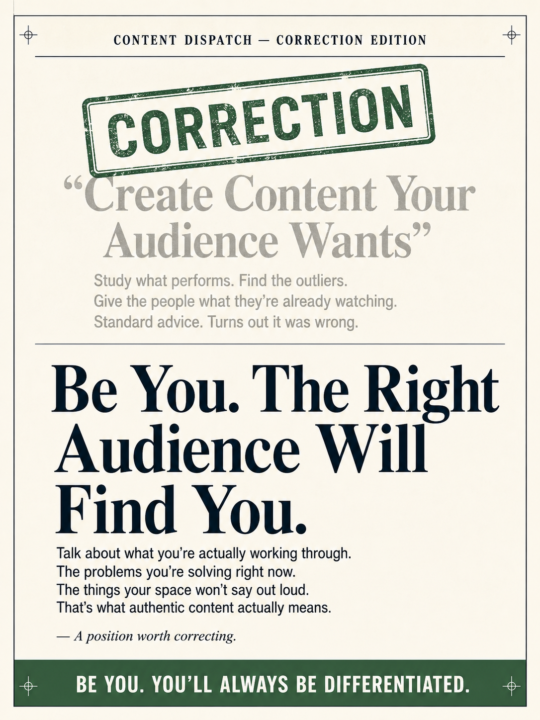
I told you to create content your audience wants. I was wrong.
I picked this up from Alex Hormozi recently. He called it "becoming the algorithm." You find what performs, you reverse-engineer the format, you chase the outlier. Makes sense on paper. The problem is you end up feeling like you're feeding the machine, not your audience. I know because I was doing it. Studying what worked in my space. Picking topics based on what I thought people wanted. Publishing consistently. Dreading every session. The content was fine. The metrics were ok. And it sounded exactly like twelve other people running the same playbook in the same space. Because they were. Here is what I actually believe now... Talk about what you are genuinely working through. The problems you are solving right now. The things your space dances around but won't say directly. Two reasons this works better: First, if you're dealing with it, other people are dealing with it right now. You're looking forward, not in the rearview mirror. Second, you won't look like a "cover band." You'll be making original songs. And cover bands never build the audience the original artist has. The right people find you because of that specificity. You cannot sound like what people already follow and expect them to choose you. Be you, and you'll always be differentiated. That's what authentic content actually means.
1 like • Jun 1
@Muskan Ahlawat
Jun 1 •
The era of BYOK is ending.
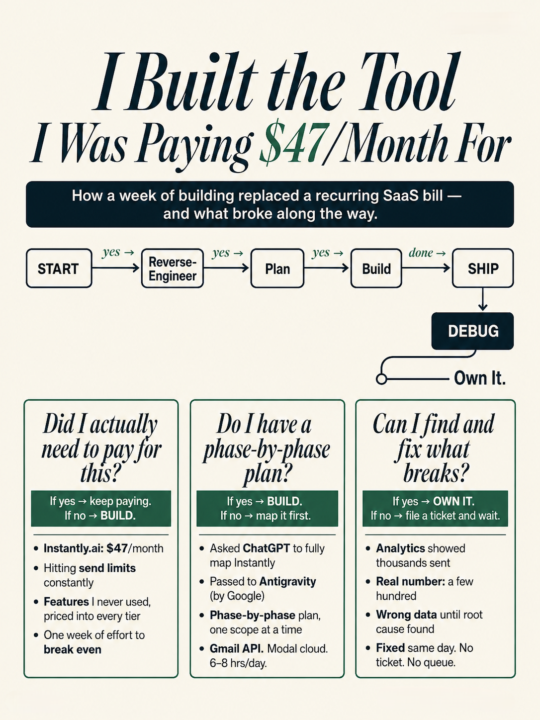
I asked ChatGPT to reverse-engineer a $99 tool. Then I built my own version for $2 a month. A year ago, the smart move was BYOK. Bring Your Own Key. Plug your API key into someone else's tool. Use their infrastructure, their limits, their roadmap. That era is ending. BYOS, Bring Your Own Software, is what comes next. Alex Hormozi coined the term. The premise: coding agents have reached the point where building your own tools is a founder's decision. You scope it, you run the agent, you own what comes out. I wanted to test whether this was real or just another thing people say on the internet. I was paying $47/month for Instantly.ai. Good tool. But their sending limits and built-in SOPs kept capping how far I could scale my outreach. I was paying for a ceiling. So I built Emailify in a week. Six to eight hours a day, treated it like a real project. This is what I do, so it doubled as a way to sharpen my skills with the new generation of coding agents. The process: I asked ChatGPT to fully reverse-engineer Instantly, every feature, every function, the complete picture of what the software does. Then I passed that to Antigravity (by Google), an IDE coding platform, and we built a phase-by-phase plan. Each phase had a clear scope. Each phase fed the next. By the end, I had fully functional outreach software. Multiple campaigns, hundreds of thousands of prospects, unlimited sends, Gmail API, cloud-hosted on Modal. Monthly cost: $2 to $4. A one-week build against $47/month recurring. One month to break even. After that, every month is margin. Now... the bugs. There were bugs. Plenty of them. The analytics kept breaking in a particular way that was genuinely painful to debug. It would report that I had sent thousands of emails when the real number was a few hundred. Completely wrong data, which meant I could not trust my own reports until I found and fixed the root cause. Every SaaS you subscribe to also has bugs. The difference is you cannot see them, cannot touch them, cannot fix them. You file a ticket. You wait. You work around the issue or you upgrade to the tier where it supposedly gets fixed.
1 like • Jun 1
@Muskan Ahlawat
May 30 •
How to avoid getting tricked by AI sycophancy.
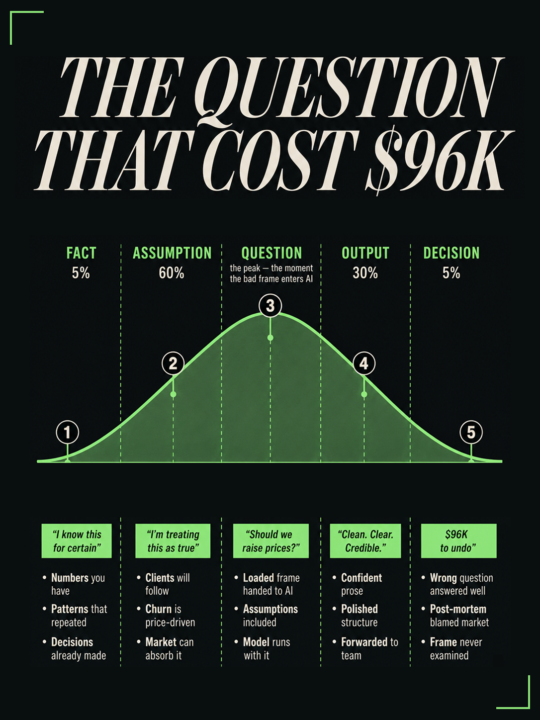
"Sycophancy refers to the behavior of offering insincere, excessive flattery to someone powerful or wealthy, usually in order to gain a personal advantage, promotion, or special favor." Simply said: AI agrees with everything you say. AI gave you the answer in 28 seconds. But cost you $96K to undo. What happened was... You gave AI a messy decision. It came back in under thirty seconds. Clean structure. Clear recommendation. You forwarded it to your team. Six weeks later you dropped the pricing model it suggested. Two clients didn't follow you into the new structure. At roughly $4,000 a month each, that's $96,000 in ARR you spent the next quarter trying to replace. You gave it a bad input and the AI just returned a polished version of that bad input. You asked: "Should we raise prices?" when the real question was: "Why are clients churning before month three?" The model answered what you asked. The answer was coherent, supported, and built on a frame that was already broken. This is the failure that never shows up in the post-mortem. When a decision goes wrong, founders blame the market, the timing, the execution. Almost never the question they handed AI. Because the output looked credible. Because confident prose signals rigorous thinking. The failure is structural. You were stressed. You opened the chat. You typed the question already forming in your head, assumptions included. The model took your frame and built on it. It does not push back on a loaded question. It runs. Here is what to do before you hand a real decision to AI. Write two things before you open the chat: 1. What you know for certain: Facts you can point to, numbers you have, patterns that have repeated 2. What you're assuming: Things you're treating as true that you haven't verified The second list is where most decisions break. For the pricing example, the fact list had one item: "margins were tighter than last year." The assumption list had five: - "clients would follow the new pricing",
1 like • May 31
@Muskan Ahlawat
1-9 of 9

Active 11d ago
Joined May 19, 2026
INTP