Activity
Mon
Wed
Fri
Sun
Aug
Sep
Oct
Nov
Dec
Jan
Feb
Mar
Apr
May
Jun
Jul
What is this?
Less
More
Owned by J
Juris Vitae = “Law of Life”: stewards learning their inherent rights, due process, faith, liberty, and self-governance to stand in truth in community.
Memberships
Serving Humanity Community
2.4k members • Free
Skoolers
165.2k members • Free
Investing Possibility Estate
39 members • Free
17 contributions to Juris vitae

22h •
Recording in the Courts
TX rules of procedure prohibit recording a proceding without permission from the judge in advance. Well, I recorded it and requested the court reporter to include the ommissions. There is a $500 fine or up to 6 month jail time associated with that. How do I handle this? Anyone have info to share about this?

1 like • 20h
Did you let them know you were recording? Never admit, always change the narrative. They would have to file something additional to prosecute you and you would had to know anout that rule and intentionally continue to violate it but also remember the 1st amendment protects that right in a public venue. So if they were to make a claim, you can either abate or prohibit it in an appellate court or counter sue in federal court. in everything you do make sure you strategize the different possibilities and let your spirit choose the proper course of action. I would exhaust my remedy in appellate court especially since it’s cheaper for the filing fees. But again I don’t think they are going to follow thru with it, if so attack the element of the law/rule. Also remember we can always challenge the constitutionality of any rule, law or statues.
0 likes • 2h
@Kay Schroeder and that’s the key to having a witnesses. The witness is not subject to the court rules unless they are included in the claim and the court has jurisdiction over them. Now hold the court reporter accountable by filing an objection on the record and use that video as evidence in support of the inaccuracy. Request correction, if judge denies correction then you can move that order for appellate review. Force them to do the right things by applying the laws on them.
15h •
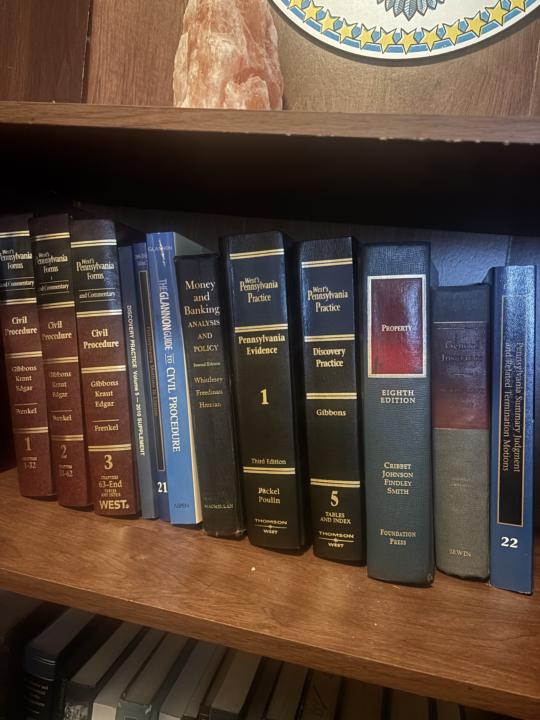
State Practice books
these Pennsylvania/state Practice books are good for research and studying. The “elements of an actions” help identify each element per cause of action. They also have good templates on how your pleading should look. Great books for research and studies.
3
0
6d •
Founding/constitutional Fathers
Info related to include everyone who significantly influenced the Constitution’s drafting, ratification, and early interpretation—not just those who signed it.
3 likes • 6d
On this day in 1835, church and city bells tolled as a funeral procession honoring Chief Justice John Marshall made its way through the streets of Philadelphia. According to a long-standing tradition, the Liberty Bell cracked while tolling for Marshall’s funeral. Although this story has become part of American folklore, historians have never been able to conclusively verify that the famous crack occurred on that particular day. Regardless of whether the legend is true, it is fitting that one of America’s most influential constitutional figures would forever be associated with one of the nation’s greatest symbols of liberty. Marshall served as the fourth Chief Justice of the United States, from 1801 until his death in 1835—more than three decades on the Supreme Court. His extraordinary tenure fundamentally shaped the role of the federal judiciary and helped define the constitutional system that continues to influence American government today. But do you know the rest of this Patriot’s story? Marshall was born in Virginia, where George Washington had helped his father secure work as a surveyor. He grew up in a frontier family that prized education, personal responsibility, and hard work. Although his father began life with modest means, he eventually became one of Virginia’s largest landowners. Those experiences instilled in Marshall a lifelong belief in perseverance, discipline, and public service. When tensions with Great Britain escalated, Marshall quickly joined the Patriot cause. He served first in the Virginia militia and later in the Continental Army during the American Revolution. He fought in several pivotal campaigns, including the Battles of Brandywine, Germantown, and Monmouth, and endured the brutal winter alongside General Washington at Valley Forge, where the Continental Army’s resilience became one of the defining moments of the Revolution. When his enlistment expired, Marshall intended to continue serving. However, the Virginia legislature delayed raising additional troops, leaving many officers without soldiers to command. Rather than remain idle, Marshall used the opportunity to study law at the College of William and Mary, where he attended lectures under the renowned legal scholar George Wythe, one of America’s earliest professors of law and a signer of the Declaration of Independence.
1 like • 20h
“A body of men holding themselves accountable to nobody ought not to be trusted by anybody.” — Attributed to Thomas Paine Thomas Paine understood a timeless truth: unchecked power is the greatest threat to liberty. In Common Sense and The Rights of Man, Paine argued that government is not the master of the people—it is their servant. Public officials receive their authority from the people and remain accountable to them. The American Founders designed our constitutional system around this principle: • Separation of powers prevents one branch from accumulating unchecked authority. • Checks and balances ensure each branch can restrain the others. • Due process protects every person from arbitrary government action. • The Bill of Rights places certain liberties beyond the reach of government officials. Paine warned that no person—or institution—should be trusted with power unless that power is restrained, transparent, and answerable to the people. Accountability is not a sign of weakness; it is the foundation of constitutional government. As James Madison later wrote in Federalist No. 51: “If men were angels, no government would be necessary.” Because human nature is imperfect, the Constitution was designed to limit power—not assume those in power will always use it wisely. Liberty is preserved when government follows the law, when courts remain impartial, when public officials honor their constitutional oath, and when citizens stay informed enough to hold their government accountable. As Thomas Paine reminded us throughout his writings, the price of liberty is not blind trust in government—it is an informed and vigilant people. #ThomasPaine #CommonSense #Constitution #BillOfRights #Liberty #RuleOfLaw #LimitedGovernment #ChecksAndBalances #DueProcess #FoundingPrinciples #CivicEducation
2 likes • 2d
Peace & love! Welcome to the community. Let’s grow and expand on the consciousness

2d •
US National versus RoE
Who here is knowledgeable about becoming officially recognized as a US National versus Resignation of Election pro as cons, such as voting driving flying. Signing up accounts requiring an “SS”?
1 like • 2d
So the only way is thru the Secretary of State for claiming nationality. It’s states it in their own website. The second part, I’m not sure what you are speaking on. But if you mean revocation of election, that’s in regard to taxes. And there’s a thing called minimum contact and operating in the private vs public. If you are seeking public privileges then you would get a ssn and any minimum contact with the state or union. If you want to operate in private then you need to create your own day of nativity records and not opt into a ssn card or drivers license. There’s ways to commingle if it’s a matter of rights, for instance, right to travel. If you honestly never got a ssn then you are not obligated to provide it. Jordan vs Rubio supported that with religious beliefs.
1-10 of 17