Activity
Mon
Wed
Fri
Sun
Sep
Oct
Nov
Dec
Jan
Feb
Mar
Apr
May
Jun
Jul
What is this?
Less
More
Memberships
Frightfully Good Paranormal
88 members • Free
ParanormalExplorers Collective
50 members • Free
Get Haunted University
63 members • Free
3 contributions to Frightfully Good Paranormal

May 5 •
Skeptics V Believers
Here are some thoughts about what might a skeptic say and what might a believer say. 1. What counts as real evidence The skeptic will say there is no solid proof. Photos can be faked. Audio can be explained. People see what they want to see. The believer will say experience matters. If ten people hear the same voice, that is not nothing. They trust repeated patterns over lab proof. 2. Electronic equipment vs natural causes The skeptic will go straight to fault. EMF spikes from wiring. Spirit boxes pulling radio bleed. Temperature drops from airflow. The believer will say the same gear is used again and again and gets similar results in certain places. They see patterns, not random faults. 3. Eyewitness accounts The skeptic will say memory is unreliable. People exaggerate. Fear changes perception. One person tells a story and others follow. The believer will say some witnesses have no reason to lie. Police, nurses, guards. People who were not looking for ghosts at all. 4. Haunted locations and history The skeptic will say old buildings creak, shift, and hold sound. Add in suggestion and you get a haunting. The believer will look at the history. Death, illness, trauma, long-term suffering. They see a link between events and activity. 5. Psychological vs paranormal The skeptic will lean hard into the mind. Sleep paralysis, stress, grief, and expectation can all create very real experiences. The believer will agree the mind plays a role, but not every case fits that box. Some events happen in full daylight, wide awake, with others present. 6. Why some people experience things and others don’t The skeptic will say it comes down to personality. Some people are more suggestible or more open to belief. The believer will talk about sensitivity. Some people notice more. Some people seem to attract activity. What can you add to this conversation?

0 likes • May 28
I have a foot in both worlds. I’m skeptical until there’s no other explanation. That doesn’t mean I don’t believe. I grew up in an active house and I’ve had a lot of experiences. I think we have to look at it from both sides if you’re trying to prove anything scientifically.
May 23 •
You are going to really be pissed off at this - but I invite you to you read it!
Because, I have just found a disturbing link between what cults try to sell their followers and what some paranormal investigators are also doing, as the amount of demonic entities they seem to find at each haunted site keeps ramping up to another extraordinary level. My goodness its a miracle we aren't all possessed. Or are we????? Some cults tell their followers that portals exists where demons come through to cause havoc on Earth. Yet some paranormal investigators on You Tube tell you the same thing. How strange? Why? I decided to ask this question of myself after watching a number of videos about cults that still exist today. I want you to think critically every time you hear the words 'portal' and 'demon'. Because paranormal investigators are still throwing them around like its the 1600's. The similarity exists because both groups are drawing from the same deep well of human fear, mythology, religion, and the need to explain the unknown — but they often use it for very different purposes. The idea of “portals” is not new. Variations of it appear in ancient folklore, shamanic traditions, medieval demonology, spiritualism, horror fiction, and modern occultism. Scaring people into the need to heal themselves. The language changes, but the concept remains familiar: a doorway between worlds where spirits, gods, demons, or the dead can cross into human reality. What is interesting is how modern paranormal media and high-control spiritual groups sometimes recycle the exact same narrative structure: There is a hidden danger. Invisible entities are influencing people. Certain people have special knowledge about it. Ordinary people are vulnerable. Fear keeps people engaged and dependent. In cult environments, this can become a control mechanism. If followers are convinced demons are constantly attacking them through “open portals,” they become easier to isolate, manipulate, and keep emotionally dependent on the group leader for protection. In paranormal entertainment, the motivation is often different:
0 likes • May 28
Very well said!!
May 24 •
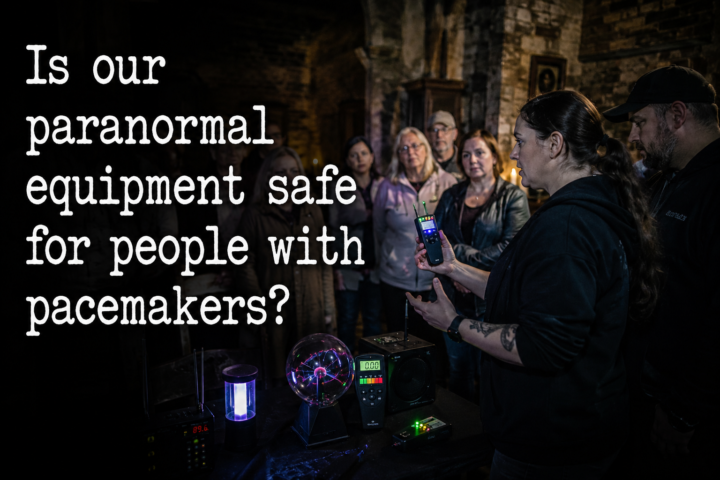
Can Paranormal Equipment mess with Pacemakers?
Had a question come through today which I want to address. We need to look after the living as well as the dead and some of the things that can be important are not visible to those off on ghost tours or your own paranormal investigations. Too much equipment might look awesome on YouTube but it may be harmful to people. Please read and be aware that some participants may wear pacemakers. Some paranormal investigation equipment can potentially interfere with a pacemaker, especially devices that generate electromagnetic fields, strong radio frequencies, magnets, or electrical pulses. Anyone with a pacemaker should treat ghost-hunting equipment cautiously and ideally get advice from their cardiologist or the pacemaker manufacturer before participating. Higher-risk equipment can include: EMF meters with strong active transmitters or modified coils Tesla coils or Jacob’s ladders used for theatrical demonstrations Spirit boxes / sweep radios held directly against the chest for long periods. High-powered walkie-talkies or radio transmitters Magnetic trigger devices Homemade “energy” devices or experimental equipment Devices using pulsed electromagnetic fields Static electricity generators Strong magnets used in trigger experiments The biggest concern is electromagnetic interference (EMI). Modern pacemakers are well shielded, but strong or close-range electromagnetic sources can sometimes: temporarily disrupt pacing, trigger false readings, or switch the pacemaker into a safety mode. Common paranormal gear that is usually lower risk when used properly: standard digital voice recorders, REM pods at normal distance, LED trigger objects, cameras, infrared thermometers, motion sensors, and flashlights. But “lower risk” does not mean “risk free,” especially with older pacemakers or people who are pacemaker-dependent. A good practical rule: keep active electronic devices at least 15–30 cm (6–12 inches) away from the pacemaker site, avoid hanging radios or spirit boxes on a chest lanyard,
0 likes • May 27
Good point, you can never be too safe.
1-3 of 3

@eric-larson-2753
I’m a Paranormal Investigator/Researcher from Des Moines Iowa. I investigate claims of the paranormal, from ghosts, cryptids, UFO/UAPs, etc..
Active 32d ago
Joined May 5, 2026