Activity
Mon
Wed
Fri
Sun
Aug
Sep
Oct
Nov
Dec
Jan
Feb
Mar
Apr
May
Jun
Jul
What is this?
Less
More
Memberships
Optimum Wellness Institute
54 members • Free
8 contributions to Optimum Wellness Institute

Dec '25 •
You're not moving Lymph
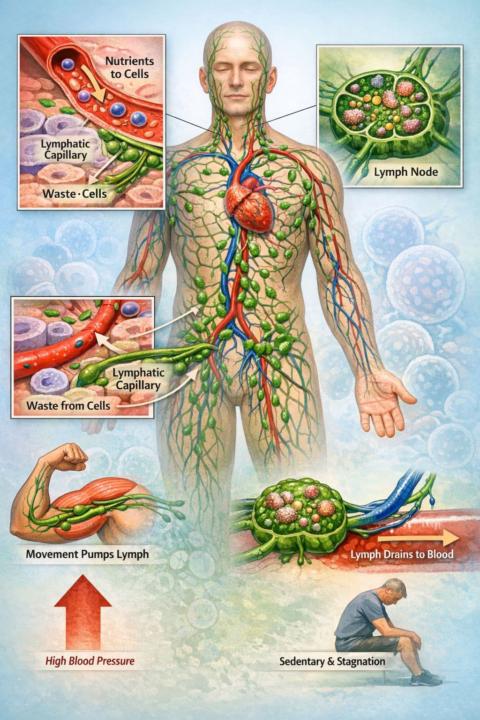
Understanding The Lymph: What actually happens The lymphatic system is not a minor side system. It is a primary transport and drainage network that sits between the blood and the cells. While the blood circulatory system is a closed loop driven by the heart, the lymphatic system is an open, free-draining system that relies entirely on pressure, density, and movement. Nutrients carried in arterial blood leave the bloodstream at the capillary level due to higher arterial pressure and density. These nutrients move into the surrounding interstitial and lymph fluids, and from there into the cell, driven by osmotic pressure and concentration gradients. Once inside the cell, nutrients are metabolised to support structure, energy, and repair. After metabolism, waste products leave the cell and enter the lymph. This transfer again depends on relative density and pressure. As waste accumulates, the lymph becomes denser. Under ideal conditions, some of this waste passes from the lymph into venous blood, where it can be carried toward organs of elimination. However, when lymph density becomes too high, this transfer is impaired. This is where movement becomes critical. The lymphatic system has no pump. Muscle contraction and joint movement create localised pressure that pushes lymph forward and helps overcome pressure differences between lymph and venous blood. Without movement, lymph stagnates and waste accumulates in tissues. Lymph nodes act as temporary holding and redistribution points, not as disposal sites. When lymph becomes too dense, material may collect in nearby nodes, allowing the surrounding lymph to regain a density that permits onward flow. Most lymph nodes are located near joints for this reason. Movement helps empty them. When vitality is low or movement is restricted, nodes can become swollen or tender as congestion persists. Blood pressure also influences lymph drainage. When diastolic pressure is moderate, pressure differences allow lymph to transfer its contents more easily into venous circulation during movement. When both systolic and diastolic pressures are elevated, higher lymph pressure is required, making efficient drainage more difficult, especially if mobility is reduced. Over time, lymph nodes can shift from short-term holding points to long-term storage areas.

0 likes • Jan 8
@India Simmons I need to try that too. Thanks for that information.
Jan 7 •
NEW CLASS ALERT
Hey Healers! Having a good Materia Medica is the key to learning and memorizing herbs, their functions, and actions and how they relate to each body system. I have added a Master Materia Medica course to teach you all about how to create your own herbal journal! Click on the classroom tab and start your lesson today! This class is free and is available at level 1.

1 like • Jan 8
This is awesome
1 like • Jan 1
Interested in seeing what's coming.
2 likes • Dec '25
Hibiscus, ginger

Dec '25 •
Congratulations 💐
Hey guys I really enjoyed our mini graduation ceremony yesterday good luck everyone happy herbalism!
2 likes • Dec '25
It was nice meeting you & getting to spend 12 weeks in class with you.
1-8 of 8

@elleana-martin-8858
I'm new to the herbalism world & eager to learn.
Active 7d ago
Joined Dec 10, 2025