Activity
Mon
Wed
Fri
Sun
Aug
Sep
Oct
Nov
Dec
Jan
Feb
Mar
Apr
May
Jun
Jul
What is this?
Less
More
Memberships
Signal Guitar Skool
55 members • Free
Electric Guitar Club
9 members • $15/month
Guitar for Beginners
261 members • Free
Rock N Blues Fretboard Friends
39 members • Free
Guitar Gym Pro (free)
3.2k members • Free
Ben's Blues Guitar Lessons
57 members • Free
Fretboard Freedom
361 members • Free
Piano with Ease Mini
14 members • $8/m
Piano with Ease 🎹
256 members • Free
18 contributions to Rock N Blues Fretboard Friends

🔥
0 likes • 5h
How do we find your feed? Oops! Found it.

7h •
Theory Talk - Analysis of Country Roads 3
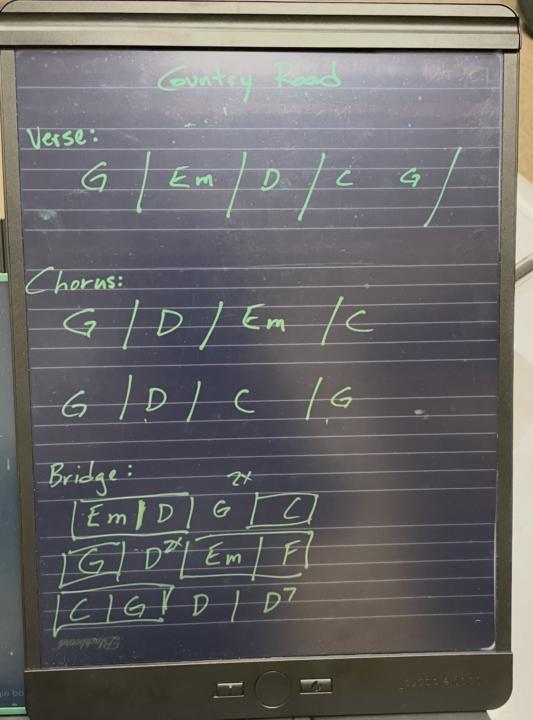
So last time we talked about the Chorus. Sometimes songs use a bridge to insert more interest or flavor to the song. A bridge itself can be a very good songwriting tool or technique. It often fits with the song but its comprised of a different progression from that key. Lets look at one of the things that are going on with this bridge. Em - D : The first thing that stands out to Me, is chords are now coming faster, 2 chords are sharing a single bar, so that contrast from the long meandering (predictable) strumming in the rest of the song, just added interest, because chords are coming faster now. The bridge also starts on a minor chord, which is different than the verse and chorus, again it suggests emotional contrasts, a wistful longing for home. Make no mistake. The construction of these things, are intentional. This is bread and butter songwriting. So lets put the whole thing down in Nashville Numbering. 6m 5 1 4 1 5 6m b7 4 1 5 5/7 So it begins on the 6m and you know that the 6m (if you went though Theory Bites, and Mastered G major) shares 2 notes with the 1 chord. 6 then goes to 5 which we expect to pull to…? Thats right, the 1! Authentic cadence. And sure enough, it does! But then the 1 goes to… the 4 The 4 goes to the 1 next. Thats our 4-1 move, the Plagal cadence. See, this stuff really happens! Its not all just randomness and throwing chords out everywhere. This stuff happens all day long right under our noses. Our next chord after that is 5, but does it go to the 1 again? Nope it goes to the 6m. A deceptive cadence! Heres something new (but if you followed Theory Bites to the end, youre not lost). a b7! @Robbie Gonzalez has referred to this chord as a “backdoor dominant”. I told you its a common way we dont play the typical diminished chord in music and this b7 is a very common departure. In this case the b7 instantly adds a slightly outside sounding chord, that has not come up one time in this tune, to this point. Why is it here now? One word - interest. Its literally ear candy, and perks the ears up “oh what was that?”. Songwriters LOVE a different, unpredictable chord, even once! Piano players make their money on crazy off sounding chords because its easier to do for their instrument. We try it like they do, and a couple fingers might snap off!
🔥
0 likes • 5h
Going through these three Country Roads posts a 2nd time helped a lot for my understanding. Also, I had previously viewed the Theory Bites. Fastinating stuff!
9d •
Theory Talk - Analysis of Country Roads 1
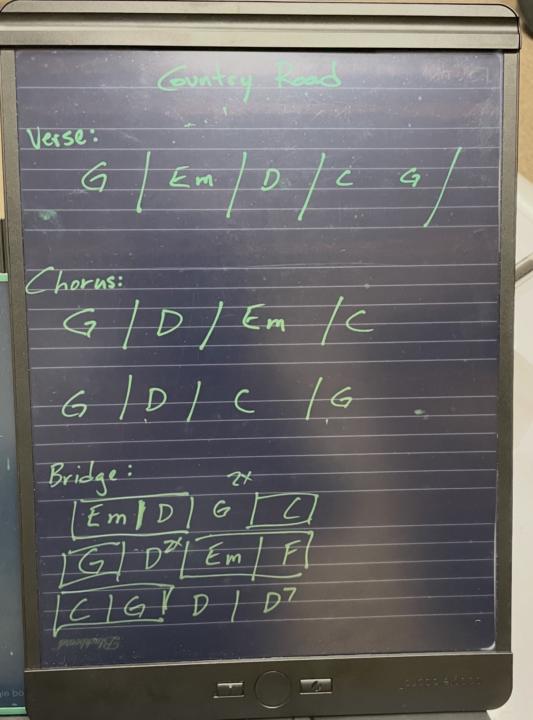
Part 1 Verse Good morning! So, if you’ve been following our theory bites, you should now know the chords in the key of G Knowing the chords, and the triads and their spelling and all of those things, will make this much easier to follow. Analysis tries to figure out what is going on with a song, and highlight things like cool changes that work, song construction, and cadences. Verse G - Em - D - C back to G This is a I vi V IV to I. In Nashville terms its 1 6m 5 4 1 Today we will do this in Nashville Numbering System (NNS) but commonly, analysis is done with Roman Numerals. G goes to the relative minor Em then as you recall a 5 wants to pull to the 1 and in this case, with D it does not go straight to the 1 but takes a path towards the 1 by first going to the 4 which is C, then to the 1, our G. This is VERY common in music, and still gives a nice resolution. This is solid but effective songwriting. By the way, a 4-1 by itself is an effective cadence, called a Plagal cadence. It’s very common, and does not require a 5 for it to feel resolved. Its not as powerful, but its still in a solid 2nd place as runner up,for how well it works. So how does this analysis help us? Well it teaches us very common ways that a song can be built and most especially demonstrates ways that it can resolve back, and feel “home” again! Tomorrow we will look at the chorus!
🔥
3 likes • 9d
@Sean Christiansen, I'm one of the weirdos that finds music theory very interesting. Ha ha! I like to know the "why" of what I'm playing and this post helps with that. By the way, where are these "Theory bites" you mention? I don't see them in the Classroom. UPDATE: Never mind, I found them under the "Theory Talk" Category.
🔥
0 likes • 5h
@Sean Christiansen I still need to make a video showing how I do "Blue Eyes Cryin in the Rain". So I'm behind too.
9h •
Welcome to two new members
@Zeph C. What a cool guy! Met him through @Elliott H and got to hang out with him last weekend at my studio! Great player, knows a lot about music and theory, and just instantly can see, hes one of us! I think he’s going to be one of my future in-person students. We just really all hit it off. Great to have you! @Jordan Howes Welcome to the community. You just joined, and I see you play guitar. We look forward to getting to know more about you! Great having you! Please join me in making our new members feel welcome!
🔥
0 likes • 8h
Zeph is like me, a forever beginner and Elliot is a man of mystery. Welcome both of you! @Zeph C. and @Jordan Howes
🔥
3 likes • 2d
It's almost time. There's no post and nothing on the Calendar. Canceled?
1-10 of 18

🔥
@phil-smith-1431
As a retired individual residing in Kansas, USA, I aspire to learn songs from artists such as Dean Martin, classic Country songs, and improvisation.
Online now
Joined Jul 2, 2026
USA