Activity
Mon
Wed
Fri
Sun
Jul
Aug
Sep
Oct
Nov
Dec
Jan
Feb
Mar
Apr
May
What is this?
Less
More
Owned by Dr. Severine
A supportive community where people strengthen their relationship with money, build better habits, and gain clarity that leads to financial freedom.
Memberships
Digital Roadmap AI Academy
737 members • Free
Your First $5k Club w/ARLAN
29.1k members • Free
LinkedIn Strategy Lab
410 members • Free
Social Selling with Sam
835 members • Free
Skool Growth Lab
114 members • Free
Skool Owners Lounge
359 members • Free
Panda for Skool
342 members • Free
Six-Figure CEO Profit Lab
60 members • $10
Revenue Accelerator Cohort
21 members • $5,000
26 contributions to The Authority Engine

🔥
20d •
Two days ago I finally had full visibility over my pipeline for the first time
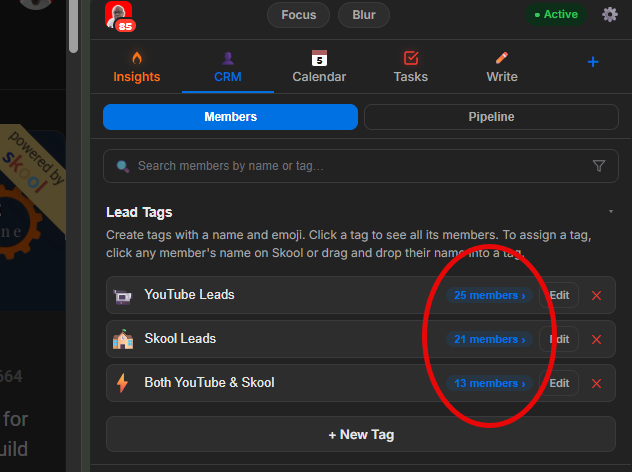
Not new leads. Existing conversations - coaches and consultants who had already engaged, asked questions, or shown intent - that were sitting in my community with no tag, no stage, no follow-up scheduled. Within 48 hours of setting up a proper CRM inside Skool, I had over 50 potential leads mapped and tracked that I would have continued to ignore by accident. Let me explain what a CRM actually is, because the acronym puts people off. Imagine you're a GP. Every patient who walks through your door has a file. That file tells you when they last came in, what you discussed, what you prescribed, and when they're due back. You never start a consultation from scratch. You never forget who they are or where you left off. The file does the memory work so you can focus on the diagnosis. That's a CRM. It's your client file system. Nothing more complicated than that. Now imagine that same GP trying to run their practice entirely from memory. No files. No notes. No record of who said what or when. A patient calls back and they're starting from zero every single time. Appointments get missed. Follow-ups don't happen. People fall through the gaps, not because the GP doesn't care, but because the system isn't there to catch them. That's most coaches and consultants right now. The pipeline problem in this industry isn't a lead generation problem. Most people reading this have had more conversations with potential clients in the last 90 days than they realise. The problem is a lead visibility problem. The enquiries are there. The interest is there. But without a system to track where each person is in the journey, who needs a follow-up, who's ready for a discovery call, who went quiet three weeks ago and might just need a nudge - those conversations evaporate. A CRM doesn't generate leads. It stops you losing the ones you already have. I've been using Panda for this - it runs natively inside Skool, took about an hour to set up, and gave me a Kanban-style view of every conversation in my community organised by stage. No third-party tools. No data leaving the platform.

1 like • 19d
That was one of the selling points for me. I am just getting back into the swing of things and will set mine up by the weekend. I am enjoying the master calendar of events too.
🔥
Apr 25 •
When B-Roll Hurts Your Authority (And When It Doesn't)
B-roll is one of those things coaches and consultants overthink before they've even filmed a single video. Here's the honest answer on when it earns its place - and when it doesn't. **Add B-roll when:** The point you're making is abstract. If you're explaining a concept that lives in someone's head - a sales cycle, a lead generation gap, a methodology - a visual cuts through faster than words alone. You've just delivered a big insight. Attention dips after a value peak. A cut to something visual buys the viewer a beat before the next point lands. It's a re-engagement tool, not decoration. The section is running long. If you're 90 seconds into a single talking-head sequence, B-roll breaks the fatigue before the viewer decides to leave. **Skip B-roll when:** You're making a direct, personal point. If the credibility of the statement comes from you saying it - a client result, a diagnostic observation, a direct challenge - cutting away undermines it. Stay on camera. You don't have footage that matches. Generic stock imagery is worse than no B-roll at all. A consultant explaining lead generation over footage of people shaking hands in an office is a positioning leak. If the visual doesn't match the argument, leave it out. You're still early in production. Getting the script, the delivery, and the hook right matters more than covering every cut. Build the asset first. Refine the production second.

3 likes • Apr 25
Makes sense.
🔥
Apr 20 •
Why sending YouTube viewers to a booking link kills your conversion rate
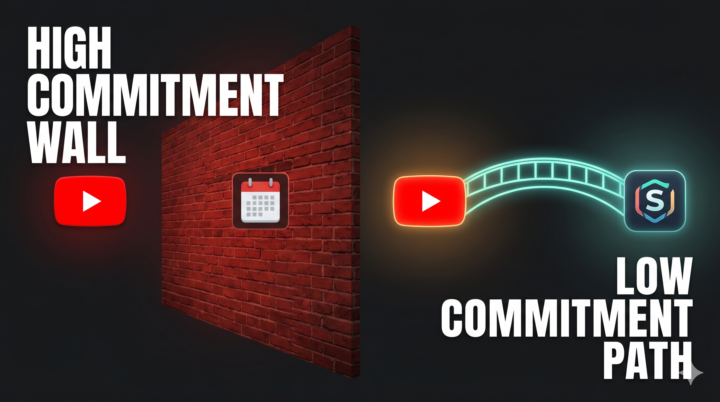
Most coaches, consultants, and founder-led businesses make the same mistake when they finally start getting traction on YouTube. They send the viewer straight to a booking link. It feels logical. The video did the work. The viewer is interested. The next step is the call. Right? It's the wrong step. And once you understand why, you can't unsee it. A YouTube viewer who has just watched 8 minutes of your content is *warm* traffic - they know you, they like the thinking, they're curious. But warm is not hot. Hot traffic books calls. Warm traffic needs one more step before it's ready to commit time on a calendar to a stranger on the internet. When you ask warm traffic to behave like hot traffic, you don't get a low conversion rate. You get *no* conversion. The viewer closes the tab and you never hear from them again. A free community sits in the middle for three reasons. One - it matches the temperature. Joining a community is a low-commitment yes. Booking a discovery call is a high-commitment yes. The brain processes them completely differently. Behavioural research going back to the 1960s shows that a small initial commitment makes a larger second commitment far more likely. Skip the small one and the big one rarely happens. Two - it removes the decision pressure. A booking link forces a yes/no in seconds, right after the viewer has been sitting passively for 10 minutes. That's cognitive whiplash. A community lets them lurk, read, and self-qualify in their own time. No countdown. No pressure. Just a quiet space to decide. Three - it adds peer proof. Inside the community, the viewer sees other people who look like them — same niche, same stage, same problems. That peer presence does more for conversion than any amount of testimonials on a sales page. The trust you built on YouTube gets transferred and amplified by the room. The trade-off is real. A community that nobody tends to becomes a ghost town, and a ghost town converts worse than a booking link. So the model only works if the community is actually run.
2 likes • Apr 21
Currently, I'm sending them to my Skool About page. I plan to start giving them a free lead magnet to collect emails in readiness for my upcoming webinar and coaching cohort.
🔥
Apr 13 •
Quick question for coaches and consultants
When a potential client reaches out to you unprompted, what usually triggers it? (Genuinely curious. Voting takes 5 seconds and shapes what I cover this week.)
Poll
8 members have voted
2 likes • Apr 15
I have a built in question in my intake form asking where the found me and if via search, what search term they used.
1 like • Apr 19
@Des Dreckett Thank you.
🔥
Apr 14 •
The £0 CRM That Most Coaches Are Missing
Most coaches and consultants I speak to are sitting on warm inbound enquiries they've forgotten about. Not because they don't care. Because there's no system catching them. You don't need expensive software. A Google Sheet with five columns, name, date, source, status, next action - is enough to turn a trickle of inbound into a functioning pipeline. The videos build the authority. The spreadsheet protects it. What are you currently using to track inbound enquiries?

1 like • Apr 15
I section them off in MailerLite.
1 like • Apr 19
@Des Dreckett The free version. I have been using it for several years and it serves me well.
1-10 of 26

@drsev
Accredited Financial Counselor® helping people strengthen their relationship with money, build better habits, and create lasting financial freedom.
Active 1h ago
Joined Feb 22, 2026
INFJ