Activity
Mon
Wed
Fri
Sun
Nov
Dec
Jan
Feb
Mar
Apr
May
Jun
Jul
Aug
Sep
Oct
What is this?
Less
More
Owned by Doug
We help the sailing community to improve their sailing skills and confidence. A place for learning and asking questions. “Skippers appreciate skills”
AI Business Friends
115
Free
Social Media Skool
388
5.0
$25/m
AI Automation Made Easy
20.7k
Free
How to Cross an Ocean
325
Free
Camping Wilderness Skool
204
5.0
$19/m
Learn To Live Aboard
26
Free
Nautical Me!
28
Free
AI Workshop Lite
65.6k
Free
7 contributions to Nautical Me!
0 likes • Aug 3
What a great history lesson. Learn something every day.

Jul 24 •
[Maker] Nautical Me! Maker Project #2; Build a Model Sea Anchor
Build a Model Sea Anchor Hold the Bow to the Weather There comes a point in heavy weather when seamanship is no longer about making the boat go faster. Sometimes the smarter move is to slow everything down, reduce the boat’s freedom to yaw, and encourage the bow to remain presented toward the weather. That is where the idea of a sea anchor becomes fascinating. Unlike a conventional anchor, which grips the seabed, a sea anchor creates drag in the water itself. Historically, sea anchors have been used from the bow in rough conditions to help control a vessel’s attitude to the sea. For our second Nautical Me! maker project, we are not building offshore survival equipment. We are building a working scale model so we can see the principle with our own eyes. The Maker Challenge Our goal is simple: Build a small parachute-style sea anchor and test whether it can make a model boat resist drifting sideways and align itself more consistently with the pull of wind and water. This is partly a sewing project. Partly a knot-and-line project. And mostly a seamanship experiment. What We Will Build Picture a small underwater parachute. The basic assembly has: Canopy - Creates water resistance. Bridle lines - Spread the load around the canopy. Main rode - Connects the sea anchor to the bow. Trip/retrieval line - Allows us to collapse and retrieve the device more easily. Optional float - Makes the model easier to locate and retrieve. For a demonstration model, the precise dimensions are much less important than getting the basic geometry and load path right. Suggested Materials For our educational model: - approximately 12–18 inches of durable fabric for the canopy; - nylon webbing or strong cord; - braided line for the rode; - lighter line for the retrieval line; - small stainless or plastic ring; - needle and heavy thread; - scissors; - marker; - measuring tape; - small float or brightly colored cork; - model boat. Canvas will give the project a wonderfully traditional feel.
1 like • Jul 24
Slowing the boat so you get to your destination faster and in one piece.
1 like • Jun 26
@Phil Wilson Saturday we fell into a hole and let 2 boats pass for finish line but on Sunday we got line honours. Having the fastest boat means a low handicap. We finished 5 over all. We still had a great time and all of us had a few jars to celebrate the race.
Apr 27 •
Introducing the Ferrari Hypersail Prototypes
Finally, we're getting the details on these exciting foilcraft!
0 likes • May 25
The time has come where AI takes over.
0 likes • May 27
Will there be any room for the purest in our sailing future?
Jan 23 •
⚓ 3) Captain’s Starter Kit: First 3 Things to Do
Captain’s Starter Kit (No Homework—Just the Good Stuff) 1) Say hello in 👋 The Dock -----> Use the intro prompt and add one sea-thing you love (book, ship, place, or memory). 2) Drop a post in 📖 Captain’s Log -----> Share any of these: - A short sea story (true or tall) - What you’re reading/listening to right now (2 sentences, no spoilers) - A favorite nautical film scene or quote - A piece of sea lore or naval history you can’t stop thinking about 3) Join the crew conversation -----> Pick one: - Ask a question in 🧠 Ask the Crew - Share a win/lesson in 🌊 Sea Wins & Hard Lessons - Jump into a challenge or trivia in 🪶 Crow’s Nest Bonus (if you’ve got a shipmate in mind): Invite a friend who belongs here. Nautical Me! gets better with every great storyteller and maker aboard. Welcome again — your crew and your port.
0 likes • May 25
I returned from traveling/living in Europe to Canada. First snow fall sent me south. Heard there was work in the BVI's so off I went. This started my love affair with sailing. Wrote a book of my impressions but did not publish. Send me a DM if you would like a read.
1-7 of 7
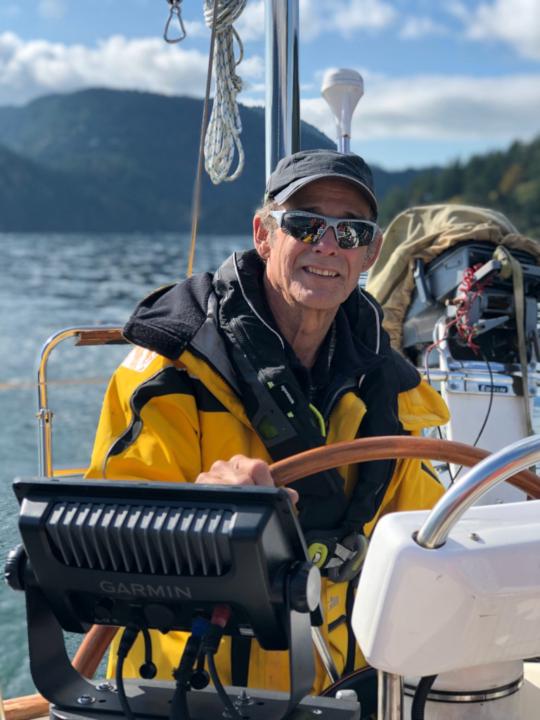
@doug-rutherford-3364
I am a passionate sailor with over 40 years of sailing experience. To share my skills is my main objective.
Active 13m ago
Joined Apr 24, 2026
Kelowna, BC. Canada