Activity
Mon
Wed
Fri
Sun
Mar
Apr
May
Jun
Jul
Aug
Sep
Oct
Nov
Dec
Jan
Feb
What is this?
Less
More
Owned by Doris
Raus aus der Lern-Einsamkeit • Tauch als Solopreneur ein in die Lernkultur von Mensch zu Mensch in Mastermind, LernCircle, Barcamp, Coworking, ...
Memberships
CoWorking Space (deutsch) 💻✨
47 members • Free
Skool Festival Deutschland
139 members • Free
THE Parkour Guide
32 members • Free
Free Skool Course
41.8k members • Free
DIGITAL BUSINESS MASTERY
19 members • $497
Solopreneurs Community DACH
505 members • Free
Einfach Neukunden ⭐️⭐️⭐️⭐️⭐️
841 members • Free
SkoolHers
466 members • Free
Skool Community (deutsch)
4.7k members • Free
11 contributions to What Is Skool?

🔥
21h •
Why I Made My Skool Community Public
When I decided to make my community public, I got a lot of questions. But the main one was always the same. Why? 🤷♀️ The answer is that there are several reasons. I wanted to explain them, especially if you are thinking about whether you should have one too. I have always recommended having a public Skool community alongside whatever you are doing on Skool. Whether you are running your own community or supporting someone else, it is something I genuinely believe in and have told people to do for a long time. Especially now that we have the option of a $9 hobby plan community, but even when there was only the $99 option, I still saw it as one of the cheapest forms of SEO and marketing you could invest in. Do you know how much it costs to have someone do SEO for you? A good one can cost a lot, so this is super affordable. But at a certain point I realized something. Even if I understand how valuable it is and can explain what to do and how to do it, a lot of people need to actually see it. They need a real example. Something visual and hands-on. I get it.. I learn better that way too! 😅 Why am I so sure everyone should have one? I have tested the power of a public community on Skool, and I also know how powerful SEO is from long before Skool even existed. That combination is what made the decision obvious for me. Let me ask you this.. If you saw what YouTube looked like before it got big, or what TikTok looked like before it took off, and you understood the potential back then, would you not lean into it and tell others to do the same? That is where I believe Skool is at right now, and where the real opportunity is with AI discoverability. You're not too late to the game and you don't need to feel FOMO, because you're here right now. Another big reason is time. ⏳ I only have so much time in a day and everyone wants some of it, and I genuinely want to give it. But I am still only human with life happening. I am a single mom, I homeschool my little one, and I am everyone’s go-to person.
Poll
22 members have voted

1 like • 16h
I am running my website/blog since 2009. If I would start blogging 2025/2026, a public Skool Community instead of a blog might be a clever option for "instant" visibility. What I would miss compared to my website/blog: - Digital sovereignty with servers in Europe - Structuring of longer texts with subheadings and bold text - Graphics integrated into the text - Visual design matching the corporate identity - Content export is easy What's cool about Skool - Indexing & visibility through a strong content domain - More visible interactivity - Pricing - Integrated payment system - Integrated course option Well, what do you think? 😎 Leaves the risk of a buyout by someone you do not want your content hosted.
1 like • 15h
@Eric Howell Yeah, what I know so far of him, you are right 😎🫵🫶
🔥
2d •
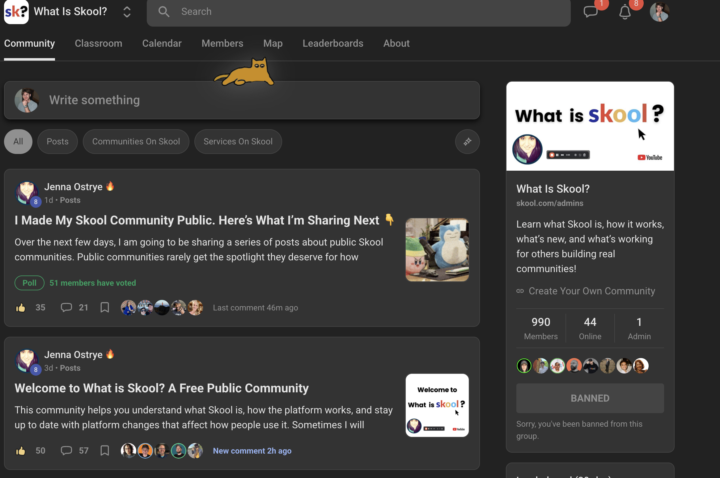
I Made My Skool Community Public. Here’s What I’m Sharing Next 👇
Over the next few days, I am going to be sharing a series of posts about public Skool communities. Public communities rarely get the spotlight they deserve for how powerful they can be. It has been a long time coming, and I have gotten a lot of questions about this decision from people building on Skool, people considering it, and people trying to decide what direction to go. So instead of making one long post that could turn into a novel, I wanted to break it down into a series of posts so we can cover everything properly and answer questions as they come up. ✍️✅ Here is what we will cover: Why I made my Skool community public Should you have a public Skool community or a private one? Things to make sure you do if you go from private to public What will help your public Skool community Skool tips for a public community, including how to prevent spammers and low quality posts And the Skool strategy I personally recommend and will lead by example with After that, I will shift back to what this community is here for: - Resources and templates you can use. - New Skool videos and podcast episodes. - Highlighted communities that are worth checking out. - Posts about new Skool features and platform changes. - Breakdowns of how different Skool communities are structured and what is working. - Plus, little things I find across Skool that most people miss, like features, pages, or tools you might not know exist. Yes, I did say a podcast! 🎤 I finally can announce that my podcast host Eric and I are launching a new one together! We had one when we first started on Skool two years ago, took a break, and now we are starting fresh with a new one focused on online communities and what actually works in practice. So… who is @Eric Howell? If you are building a Skool, it is really easy to feel like you should be able to do everything yourself. Content, community, offers, systems, traffic. And the truth is, you probably can.. I know I felt like that.
Poll
53 members have voted

6 likes • 2d
Great idea, love it 🥰 How about live recording the interviews with the community as audience and a question section from the audience (via Chat)?
🔥
24d •
How To Catch Spammers Fast In Skool Membership Requests
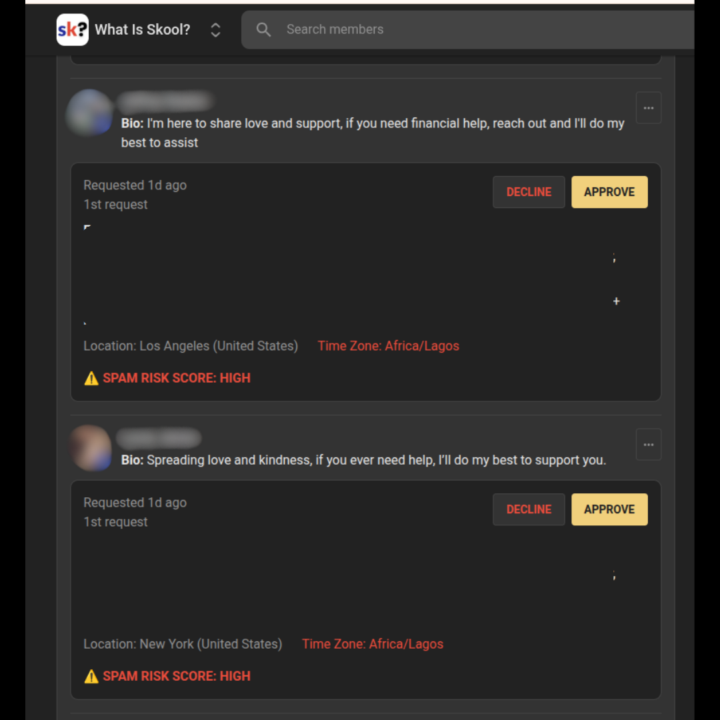
When you are on any online platform, we all know by now there is bound to be spam. People talking about dropshipping, asking you to move to WhatsApp, saying “Hello dear,” and sending messages that clearly do not belong in a real community space. Some of the common questions Skool community owners and admins have about dealing with spam are: How do I stop spammers in my Skool community? How can I tell if a Skool membership request is fake? What is the best way to prevent spam DMs in Skool? How do I use Skool’s features to reduce spam? Well Skool just released a new feature update that helps community owners spot spam accounts directly inside Skool membership requests. You can now see when a profile is marked as high risk for spam before approving them, which makes protecting your Skool community much easier. Before this update, one of the best ways to identify fake accounts was by checking location details through chat. Many spammers say they are from one place, but their profile data shows something completely different. That extra step worked, but it took more time. Now the process is faster and clearer. See the photo to see how the locations do not match. This is a simple example of how spotting these red flags early can help you stop spam accounts before they ever get inside your community. You can also put smart systems in place alongside this new feature. Setting level requirements for things like sending direct messages or posting in your Skool community helps reduce spam and protects your members. Requiring people to reach a certain level before they can message others or post gives you more control, saves time, and keeps your community focused on real conversations instead of cleanup. Personally, I recommend setting the chat level to at least 4. This gives you a better chance of spotting accounts that try to comment back and forth quickly just to level up and unlock messaging. It also gives real members time to get to know each other inside the community before moving straight into private messages.
3 likes • 24d
Easier and less time-consuming than chatting 👍
🔥
27d •
Skool Tax Documents Where to Find Invoices and How 1099s Work
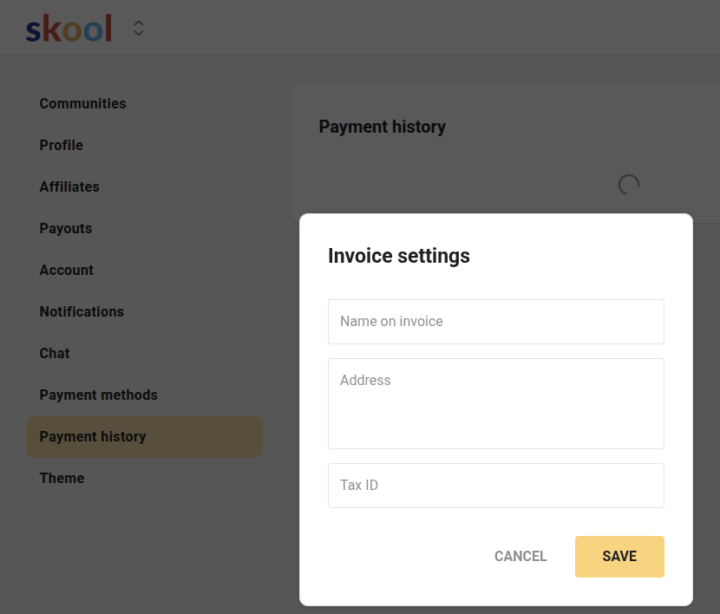
If you make money through Skool and are getting ready for taxes, the biggest thing to understand is where your tax information actually comes from and how it is handled. Skool does not issue 1099 forms. Stripe does. Skool uses Stripe to process all payments. Because of that, Stripe is the platform responsible for tax reporting. If you meet the reporting requirements for your location, Stripe will generate and send your 1099 for the income you earned through Skool. You will not receive a 1099 from Skool support. It comes from Stripe. Whether or not you will receive a 1099, you can still access everything you need inside Skool to stay organized. If you are looking for invoices related to money you earn on Skool, you will find those under payouts. You can go into the community you own, open the group settings, click on payouts, then select any individual payout to view the invoice tied to it. Or you can go to your profile settings, click on Payouts, and see all of your payouts in one place. This includes both your community payouts and your affiliate payouts. If you are looking for invoices related to money you pay on Skool, those are found under Payment History in your profile settings. This includes community memberships, one time purchases, and your monthly subscription payment to run your own community. You can also customize your invoices by adding your business name, address, and tax information. This is available on the settings wheel in Payment History. Once you update that, it applies to your invoices automatically. This helps keep everything consistent when you are organizing your records or sharing them with your accountant. If something is not showing up correctly, you can reach out to Skool support. To make the process go smoothly, be sure to submit the support ticket under the name of the community you need help with. Explain the issue clearly, include a screenshot if you have one, and share the correct information it should reflect. You can submit your request here: https://www.skool.com/support
Poll
26 members have voted
1 like • 25d
Well, what are "1099 forms"? asking from Europe...
1 like • 24d
@Jenna Ostrye Thank you!
🔥
Dec '25 •
The Difference Between the Skool Platform & the Skoolers Community
If you are new to Skool, one of the most common questions is what the difference is between Skool and Skoolers. Mark Novikov, Creator Success Manager on the Skool team, recently started a YouTube channel and shared this video explaining what Skoolers is, how it is different from the Skool platform, and what you get access to inside the Skoolers community. What is Skool? Skool is the platform. Skool is where all communities are hosted. When you create a Skool account, you can start your own community, invite members, post content, and choose whether your community is free or paid. Your Skool community is your space and you decide how it runs. What is Skoolers? Skoolers is a community for Skool owners. Skoolers is a private community inside Skool. It is only for people who own a Skool community. Skoolers is not the Skool platform itself. It is a place where community owners talk specifically about building, growing, and managing communities on Skool. That difference matters. Skoolers is where people share what is working on Skool, what they are testing, and what they are learning as they grow their communities. Posts in Skoolers should always be related to Skool or community building. Promotion of your own community or unrelated topics should stay inside your own Skool community or a community on that topic. Inside the Skoolers community, there are a few key areas worth knowing about. The Classroom This includes Skool 101, created by the founder and leadership team. It walks through how to use Skool, how to set up your community, how to get members, how monetization works, and how to reduce churn. Skool News Weekly updates that cover new Skool features, product changes, and platform updates. This is one of the easiest ways to stay up to date on what is changing inside Skool.
2 likes • Dec '25
Thank you, subscribed 😎
1-10 of 11

@doschu
Gestalterin & Moderatorin von Lern- und Begegnungsräumen (Community, Barcamp, Coworking, LernCircle) mit Herz & KI-Kompetenz ✍️ Autorin Blogs & Bücher
Active 11h ago
Joined Aug 19, 2025
INFJ
Mallorca 🇪🇸
Powered by