Activity
Mon
Wed
Fri
Sun
Jun
Jul
Aug
Sep
Oct
Nov
Dec
Jan
Feb
Mar
Apr
What is this?
Less
More
Owned by Diego
Cansado(a) do trabalho mal pago? Aprenda a multiplicar seu salário e conquistar independência geográfica trabalhando com Redes de Computadores e TI.
For IT and non-IT Professionals Stuck at $2K–$3K/Month Who Want to Become Highly Paid Network Engineers.
Memberships
AI Automation Mastery
28.6k members • Free
MyFirstHack
85.7k members • Free
AI Ads Mastery
1.7k members • Free
Free Skool Course
66.6k members • Free
Skoolers
193.1k members • Free
AI Automation Agency Hub
314.2k members • Free
AI Automation Society
350.5k members • Free
2 contributions to Zero to WIFI HERO

6d •
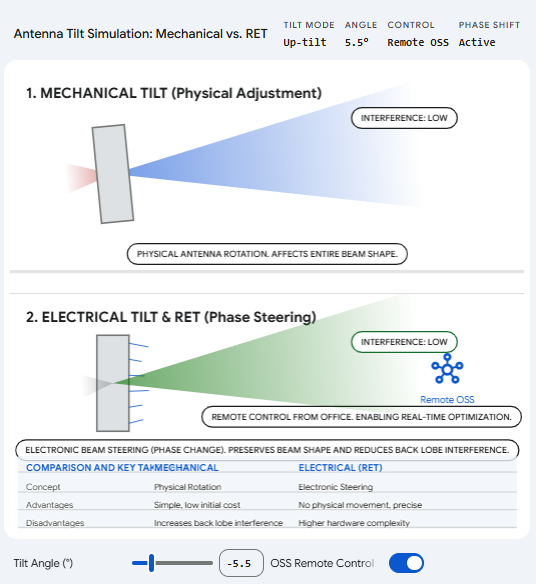
🎯 Mechanical Tilt vs Electrical Tilt . What’s the Real Difference?
In cellular networks, antenna tilt is a key parameter used to shape coverage, control cell overlap, and manage interference. 🔧 Mechanical Tilt Physical adjustment of the antenna’s position (tilting the whole panel) - Simple and low-cost implementation - Alters the entire radiation pattern, including front and back lobesCan unintentionally increase interference in certain directions (not always, but possible) - Limited precision and requires manual intervention (tower climb) ⚡ Electrical Tilt Adjusts the vertical beam electronically (no physical movement) - Provides more precise control of the main lobe - Minimally impacts side and back lobes compared to mechanical tilt - More effective for fine-tuning coverage and interference management - Can be dynamically optimized in modern networks RET (Remote Electrical Tilt) Enables remote control of electrical tilt via OSS/NOC - Eliminates the need for site visits or tower climbing - Supports faster optimization and network tuning - Widely used in LTE and 5G deployments as a standard feature Key Takeaway: Mechanical Tilt = coarse, physical adjustment (macro-level changes) Electrical Tilt = precise beam shaping (fine optimization) RET = scalable, remote control for modern network operations 🎯 Question 1 — Conceptual An engineer is optimizing a congested LTE cell and decides to apply mechanical downtilt to reduce interference with neighboring cells. Which statement is TRUE?
Poll
Cast your vote
0 likes • 6d
To the previous Question... 💡 Correct Answer: C 🔍 Explanation: Mechanical tilt physically moves the antenna, meaning the whole radiation pattern is shifted, not just the main lobe.
17d •
Welcome! (Start Here)
Here’s what to do next: 1. Watch the video below. 2. Start the CWNA CRASH COURSE. 3. Learn how to not only Nail the CWNA exam down, but also , how to apply its skill in real life. 4. Be active here in this community. Have fun & let’s get rocking! Diego and Network Carreer Accelerator Team PS: Want my personal help? Comment "DIEGOCCIE" below QUESTION: Have you tried CWNA exam before? If you tried any other IT Exam and failed , let me know what.
Poll
Cast your vote
0 likes • 17d
Let's nail it down !!!
1-2 of 2

@diego-de-oliveira-7304
Eu sou a ponte entre a insegurança teórica e a maestria operacional. Criando lendas do mercados de infraestrutura de redes e CyberSegurança.
Online now
Joined Apr 13, 2026
Gold Coast