Activity
Mon
Wed
Fri
Sun
Jun
Jul
Aug
Sep
Oct
Nov
Dec
Jan
Feb
Mar
Apr
May
What is this?
Less
More
Memberships
The Worldmind Society
72 members • $10/month
2 contributions to The Worldmind Society

Feb 19 •
Who Owns the Past? The British Museum Question
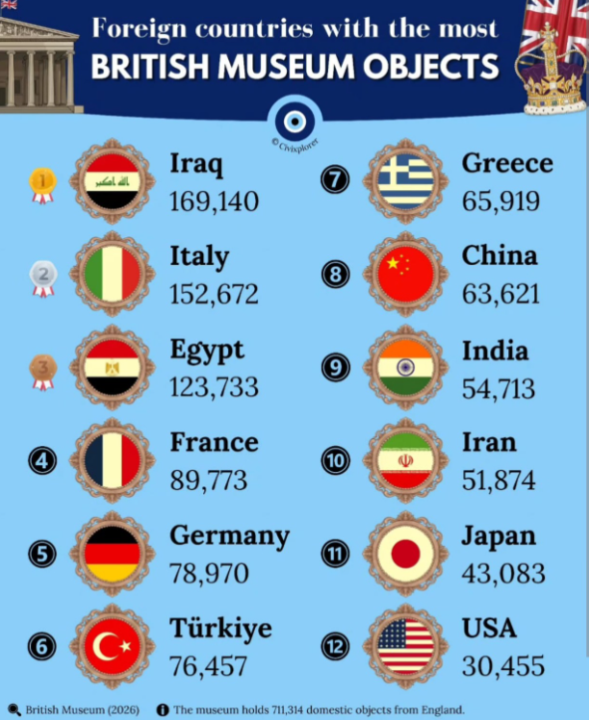
A recent graphic circulated showing which foreign countries have the highest number of objects in the British Museum’s collection: Iraq – 169,140 Italy – 152,672 Egypt – 123,733 France – 89,773 Germany – 78,970 Türkiye – 76,457 Greece – 65,919 China – 63,621 India – 54,713 Iran – 51,874 Japan – 43,083 USA – 30,455 The museum also holds more than 700,000 domestic objects from the UK. Numbers alone, of course, tell us very little. But they raise a foundational question. Are these artefacts preserved fragments of world civilisation — or displaced pieces of cultural memory? This is not a slogan-driven issue. It is a structural one. It touches on empire, legality, preservation, identity, and the architecture of global heritage itself. The Universal Museum Argument. The British Museum has long described itself as “a museum of the world, for the world.” The underlying philosophy is Enlightenment in origin: that civilisation belongs to humanity, not to modern political borders. Within this framework: Artefacts are preserved under stable institutional care.They are accessible to a global audience.They are studied comparatively across cultures.Many were acquired legally under the laws of their time. The universal museum model allows a visitor to walk from Assyria to Athens to Egypt in a single afternoon. It presents civilisation as interconnected rather than fragmented. From this perspective, removal is not theft. It is consolidation. The Repatriation Argument. The counter-position challenges not preservation, but power. Many artefacts were acquired during periods of imperial expansion or asymmetrical influence. Legal frameworks of the eighteenth and nineteenth centuries operated within systems that were rarely equal. Legal does not automatically mean ethical. Cultural artefacts are not neutral objects. They are embedded within landscapes, rituals, and collective identity. Their removal can fracture historical continuity. The debate surrounding the Parthenon Marbles illustrates this clearly. The question is not simply about sculpted stone. It is about sovereignty, memory, and symbolic dignity.

0 likes • Feb 19
As for your comment on Syria.Its very difficult to save anything in middle of a war and I understand that but the Elgin Marbles doesn't fall under that category. There was no fighting going on at the time they were stolen.The same cannot be said about wanton vandalism like Napoleons solders using the Sphinx for target practice and shooting half it's face off.Do you suggest the Sphinx should have been removed and stored in BM for safe keeping. Where is the line drawn.
0 likes • Feb 19
And that is the basis of my argument. Taking for protection or safety is one thing.Taking and not returning is common theft.
1-2 of 2