Activity
Mon
Wed
Fri
Sun
Aug
Sep
Oct
Nov
Dec
Jan
Feb
Mar
Apr
May
Jun
Jul
What is this?
Less
More
Owned by Denise
Sharing revelations, poems or words from God
Memberships
Skoolers
166.5k members • Free
284 contributions to Echoes From the Father’s Heart

17h •
Strength for the Journey
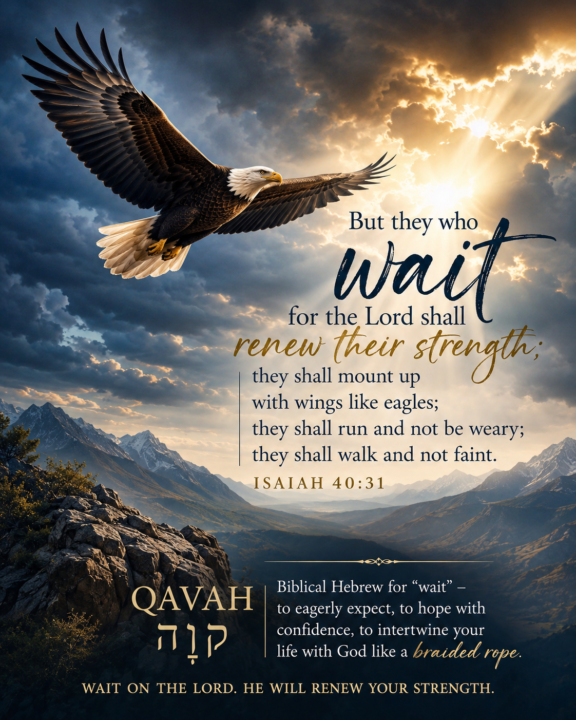
Strength for the Journey We all face battles, troubles, and seasons when we reach the end of our own ability to hold on. Our natural response is often to try to work everything out ourselves. We plan, we strive, we scheme, hoping that somehow we can carry the weight on our own. But when you feel like you simply cannot keep going, God’s Word gives us the key to continuing on. “But they who wait for the Lord shall renew their strength; they shall mount up with wings like eagles; they shall run and not be weary; they shall walk and not faint.” Isaiah 40:31 The key word in this verse is wait. In Biblical Hebrew, the word translated “wait” is qavah. It is far more than simply passing time. It carries the rich meaning of eagerly expecting, hoping with confidence, and even becoming intertwined with God like the strands of a braided rope. The picture is one of our weakness being woven together with His strength. We live in a world where almost everything is available at our fingertips. Waiting has become one of the hardest things for us to do. We pray, we ask, and when the answer is not immediate, we are tempted to become discouraged. Some even conclude that God has not heard them or that He is not there. But biblical waiting is not passive. It is choosing not to rush ahead of God. It is spending time in His presence. It is talking with Him, listening for His voice, allowing Him to shape our hearts while we trust His timing. As we wait on the Lord, He promises to renew our strength. He does not simply help us survive our circumstances, He enables us to rise above them. Like an eagle that catches the wind beneath its wings, we are lifted by His strength rather than our own. We find ourselves able to run without growing weary and to walk without fainting because He is carrying what we could never carry ourselves. God has not forgotten you. He knows the plans He has for you, plans for your good and not for your harm. He sees every circumstance you face. His invitation is simple, wait in His presence, listen for His voice, and allow your life to become intertwined with His. There you will discover a strength that is not your own, a peace that cannot be shaken, and the grace to keep moving forward one faithful step at a time.
0
0
2d •
Trust Beyond What We Can See
Trust Beyond What We Can See “Some trust in chariots and some in horses, but we trust in the name of the Lord our God.” Psalm 20:7 When the battle is at its fiercest, our natural tendency is to trust in what we can see, touch, and control. We look for visible solutions, influential people, financial security, or our own strength to rescue us. Throughout Scripture we repeatedly see God’s people tempted to place their confidence in earthly alliances. Kings looked to Egypt and other nations for protection instead of trusting the God who had delivered them time and time again. What seemed powerful in human eyes could never compare to the power of the Lord. God continually calls us to a different kind of trust. “Do not be afraid, for those who are with us are more than those who are with them.” Then Elisha prayed, “O Lord, please open his eyes that he may see.” So the Lord opened the eyes of the young man, and he saw that the mountain was full of horses and chariots of fire all around Elisha. 2 Kings 6:16–17 The servant could only see the enemy. Elisha saw heaven’s army. Nothing had changed in the natural. The enemy was still there. The city was still surrounded. The only difference was that God opened the servant’s eyes to the unseen reality. How often are we like that servant? We become overwhelmed by the circumstances in front of us because we cannot yet see what God is already doing around us. When our trust is in the Lord, we can rest even when everything appears impossible. Though the battle may look dire, God surrounds His people on every side. He is never caught by surprise, never outnumbered, and never defeated. Sometimes it is darkest just before the dawn, but darkness has never prevented God from bringing the morning. The victory has never depended on the size of the enemy. It has always depended on the greatness of our God. When we choose to trust Him, He teaches us to see beyond what our natural eyes can perceive. Faith begins to recognise what fear cannot see. We discover that the battle truly belongs to the Lord, and that He is already fighting on behalf of those who place their confidence in Him.
0
0

3d •
God has a plan
Jeremiah 29:11 is often quoted as a promise of immediate blessing, but its original setting tells a deeper story. These words were spoken to God’s people while they were living in exile. Their circumstances were difficult, and there would be no quick escape. Instead of offering an instant solution, God gave them something greater—a promise that His plan was still unfolding. God has a plan, not merely an immediate solution. His promise is not that the path will always be easy, but that His purposes are ultimately good. He is not finished with us. He is still writing our story. A plan unfolds as we journey. It is carefully thought through, requiring intention, wisdom, and purpose. In the same way, God’s plans reveal His love and care. He has never acted carelessly toward His children. Every step He allows, every season He leads us through, is woven into a story that reaches far beyond what we can currently see. What is even more remarkable is that His plans are not only about our story. They become part of someone else’s story as well. God is weaving countless lives together into one great work of redemption. Our moments of waiting, obedience, perseverance, and even suffering may become the very testimony that brings hope to another. As Romans 8:28 reminds us, God works all things together for the good of those who love Him and are called according to His purpose. That good is not always immediate comfort, but His greater purpose being accomplished in and through us. God’s plans are never frivolous or without meaning. They are filled with depth, wisdom, and eternal purpose. We may not always understand the mind of God or the road He chooses for us, but we can trust the heart of the One who is leading us. Faith is not having every answer. Faith is believing that the Author of our story knows exactly where He is taking us. Even when we cannot see the next chapter, we can trust the One who is writing it.
0
0

3d •
Meditating On the Word
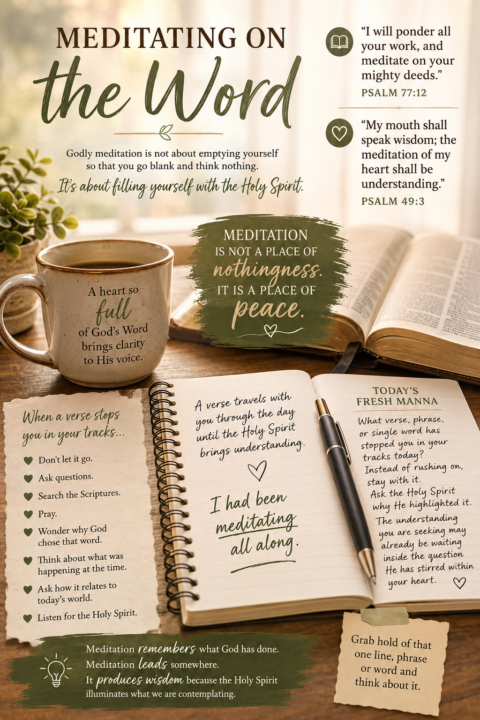
Meditating On the Word For years I thought meditating on Scripture meant sitting quietly like a monk, trying to empty my mind. Then I realised that was never what I was doing. Meditation happened when a verse stopped me in my tracks. I couldn’t let it go. Questions began to fill my mind. Why is that important? Why did God choose that word? What was happening when those words were written? How does this apply to my life today? I searched the Scriptures. I prayed. I followed cross references. Throughout the day the verse stayed with me until, often unexpectedly, the Holy Spirit brought understanding. Then I realised something wonderful. I had been meditating on God’s Word all along. Biblical meditation is very different from the way our culture often understands meditation. It is not about emptying the mind until nothing remains. It is about filling our hearts and minds with God’s truth until His Spirit brings understanding. The Hebrew idea of meditation carries the thought of pondering, reflecting, murmuring, and turning something over again and again. Like a jeweller examining a precious diamond from every angle, we keep looking at God’s Word until another facet catches the light. Psalm 77 says, “I will ponder all your work, and meditate on your mighty deeds.” Meditation remembers what God has done. Psalm 49 says, “The meditation of my heart shall be understanding.” Meditation leads somewhere. It produces wisdom because the Holy Spirit illuminates what we are contemplating. Perhaps meditation is simply this: refusing to rush past the verses that capture our attention. When one word, one phrase, or one sentence grips your heart, don’t hurry on to the next chapter. Stay there. Ask questions. Wonder. Pray. Search. Listen. Allow the Holy Spirit to reveal why that particular verse has become today’s fresh manna. Godly meditation is not a place of nothingness. It is a place of peace. It is not an empty mind. It is a heart so full of God’s Word that His voice becomes clearer and His truth begins to transform the way we think, live, and see the world.
0
0
4d •
The Shepherd of My Soul
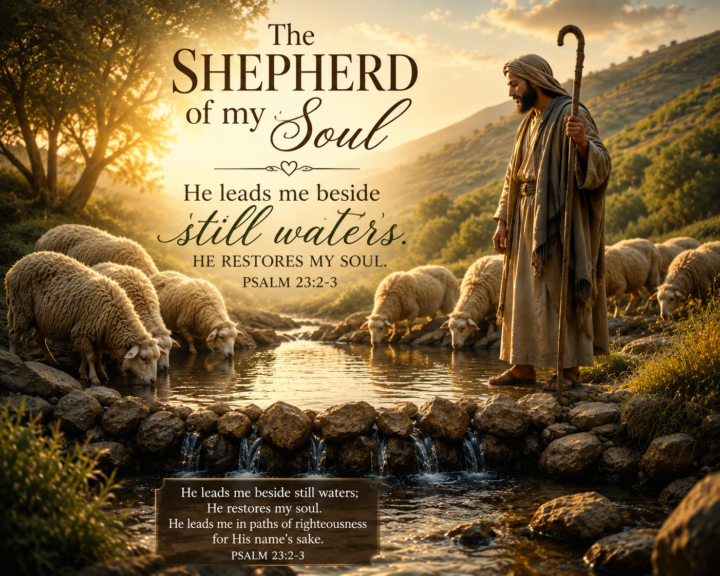
The Shepherd of My Soul While praying, the phrase “Shepherd of my soul” filled my heart. It immediately drew my thoughts to Psalm 23: “He leads me beside still waters. He restores my soul.” Psalm 23:2–3 I began to see this passage from a shepherd’s perspective. Sheep are easily frightened. They will not drink from rushing, noisy water because they fear being swept away. A good shepherd understands this. Rather than forcing the sheep to drink from a dangerous stream, he carefully places rocks across the bubbling water, creating a quiet pool where they can drink in safety. What a beautiful picture of God’s heart toward us. Sometimes life feels like a rushing river. Responsibilities, uncertainty, disappointment, grief, and endless demands create so much noise that our souls become anxious and weary. Yet our Shepherd doesn’t ask us to drink in the middle of the chaos. Instead, He gently calms the waters. The Hebrew word translated “still waters” is menuchot, meaning waters of rest or restful waters. This isn’t simply the absence of movement; it speaks of a place of peace, security, and refreshment that the Shepherd intentionally provides. The Shepherd of our souls knows exactly what we need. He leads us to places where our anxious hearts can become still, where our minds gain clarity, where our burdens begin to lift, and where our strength is restored. His guidance is never hurried or harsh. It is gentle, patient, and perfectly suited to our condition. Perhaps today the Shepherd is inviting you to stop striving for a moment. To slow your pace. To lay down the burdens you were never meant to carry alone. The Shepherd of my soul is still leading today. He knows where true rest is found. He knows how to restore what life has worn down. He knows how to quiet the waters around your heart. All He asks is that you trust Him enough to follow.
0
0
1-10 of 284
@denise-roberts-6177
Woman of God just wanting to share the things that God shows me
Active 17h ago
Joined Nov 17, 2025
Mackay Queensland Australia