Activity
Mon
Wed
Fri
Sun
Sep
Oct
Nov
Dec
Jan
Feb
Mar
Apr
May
Jun
Jul
Aug
What is this?
Less
More
Frightfully Good Paranormal
88 members • Free
4 contributions to Frightfully Good Paranormal
Jan 10 •
What can Assist with the Removal of Dark Energies
This information will be very unpopular we are sure. But, it has to be said. Because our job is to offer relief and safety and not create distress. And, you only know what you know. Here’s what the latest research and field studies do show, across psychology, environmental science, and parapsychology-adjacent work: What people describe as “dark energy” almost always correlates with one (or more) measurable factors:• prolonged stress or trauma in occupants • suggestion and expectation (priming) from watching YouTube shows about hauntings. • poor sleep and circadian disruption • infrasound, EMF irregularities, mould, or air quality issues • unresolved grief or emotional charge tied to a location When those are addressed, the “energy” often disappears — without rituals, mediums, or smoke. That’s not dismissal. That’s pattern recognition. It happens more than anything nefarious from a ghostly or demonic perspective. If you are unaware of how to deal with the people involved in the haunting then it is really important to educate yourself. That is not to say that there are not unusual cases that do not fit the normal issues that can lead to people believing that they are involved in a haunted experience. There are and we do understand that. In most cases though, there is a combination of things happening and we are investigators owe it to our clients to be honest and thorough. Now, about psychic mediums — this is where nuance matters. Mediums can be useful, but not in the way people think. The research-backed value of mediums (and this includes studies looking at anomalous cognition and counselling crossover) isn’t that they “remove” anything. It’s that they: • provide narrative closure • reduce fear and uncertainty • give people language for experiences they can’t articulate • help individuals emotionally disengage from a perceived presence When fear drops, activity drops. Consistently. That’s not magic — that’s human psychology regulating the environment. Where mediums don’t help?
0 likes • Feb 19
What timing ! This is exactly what is being taught in my classes at The Rhine, with Loyd Auerbach this semester. So many factors to be investigated along with potential misperception and biases of the reporting person/s. Mediums can absolutely play a role for all the reasons Renata has explained. It’s all about bringing the human element of help and guidance.
Feb 5 •
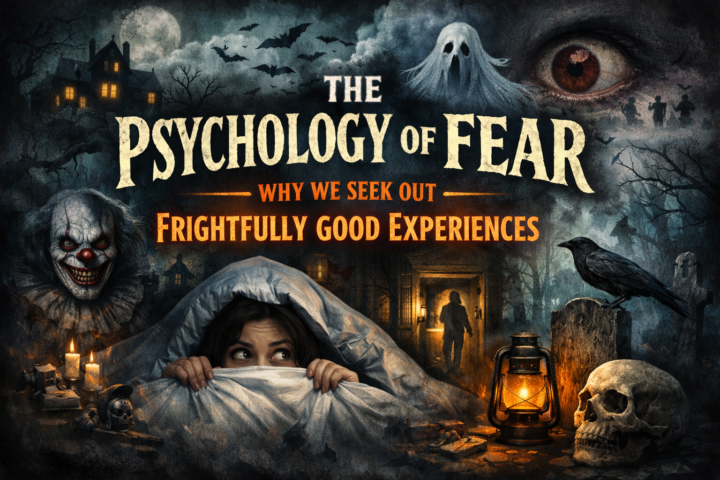
THE PSYCHOLOGY OF FEAR — WHY WE SEEK OUT FRIGHTFULLY GOOD (AND SCARY) EXPERIENCES
If fear was genuinely unpleasant in every way… none of us would be here. No horror podcasts. No ghost hunts. No haunted houses, no creepy castles, no late-night “why did I do this to myself?” binges of paranormal content with one eye covered by the doona! And yet — here you are. Voluntarily choosing to be unsettled. That’s not an accident. And it’s definitely not a flaw in your wiring. It’s your brain doing exactly what it was designed to do… just in a slightly mischievous, modern way. Fear is one of our oldest survival tools. And it is still a giant motivator! Long before it became entertainment, it kept us alive. A rustle in the bushes, a shadow where there shouldn’t be one, a sense that something isn’t right — fear sharpens attention, floods the body with adrenaline, and prepares us to act fast. Fight, flee, freeze. The classics. But here’s where it gets interesting. The same biological response that once saved us from predators is now being activated while we sit safely on the couch listening to a story about a haunted château or a poltergeist with a grudge. Your brain doesn’t entirely know the difference. When you hear a well-told scary story, your amygdala — the brain’s fear centre — lights up. Your heart rate increases. Your senses sharpen. Your body releases adrenaline, dopamine, and endorphins. It’s a chemical cocktail designed for survival… but experienced in a controlled, safe environment. That’s the key. Safe fear. This is what parents who ask us if their 10 year old can come on a tour fail to understand. There is a HUGE difference between SAFE FEAR and real fear. We've seen it when people have snuck in their under aged children into Maitland Gaol, one of our most haunted sites over the 7 years we were there and some times it was pretty devastating to see the fear in those kids eyes. Psychologists sometimes call this “benign masochism” — the enjoyment of negative sensations when we know, logically, that we’re not actually in danger. Roller coasters. Spicy food. Sad movies. Horror stories. We flirt with discomfort because the outcome is controlled.
1 like • Feb 5
I think wanting to put yourself out of your comfort zone is an experience to grow from and facing your fears can be cathartic .
0 likes • Feb 6
@Anne Rzechowicz . That’s right
Jan 16 •
📱 Paranormal Apps & False Positives — What Are We Really Measuring?
In this segment from Paranormal Hotseat, Renata breaks down how some paranormal apps use GPS and environmental data to create the illusion of “activity.” We talk about why these tools can feel convincing, how false positives happen, and why context matters more than ever when people are using apps in their own homes. 💬 Have you used paranormal apps? Did they reassure you, confuse you, or escalate things?

1 like • Jan 27
Spirit talker and necrophonic are the two I use. Really more for fun than having total faith that I’m interacting with spirit, but who know? 🤷♀️
0 likes • Jan 28
I think what is underestimated generally, is the ability to just be in the moment without any tools and quietly settling in to feel the energy and be open to experience what comes through.
Jan 10 •
What intrigues you most about the whole ghost hunting phenomenon?
What makes you keep watching the youtubers who go out investigating? Do you have a special team that you watch and why?
2 likes • Jan 10
I occasionally watch Ghost Hunters, Kindred Spirits( particularly if Chip Coffey is on) and Supernatural UK. I watch those because they keep it real- for the most part. In particular I like to see what equipment they use and how they use it, also the places they investigate. I listen to a lot of podcasts about the paranormal so it’s interesting to see some of the places mentioned. .
1 like • Jan 11
Haunted History Chronicles, Ghost Bunny and The Paranormal Podcast always have interesting guests and can be really informative.
1-4 of 4
@deborah-harris-7016
Paranormal enthusiast with a passion, seeking to meet any spooky spirits ready to step up and make themselves known !
Active 141d ago
Joined Jan 7, 2026
Central Coast NSW