Activity
Mon
Wed
Fri
Sun
Jul
Aug
Sep
Oct
Nov
Dec
Jan
Feb
Mar
Apr
May
What is this?
Less
More
Owned by Danielle
Gentle support for overwhelmed mums navigating neurodivergent family life. No perfection. No masking. Just real-life support.
Memberships
Grow With Evelyn
2.7k members • $33/month
EverAds
406 members • Free
The Nurtured Heart
8 members • Free
Rooted in Nature
114 members • Free
Awakened Mothers Rising
78 members • Free
Start Creating Again Club
253 members • Free
Thrive Again With Kelli
179 members • Free
Skoolers
184.1k members • Free
The Calm Dog Project
6 members • Free
8 contributions to Rooted in Nature
5d •
The Spiral Path
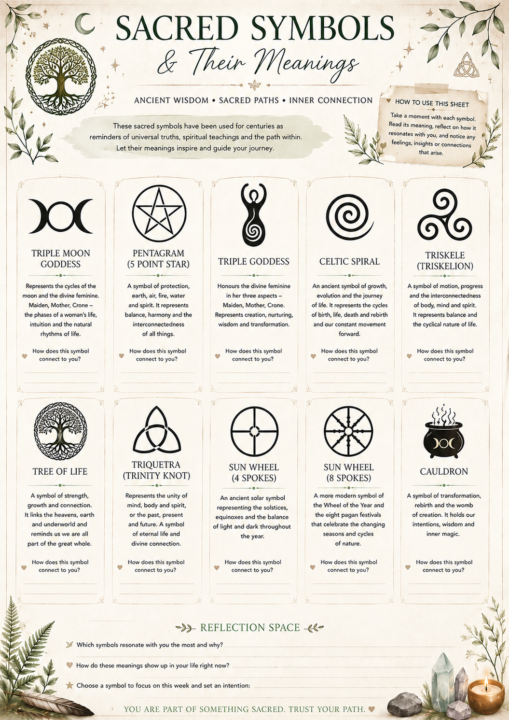
Symbols have always fascinated me — from the sun and moon symbols all over my bedroom walls as a teenager, to visiting the ancient burial site of Newgrange in Ireland years ago. Seeing those ancient spirals carved into the stone — symbols that have survived for thousands of years — stirred something in me that I’ve never quite forgotten. There’s something deeply human about our desire to weave meaning, mystery and connection into symbols. They can feel a little bit magical ✨ Even today, when I see someone adorned with tattoos, it often tells a story about who they are, where they’ve been, or what matters to them. Humans have marked themselves with symbols since ancient times — to tell stories, show status, offer protection or express belonging. Across pagan and Celtic traditions, sacred symbols were used to represent the cycles of nature, transformation, protection, wisdom and our connection to the earth. Many of them still speak to us deeply today, even if we can’t always explain why. When we last visited Glastonbury, my boy Beren traced his finger along the grooves of a wooden labyrinth in a temple dedicated to Mary Magdalene. He made a wish as he followed the path, and it struck me how simply connecting with a symbol can focus our attention, deepen intention and give our thoughts a little more power. I’ve created this sacred symbols worksheet as a gentle resource to help you explore some of their meanings and reflect on how they might connect to your own journey 🌿 This is also just one of the gifts being created for the Earth Magic course inside the premium tier of Rooted in Nature, which will also include a companion guide exploring Buddhist and Eastern spiritual symbols too. Which symbol do you feel most drawn to right now?

1 like • 5d
I'm bring pulled to both the Triple Goddess and Sun Ehern (4 Spokes)
10d •
Maybe you're not bad at meditation!
Do you practice meditation? Is it something you’d love to master? Or maybe it’s something you keep returning to, feeling like sometimes you’ve “got it”… only to feel back at square one again a few days later. Perhaps you meditate every single day, whether it feels easy or not. I’ve had a meditation practice for years now, but honestly, at the beginning of my journey it was not a kind thing I did for myself. It became another way to judge myself. Another thing I felt I was failing at. At the time, I was moving through an incredibly painful period in my life after the end of my first marriage and the breakdown of a close friendship. It was what eventually led me to leave the Midlands and move to Wales around 16 years ago. The whole experience left me with crippling anxiety that took a long time to move through, and during that year I tried every meditation and personal development technique I could find. My mind raced constantly. And every time I sat down to meditate and couldn’t “clear my mind,” I felt even more broken. Eventually I realised that what my body actually needed was gentleness. Gentle yoga helped my tense muscles soften. Time in nature became my meditation space. I was helping a lady poo pick horse fields early in the mornings, caring for my aunt’s chickens, my mum’s alpacas and Shetland ponies. I was safe with my family in Wales and slowly healing. What hindered my healing was trying to rush it. Over time things began to shift. I volunteered at the local community woodland and eventually met James, my husband. Around this time I also received an accidental ADHD diagnosis while working at a university as a Mental Health Mentor. I didn’t pay much attention to it initially, but it started turning the cogs around my own inner struggles and why traditional meditation had felt so difficult for me. I was now training to become a counsellor and doing a huge amount of supported inner work myself — which is an essential part of the training. You cannot ask someone else to bare their soul if you’ve never learned to do the same yourself.
2 likes • 10d
I completely relate to this. When I first started meditating, I genuinely thought I was doing it wrong because I could still hear my thoughts. I believed meditation meant completely silencing your mind and sitting perfectly still, and if you couldn’t do that then you were somehow failing at it. At first I could only really meditate through guided meditations, but once I realised meditation can come in many different forms, everything shifted for me and I connected to it so much more deeply. Now I can meditate sitting quietly, out in nature, through music, movement, breath, sensory grounding, or simply slowing down enough to notice what’s around me. I’ve realised I don’t always need to be still to regulate my nervous system. I also absolutely love being out in nature. There’s something incredibly grounding and regulating about it. And I really resonated with the part about children thriving outdoors. My son goes to a wonderful school with fantastic sensory support and they do Forest School every Friday. Seeing how much children regulate, connect, and thrive when they’re given supportive environments instead of constantly trying to fit into rigid boxes is really powerful 🌿
16d •
🌿 Herbs for the Nervous System 🌿
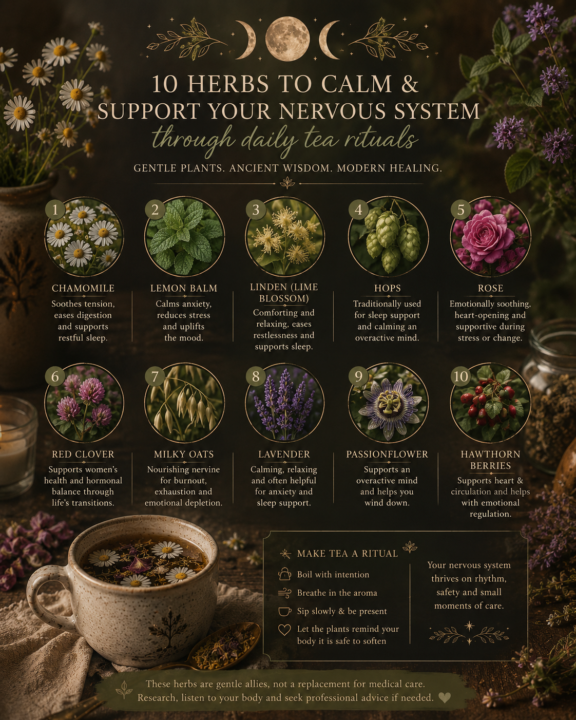
Yesterday we spoke about the nervous system and how our ancient hunter gatherer bodies were designed for short bursts of stress followed by rest, safety, and connection. And this got me thinking about the quiet role plants have always played in helping humans return to calm. Long before pharmacies and modern medicine, people sat around fires drinking infusions of flowers, leaves, berries, and roots — not simply as “treatments”, but as rituals of comfort, regulation, and care. There’s something deeply healing about the process itself. The kettle boiling.The scent rising from the cup.The act of slowing down long enough to tend to yourself. Your nervous system notices all of it . Here are 10 beautiful plants traditionally used to gently support the nervous system through teas and infusions: 🌼 Chamomile – perhaps the most well known calming herb. Traditionally used to ease tension, soothe digestion, and support sleep. 🍋 Lemon Balm – a gentle nervine from the mint family often used to reduce stress, calm overwhelm, and lift the mood. 🌳 Linden (Lime Blossom) – soft, comforting flowers traditionally used for anxiety, tension, and restlessness before sleep. 🌿 Hops – often associated with sleep support and helping calm a busy, overstimulated mind. 🌹 Rose – emotionally soothing and heart-opening. Rose tea can feel comforting during grief, stress, hormonal shifts, or emotional exhaustion. 💗 Red Clover – traditionally used to support women’s health and hormonal balance, especially during times of transition. 🍃 Milky Oats / Oatstraw – nourishing for those who feel frazzled, burnt out, emotionally depleted, or “wired but tired.” 💜 Lavender – calming, aromatic, and often supportive for anxiety, tension, and sleep. 🌱 Passionflower – traditionally used for an overactive mind, anxious thoughts, and difficulty winding down. 🍒 Hawthorn – best known for supporting the heart and circulation, but also deeply grounding and calming for many people under stress. Some herbalists use it to support emotional regulation and nervous system resilience.
2 likes • 16d
Thanks for sharing, it'svery inciteful. I have just ordered red clover to help with my wonderful night sweats 🤦♀️. I enjoy a herbal tea. I find hot drinks very soothing for my nervous system.
17d •
🌿 Understanding the Nervous System 🌿
Your nervous system was never designed for endless emails, traffic jams, social media, bills, and constant background stress. It was designed for survival. For most of human history, we lived as hunter gatherers, deeply connected to nature and dependent on our tribe for safety. Back then, danger was immediate and physical. A predator in the trees. A hostile tribe. A bear charging towards you through the forest. When this happened, the sympathetic nervous system would switch on automatically — what we often call fight or flight. In that moment, your body becomes entirely focused on survival: ⚡ your heart beats faster ⚡ your breathing quickens ⚡ muscles tense and prepare for action ⚡ digestion slows down ⚡ stress hormones flood the body ⚡ awareness sharpens onto the threat Your body isn’t thinking about long-term health or relaxation at this point. It’s thinking:“Stay alive.” And this response is incredible. It’s one of the reasons our species survived. But what’s important is what would happen next… If the bear was escaped, killed, or the danger passed, the nervous system would begin to settle again. You would return to the safety of your tribe, the fire, familiar faces, food, touch, rest. This is where the parasympathetic nervous system comes in — often called “rest and digest.” The body slowly receives the message:🌙 you are safe now Heart rate slows. Breathing deepens. Digestion returns. Muscles soften. The body begins repairing, healing, and restoring itself. The problem is that modern life can keep many of us stuck in low-level fight or flight almost constantly. Our nervous systems often react to: 📱 notifications 📧 work pressure 💬 conflict 💰 financial stress 🕰 rushing and overwhelm 👥 fear of judgement or rejection Even though there’s no bear chasing us through the forest… the body can still respond as though there is. And over time, this takes a toll. Learning about this system, and how to work with it, is something I’ve become deeply passionate about, and I’m currently creating some deeper nervous system reset courses and practices for the premium space, which I’ll share more about when they’re ready 🌿
3 likes • 17d
One of the biggest triggers I’ve realised for me over the years is lateness. Ever since I was younger, I struggled with time blindness, trying to do too much at once, and always putting myself last when getting ready. I used to hate walking into class late because I was constantly worrying about what people thought of me or the assumptions they were making about me. Then becoming a mum, especially parenting neurodivergent children, amplified that pressure massively. My youngest struggles with PDA traits and transitions in the mornings can feel really overwhelming for his nervous system. My older son struggles with time blindness too. For years I lived in this constant state of stress around getting everyone out of the house and to school on time. Eventually I realised a lot of that pressure was actually external pressure I’d absorbed and internalised. My nervous system was treating being late like danger. When my youngest started primary school, I actually made reducing that pressure part of his accommodations. The priority became: regulated nervous system first. I did the same with my older son at college too. I adjusted my own work schedule, started clients later and put systems in place that protected all of our nervous systems instead of forcing us all through panic every morning. One of the biggest shifts for me has been removing the shame around being late. Now if I’m running late, I just message or ring ahead. The second I communicate it, the pressure drops massively. And if I notice myself spiralling in the car, wanting to rush or panic, I remind myself: being late is not an emergency. There’s no point putting myself, my children or anyone else at risk because my nervous system thinks we’re in danger over time. That awareness alone has changed so much for me 🤍
23d •
🌿 Unlock the Magic of Nettles 🌿
I’ve added a new mini course inside the community all about one of my favourite wild plants — the humble and powerful nettle 💚 Inside, I share recipes, practical uses, folklore, and ways to work with nettles more confidently and intentionally. The course unlocks when you reach Level 3 in the community 🌙 You gain points simply by engaging:✨ commenting✨ posting✨ joining in conversations✨ supporting others along the way To check your progress, just hover your mouse over your profile picture and you’ll see how many points you currently have 🌿 I really love this way of doing things because it encourages us to build a real, living community together — and the more you take part, the more doors open along the path. Love from the hedgerow,Lea x
3 likes • 23d
@Lea Kendall I passed a large amount of nettles today on the way home from the school run and I wasn't sure if they were safe to harvest. Looking forward to understanding more.
2 likes • 22d
@Nicky Jones yes theres some nice off the track areas near our home with lots of nettles to harvest.
1-8 of 8
@danielle-thompson-4732
Guide for neurodivergent mums helping you calm your nervous system, find steadiness and feel less alone in the chaos of motherhood.
Active 43m ago
Joined May 5, 2026
ENFP
England, UK
Powered by