Activity
Mon
Wed
Fri
Sun
Aug
Sep
Oct
Nov
Dec
Jan
Feb
Mar
Apr
May
Jun
Jul
What is this?
Less
More
Memberships
AI Money Lab
85.4k members • Free
Free Skool Course
71.5k members • $1
Data For Potential
133 members • $10
Fast Track Reward Challenge
93 members • Free
GCIQ Networking Made Easy
260 members • Free
AI Networking Exchange
239 members • Free
OfferLab
9.5k members • Free
Kinship Cafe
63 members • Free
Authentic AF
265 members • Free
46 contributions to Kinship Cafe
2d •
The Principia Humanica
After 22 years I've finally begun writing my magnum opus, The Principia Humanica, starting with a five essay series on determinism and free will, topics often encountered when discussing the Daodejing, introduced here: https://www.principiahumanica.org/determinism-causality-and-free-will There are five essays (subtopic pages), intended to be read in order: Determinism & Causality -> Information Conservation -> Predictability -> Agency -> Free Will The first toggle on each page ("Fable essay") is the main content, the rest is source material, optional to read. These essays are newly published, so I'd love to hear any feedback from anyone who cares to read them. 🙂
13d •
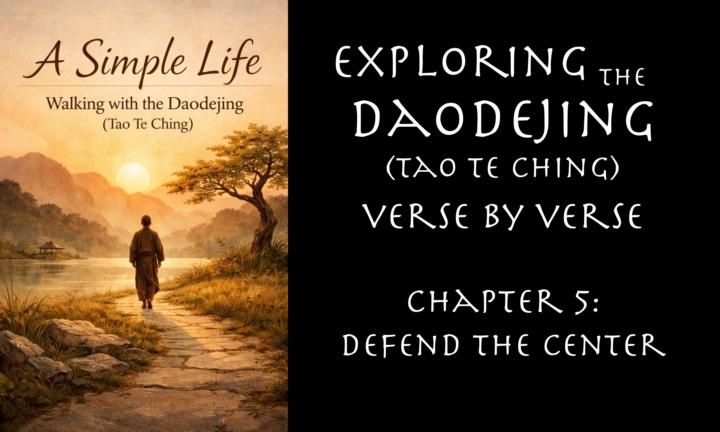
What does it mean to be centered?
Many of us think of being centered as finding balance, staying calm, or focusing on ourselves. But what if that is just scratching the surface? The Daodejing offers a surprising perspective. It suggests that every person, every tree, every animal, and every part of the universe is a unique center, not because it stands above everything else, but because it exists within a vast web of interconnected relationships. If every point in the web is a center, then no single perspective is absolute. We each see only part of the whole. Wisdom begins when we recognize both the value and the limits of our own point of view. Join us at Kinship Cafe this week as we explore chapter 5 of the Daodejing (Tao Te Ching) to see what it means to live from our natural center while recognizing that everyone else has one too. It’s a conversation that has the power to change how we see ourselves, one another, and the world we share. This is an open, discussion-based gathering. No prior knowledge needed. Just curiosity. 📍 Drop in anytime 🗣️ All perspectives welcome ☕ Thoughtful conversation, grounded in a naturalistic reading of the Daodejing (Tao Te Ching) There are 3 ways to participate. With your account at Kinship Cafe, you can: 1. Join the live online sessions on Fridays at 7am PT. The link is in the community's Calendar section. 2. Watch the past session recordings at your own time. The videos will be in the community's Classroom section. 3. If you happen to live near Fallbrook, CA, you can join our in-person session on Sundays at 9am. Hilltop Spiritual Center, 331 E Elder St., Fallbrook, CA 92028 I look forward to seeing you there!
1 like • 6d
"Centered" is the state you have to be in to use Monk abilities in DDO; you lose it if you wear armor, are overencumbered, or are wielding a shield or an oversized weapon. 😉
11d •
Road To Heaven: Encounters With Chinese Hermits
I recently learned about this great book that documented the lives of Chinese Hermits: https://www.amazon.com/Road-Heaven-Encounters-Chinese-Hermits/dp/1562790412
1
0
12d •
Two philosophers walk into a bar...
Two philosophers meet at an academic conference. The first one says "So, do you believe in free will?" The second one says "Yes, I feel like I have no choice. How about you?" The first one says "No, I choose not to."
1-10 of 46