Activity
Mon
Wed
Fri
Sun
Jan
Feb
Mar
Apr
May
Jun
Jul
Aug
Sep
Oct
Nov
Dec
What is this?
Less
More
Memberships
Shangriballa - Non Dual Group
88 members • Free
4 contributions to Shangriballa - Non Dual Group

5d •
New in the Classroom: Step 4 Non-Dual Release Session!
Hey everyone! We've uploaded a compelling, insightful new video demonstration of the Shangriballa Method classroom—you definitely don't want to miss this one. We're excited to share Part 4: The Non-Dual Release Session done with Dagmar! This session is a crucial piece of the puzzle because it brings together everything we’ve talked about in the previous steps and shows you exactly how the theory translates into real-time somatic release. What You'll See in This Session This is a profound, yet gentle inquiry. Dagmar was focusing on an underlying charge related to her relationship with her father. Watch how Patrick expertly navigates this deep, relational material: - From Belief to Body: Patrick guides Dagmar from the mental awareness of a core belief right into the physical feeling—the somatic imprint—of that paternal dynamic. - Meeting the Wounded Child: You'll see the crucial moment where Dagmar connects the pain to the Wounded Child part of herself, shifting the dynamic from self-blame to self-compassion. - Witnessing the Release: The session brilliantly demonstrates how the loving awareness of who we truly are is the necessary container for the release. The journey concludes with a beautiful sense of gentleness and softness, proving that actual release doesn't require a struggle; it requires presence. 🙏 A Big Thank You! We want to send immense gratitude to Dagmar for her courage and generosity in sharing this deep, personal session with the entire Shangriballa community. Sharing this vulnerable process is a powerful gift to all of us who are learning. And, of course, a huge thank you to Patrick for his masterful, gentle guidance, demonstrating the Shangriballa Method in action. You can find the video uploaded now in the classroom section under the Shangriballa Method module! Dive in, watch closely, and let us know your biggest takeaway in the comments below!
0 likes • 2d
Thank you so much, dear Lisa! But unfortunately I can't enter the Shangriballa Method module, because it's private. Or perhaps I've overlooked something?🤔 The session with Patrick was a wonderful and deep journey. It brought me a lot of clarity. Thank you so much for this opportunity. It's a pleasure to share this session with the community. Much love Dagmar 🐸
Oct 23 •
Huge Gratitude to Our October Retreat Participants!
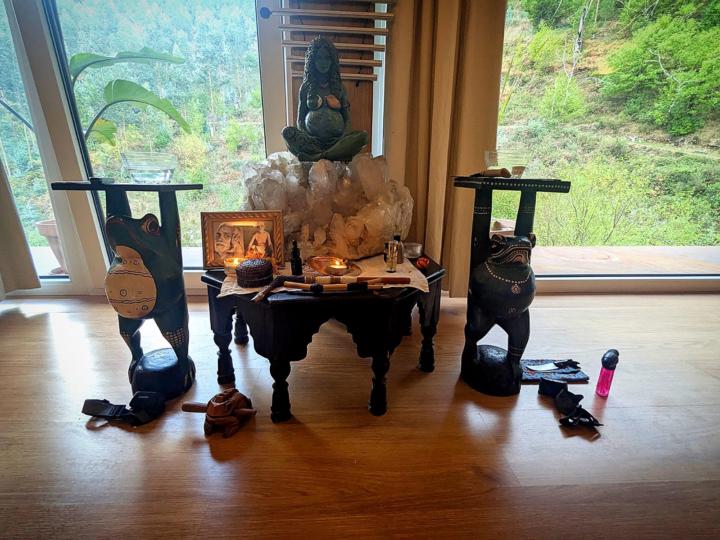
Wow. We're still feeling the powerful glow from our last Summer retreat! Honestly, we wanted to take a moment and just pour out our gratitude to every single person who showed up. You didn't just attend; you brought your whole, incredible selves. It was more than just a gathering; it was a profound sharing of hunity. We saw such deep, authentic connections being forged, and watching each of you find that deeper link to your own self was simply breathtaking. That feeling? That's what we call magic. What did the retreat confirm for us? That sharing and community are the foundation of healing. Not just for us as individuals, but for all of us, collectively. When we drop the walls and truly connect, the ripple effect is immense. That’s why we do this. To everyone who was there: Welcome to the Shangriballa Family. You are valued, you are seen, and you are officially part of our tribe. This isn't the end of the journey; it's just the beginning of a new chapter together. We can't wait to see the beautiful things you create with the energy and insights you gathered.
1 like • Oct 23
Oh, so much love and gratitude for you and your work ❤️ See you next year to continue the work. 🐸❤️🥰
Aug 11 •
How can we support you?
We're committed to supporting you on your journey after the retreat, and we're looking to you for inspiration! We already offer support through our community and regular calls, but we want to make sure the content is as helpful as possible. What topics would you like us to focus on? To get your ideas flowing, maybe it's: - How to integrate your insights from the retreat into your daily life. - Specific meditation or mindfulness practices to maintain your progress. - Navigating challenges that arise as you return to your routine. - Deep dives into specific non-duality or spiritual concepts. What topics would be most meaningful and supportive for you right now? Share your thoughts below!
1 like • Aug 12
Dear Lisa, I ask myself how I can live in this world with an open mind and an open, receptive heart. It's a huge challenge for me not to close myself off energetically again. I can understand Shanita's longing. I notice that I find it difficult not to numb myself in order to endure it all, because I find life in this world so exhausting, destructive, and alienating. There's no doubt about my true nature. And I also know how to reconnect, but I find these currently prevailing social energies very challenging and powerful. I think it's important for me that I don't have to face this alone. I sometimes feel like Don Quixote. Much love Dagmar
Aug 9 •
Free Will: A Non-Dual Perspective
This deep and often challenging topic gets to the heart of spiritual understanding. The post you provided offers a great starting point, using the insights of Sri Ramana Maharshi and Albert Einstein to question our conventional understanding of free will. Let's elaborate on this from a non-dual perspective, exploring why this view can be profoundly liberating, far from being a source of despair. The Conventional View vs. The Non-Dual View Most of us operate under the assumption that we are a separate "self" or ego, a conscious agent who makes choices and directs actions. We believe we have a "free will" that allows us to choose between options, and that we are the authors of our lives. This view, while deeply ingrained, is the source of much of our suffering. When things go well, we take credit, fueling our ego. When they go wrong, we blame ourselves or others, leading to guilt, shame, and resentment. The non-dual view, however, challenges this fundamental assumption. Non-duality, or Advaita Vedanta, points to the ultimate reality of a single, indivisible consciousness. From this perspective, there is no separate "me" to have free will. The sense of being a separate agent, the one who chooses, is an illusion. Sri Ramana and the Investigation of "I" Sri Ramana's statement, "Everything is predetermined," isn't meant to be a fatalistic decree. It's a pointer to a more profound truth that can only be realised through self-inquiry. When asked about free will, he often redirected the questioner to investigate the one asking. "Who is it that has free will?" he would ask. By investigating the source of the "I" thought, one realises that this separate "I" is a construct, a thought-form, not a solid, independent entity. If there is no separate "I," then who is there to have free will? Actions happen, thoughts arise, and the body-mind complex functions, but no separate entity directs the show. The sense of authorship, of being the one who "wills" an action, is seen as a kind of cosmic misattribution.
Poll
5 members have voted

3 likes • Aug 9
Does free will exist? The question is what one understands by that and from which perspective one views it. From the perspective of consciousness, I would say yes. Since it is not determined by anything, it is completely free to create anything from itself. One could call this free will. Since the self/ego is its creation and merely an appearance in consciousness, it cannot have free will of its own accord. The question of free will makes no sense from this perspective, since there is no separation from the Absolute. We are all expressions of this free will of Being and therefore not separate from the free will of the Absolute. This expression is spontaneous and creative and not fixed in any way. When we know who we truly are and consciously live from this perspective, we experience life as a never-ending, creative, and spontaneous game in which consciousness becomes aware of itself. Applying quantum physics, an unpredictable game that irritated Einstein. He expressed this in his statement: "God does not play dice." And yet, that's exactly what he does. So, does predestination exist? I would say no. Being is not predetermined, and therefore neither is our life. Rather, it is an interactive, creative play in infinite combinations, and we are part of this never-ending, conscious play. And because we are not separate from the Source, we are creative beings. Schopenhauer put it this way: "You can do what you will, but you cannot choose what you will." Because life is a spontaneous act that happens from moment to moment. Life is a spontaneous happening. But perhaps the Big Bang was the sole act of will. And now God watches, fascinated, as the game spontaneously unfolds in unpredictable, infinite variations. Because wouldn't it be a boring and very limited game if everything were predetermined?
1-4 of 4
Active 2d ago
Joined Jul 21, 2025
Powered by