Activity
Mon
Wed
Fri
Sun
Aug
Sep
Oct
Nov
Dec
Jan
Feb
Mar
Apr
May
Jun
Jul
What is this?
Less
More
Owned by Shawn
Mad Scientists Unite! Find community amongst the atom smashers and X-ray tubes. Over 1000 high-level STEM projects. Find your minions!
Memberships
Home Lab Explorers
1.6k members • Free
Community Launch
15.1k members • Free
Science Nerd 🤓 🧫🧬🔬⚗️🔭
149 members • Free
Diva Network
478 members • Free
Skoolers
164.6k members • Free
377 contributions to Fellowship of Mad Scientists

19m •
Electric Fields and Gauss's Law Tutorials
As we begin our overview of Maxwell's Equations, we'll start with electric fields and Gauss's Law. I've looked through a lot of tutorials, and these seem to be to be the best. It's clear and comprehensive. It's very similar to the original lecture I got about this topic in College (which may be why I like it so much). I hope you find it useful. If you find tutorials you like more please share them with me so I can recalibrate my choices to meet the interests of our members. Enjoy!
0
0
41m •
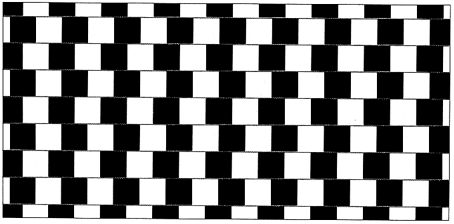
The Cafe-Wall Illusion, in Which Rows of Tiles Tilt That Should Not Tilt At All
The Cafe-Wall Illusion provides a fascinating exploration into the nature of perception. Look at a café wall built entirely from straight, level rows of black and white tiles, and something impossible happens: the rows seem to tilt and converge, zigzagging like a bellows. There isn't a single crooked line in the actual pattern — the distortion exists only inside your own visual system. So where does it come from? That question sent vision scientists on a decades-long chase through retinal wiring, and this article follows the trail: from a Bristol café wall in the 1970s, to a 19th-century psychologist's near-identical figure, to competing theories involving mortar brightness, "irradiation" at high-contrast edges, and the twisted-cord effect. The real payoff comes when the hunt reaches the retina itself — on-center and off-center ganglion cells, ancestors of the modern edge-detection models that grew out of David Marr's work — and shows how a few simple wiring rules can trick the brain into sketching tilt where none exists. It's the kind of puzzle a curious observer can test at home with nothing more than graph paper, gray markers, and a squinting eye: change the mortar's brightness by a shade and watch the illusion strengthen, weaken, or vanish entirely. By the end, you'll be equipped to build your own variants — and to spot, on real tiled walls and in graphic design, places where the pattern was quietly "fixed" so it wouldn't look broken. This article is another masterpiece from Jearl Walker. He published this in November, 1988 in The Amateur Scientist. Enjoy!
0
0
1d •
3Blue1Brown on Divergence and Curl of Vector Fields
A few of our members are asking for more content that relates to studying fields in space, with special emphasis on Electromagnetism. So, to start that journey, here's an even better tutorial about vector fields and vector functions than the one I posted last week. As time goes on, I'll be posting tutorials that build on this information and that collectively explain all of electricity and magnetism that you'd get in a good undergraduate curriculum. Enjoy!
2
0
1d •
Is Dark Energy Necessary?--Mathematicians say "Yes," Sabine Explains
A new paper claims that Dark Energy isn't necessary to explain cosmology. Sabine Hossenfelder isn't buying it. Enjoy!
2
0
1d •
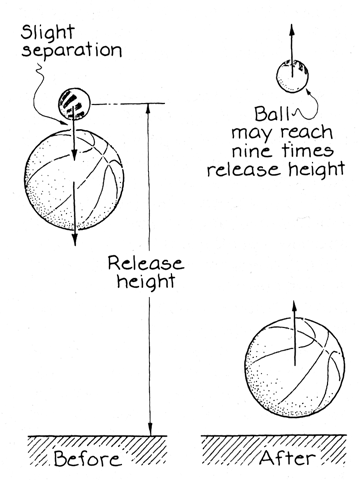
Drop Two Stacked Balls From Waist Height; the Top Ball May Strike the Ceiling
When I was a freshman taking my first college-level physics course my professor performed a delightful demonstration that absolutely stunned me. Drop a baseball on a basketball and it doesn't just bounce — it launches toward the ceiling. At first it seems quite surprising, but the physics behind it is quite simple. When a stack of elastic balls hits the floor, each collision passes energy up the chain, and the lighter the top ball, the more violently it gets flung. Two balls can send the top one nine times higher than its drop height; stack three, and the math says 49 times — enough that safety goggles are a genuinely good idea. This delightful article by the great Jearl Walker is from The Amateur Scientist. In it Walker explains exactly why using nothing more than momentum, kinetic energy, and a coefficient of restitution. It covers the pendulum experiments that mapped out ideal mass ratios, the surprising finding that transferring all the energy isn't what produces the highest bounce, and real recipes (baseball on basketball, Wiffle ball on Super Ball, a deodorant-cap ball on a steel ball) anyone can replicate at home. It even ends with open questions nobody's solved yet — the kind of thing a curious backyard experimenter could actually crack. A challenge to our members... How many balls does one have to stake to achieve escape velocity? And can you see any way to use this effect to replace the first stage of a rocket, or as a way for an underdog nation to achieve an asymmetrically advantage over a larger foe?
1
0
1-10 of 377

@shawn-carlson-8472
Mad Scientist Extraordinaire, Physicist and Educator, Scientific American Columnist, Founder-Society for Amateur Scientists, MacArthur Fellow
Active 9m ago
Joined Mar 30, 2025