Activity
Mon
Wed
Fri
Sun
Apr
May
Jun
Jul
Aug
Sep
Oct
Nov
Dec
Jan
Feb
Mar
What is this?
Less
More
Memberships
Pacific Coast Goaltending
12 members • $35/month
2 contributions to Pacific Coast Goaltending

Nov '25 •
Yaroslav Askarov 11/23
Watch his tracking, his eyes are always on the puck or battling for sightlines, and he watches pucks all the way into his pads and off

0 likes • Nov '25
At 5:43 in the video, in the second period, San Jose is up 1–0 on Boston when Askarov makes a massive save on a play that easily “wouldn’t have been his fault.” Three minutes later it’s 2–0 San Jose, and they go on to win 3–1 with an empty netter. That one stop completely shifted the momentum and set up what became the game-winning goal. These are the moments that separate goalies who play well from goalies who win games. As starters, we have to learn to come up with those tough, low-probability saves — even the ones that “aren’t our fault” — because they change the entire direction of a game.
Nov '25 •
Dustin Wolf 11/15
Just a reminder we are starting to post these clips 3-4 times a week just so you guys can watch some goalies and do some analysis on your own.

0 likes • Nov '25
One thing that really stands out in this video is how calm and collected Dustin Wolf stays when the play is right on top of him. Pucks are changing directions within a few feet, bodies are flying around him — but his game doesn’t get frantic. Wolf isn’t a big goalie, so he can’t rely on size to automatically fill space. Instead, he has an elite understanding of how to use the size he does have to frame the net behind him. That’s box control in its purest form. Watch how he: - Stays inside the posts even while adjusting and following chaos - Keeps his momentum controlled, not drifting forward and opening space behind him - Uses sharp, efficient positioning to take away ice without needing to be huge - Lets the play come to him instead of lunging or overreacting Because he’s so calm, his skating and decisions stay clean. Because he stays inside the posts, he keeps the entire net framed behind him. And because he understands box control, he turns small movements into big coverage. For younger goalies, this is a perfect example that you don’t need to be the biggest — you need to be balanced, patient, and aware of your box. Wolf shows how a smaller goalie can look “big” by managing space, angles, and composure every single play.
1-2 of 2
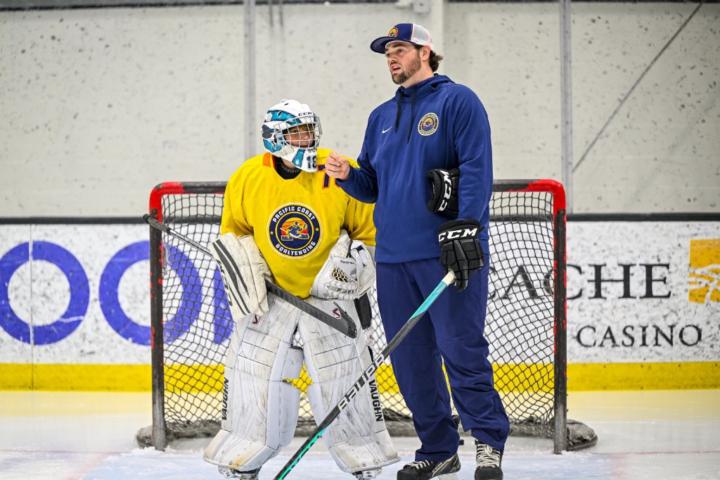
@chris-johansen-1915
Goaltending coach for the ECHL’s Allen Americans. Coach at PCG. Developing goalies at all levels through coaching, video, and education.
Active 64d ago
Joined Nov 26, 2025